L16 - Genetics of Breast Cancer
 Call Kai
 Learn
 Practice Test
 Spaced Repetition
 Match
 Flashcards
 Knowt Play
1/43

There's no tags or description
Looks like no tags are added yet.
44 Terms
what are some features of breast cancer
common, mostly affects women
can cluster in families
goos survival if caught early
lots of BCs are responsive to oestrogens
what are the 6 hallmarks cells acquire when becoming BC
independent of external growth stimuli
insensitive to external anti growth signals
capable of tissue invasion and metastasis
capable of indefinite replication
capable of sustained blood supply angiogenesis
able to avoid apoptosis
these are supported by enable characteristics

what risks influence the chances of BC
environmental- radiation toxins
diet
weight
lifestyle
age- major but still young can get it
genetics
what is the normal structure and function of the breast and mammary gland
puberty
cyclical changes
pregnancy
lactation
differentiation and expansion
involution

what normal functions of breast tissue make it more likely to be cancerous
Cyclical changes in breast structure
Pregnancy causes further development and growth
Exposed to continual cycles to grow and differentiate
At risk of cancer when checks and measures go wrong during normal processes
what is stage 0 and I of BC progression
stage 0- non invasive ductal carcinoma in situ (DCIS)
cancer cells in breast duct have not spread to breast tissue
v easily treated (not so easy to find)
stage I- invasive ductal carcinoma
cancer in breast tissue
tumour >2cm in diameter

what is stage III and IV of BC progression
stage III- invasive ductal carcinoma
tumor >5cm in diameter
cancer has spread to auxiliary lymph nodes
stage IV- metastatic breast cancer
cancer has spread beyond the breast to distant organs
preferential metastasis to brain, lungs, liver and bones

what natural variations can increase BC risk
early menarche
late menopause
nulliparity- never having a child
absence of lactation
what environmental/external factors increase BC risk
contraceptive pill
HRT
phyto-estrogens
zeno-oestrogens are industrial products
what are phytoestrogens
Have compounds that are like hormones
• Isoflavones – soya products
• Lignans - linseed oil, peas/beans
• Coumestans – alfalfa, peas/beans
what are zeno-oestrogens
Chemicals that look like hormones (industrial by-products)- modify normal cycle
oils
detergents
pesticides
what is the role of hormones in breast cancer
sources:
aromatisation in ovaries- ovarian androgens
aromatisation of adrenal androgens, testicular androgens
high concentrations in adipose tissue

what genetic changes are involved in BC
gain of function
of bad genes, promote tumour genetic characteristics
oncogenes
loss of function
of good genes, prevent tumorigenic characteristics
tumour suppressors

what is the genetic basis of BC
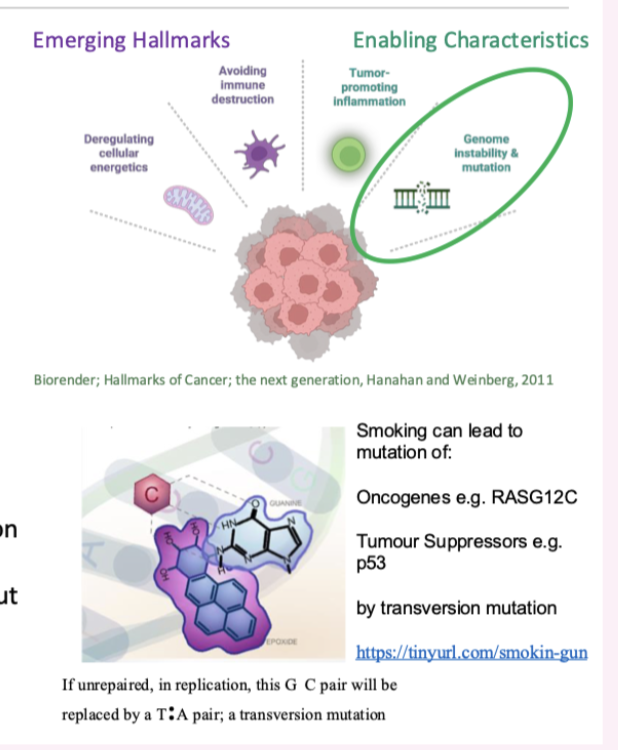
enabled by genome instability (enabling characteristics of genome instability and mutation)
may be facilitated by inherited predisposition
all cancer is caused by genetic alterations but not all cancer is hereditary
what proportion of BC is hereditary
5% hereditary, 15% familial, 80% sporadic
some arise in families for a second or third time but do not show a clear pattern if mendelian inheritance
what 3 genetic changes contribute to BC
gross alteration- loss of DNA, gain of DNA, translocations and fusions
small nucleotide changes- point mutations, small insertions, deletion, inversions
epigenetic effects- hypermethylation, hypomethylation, histine modification, DNA packaging
what do we know about the inheritance of BC
several BC cases in a family- tree suggests autosomal dominant inheritance
high but variable penetrance
early onset
sometimes bilateral
other cancers in male relatives- prostate, pancreatic, melanoma

what is knudson’s 2 hit hypothesis
Loss of tumour suppressor function requires both alleles to lose function – two-hits that take time or large amounts of damage to occur in normal cells
Mutation can be pre- existing (germline, familial cancers) e.g. Li-Fraumeni syndrome (p53), Lynch syndrome (mismatch repair), BRCA, Cowden Syndrome (PTEN)

what is the historical evidence of BC being a hereditary disease
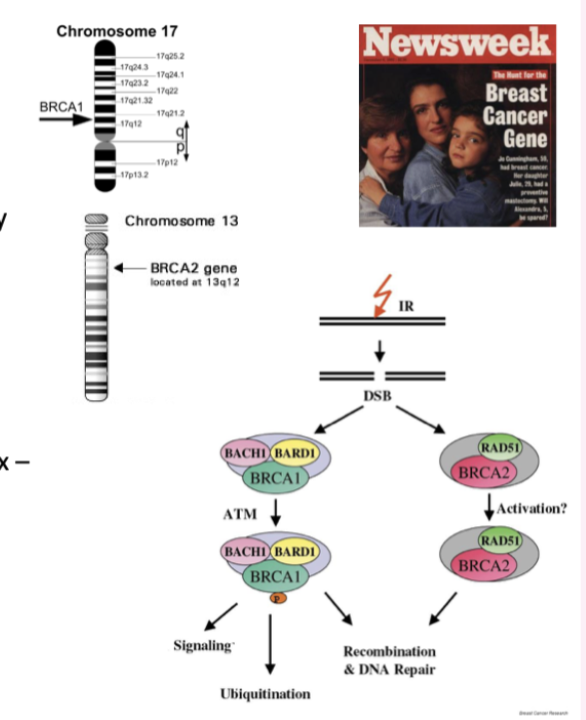
map loss of gene region in BRCA1 family to chromosome 17q in 1990
map to a different region in BRCA2 family to chromosome arm 13q in 1994
what is the functional significance of BRCA
forms a large multisubunit protein complex- with DNA damage response proteins
important in DNA repair- homologous recombination (HRR) pathway

what is the role of BRCA proteins
Maintenance of genomic stability
DNA damage response; Homologous recombination pathway for double-strand DNA repair and cell cycle checkpoints (e.g. coactivator of p53 responsive genes)
Oestrogen responsiveness – oestrogen can increase BRCA1 mRNA expression and BRCA1 can induce the expression of oestrogen receptor alpha (ERα) mRNA and regulate ERα signalling
what are the features of BRCA related tumours
Higher histological grade; 70% are Grade 3
Increased alterations in tumour suppressor gene: TP53 (55-90%)
Frequently triple-negative phenotype (ER, PgR & HER2 negative, > 80 %)
Increased proliferative capacity
Often DNA-aneuploid tumours

what are the associated lifetime risks of BRCA1 and 2

what are the features of Li Fraumeni syndrome- known breast cancer sydrome
Germline mutations in TP53 tumour suppressor
Faulty/failed response to DNA damage to halt cell proliferation
Breast cancer, brain cancer, acute leukaemia, bone sarcoma etc.
Presents at young age

what are the features of cowden syndrome - known breast cancer sydrome
1 in 200,000 births
Germline mutations in PTEN tumour suppressor
Loss of restraint of cell division
Develop benign hamartomas in late twenties on skin and mucous membranes
Breast cancer, thyroid cancer, endometrial cancer.

what are the features of Peutz Jeghers Syndrome- a potential BC syndrome
1 in 25,000 to 300,000 births
Germline mutations in STK11 tumour suppressor
Serine threonine kinase, regulates cell polarity
Develop benign hamartomatous polyps in childhood in gastrointestinal tract
Gastrointestinal cancer, Pancreatic cancer, Breast cancer, Cervical cancer, Ovarian cancer.
what are the features of Gorlin syndrome - a potential BC syndrome
1 in 57,000 births
Germline mutations in PTCH1 tumour suppressor
Receptor for sonic hedgehog; restrains cell division
Develop basal cell skin cancers
Other cancers including Breast cance
what are the clinical features of Ataxia Telangiectasia Mutated (ATM)
AT is an autosomal recessive disorder (incidence 1/40,000) – carrier frequency is much higher (1% of population)
Progressive neuronal, immunological defects and > 100-fold increased risk of developing cancers, especially B and T cell lymphomas
what are the cellular characteristics of AT
acute radio-sensitivity and hypersensitivity to some types of DNA damaging agents
what is the defect in AT
AT is a DNA damage activated kinase- signals damage to cellular machinery
somatic mutations in ATM are frequent in tumours- 2 hit hypothesis
What is the genetic basis of breast cancer susceptibility, and how does it differ between hereditary, familial and sporadic cases?
Hereditary (5%): Inherited high-risk mutations, e.g. BRCA1 and BRCA2.
Familial (15%): Family history suggests a genetic contribution, but the cause may involve multiple genes and shared environmental factors.
Sporadic (80%): Occurs without a clear family history, usually due to acquired mutations and other risk factors.
what are genome wide association studies- used to study sporadic BC mutations
Based on known single nucleotide polymorphisms (SNPs)
DNA chip is a microarray of oligonucleotides of both alleles of known SNPs
DNA prepared from peripheral blood hybridised to the SNP chips
what is the genome wide approach when studying sporadic BC mutations
Three large genome-wide association studies
DNA prepared from peripheral blood of breast cancer patients from families with at least three affected relatives
Identify possible associations with risk of breast cancer (training set)
Data then refined by interrogation of additional individuals (test or validation set)

what are the common sporadic breast cancer mutations
Seven breast cancer susceptibility loci with a higher risk allele
High risk allele SNP rs2981582 in intron 2 of FGFR2 has largest effect per allele risk of 1.26
Frequency of 38 % in population but accounts for 2% of risk of breast cancer
Discrimination insufficient to warrant individual prevention
Clinical value of single low-penetrance alleles is limited

What have genome-wide studies identified about breast cancer susceptibility genes?
COGS/iCOGS studies identified 47 new susceptibility loci.
BRCA1/BRCA2 are high-penetrance genes (high risk of developing cancer).

What does the breast cancer genome landscape reveal about tumour mutations?
Around 80 amino-acid-altering mutations per tumour (causative or bystander).
Mountains: commonly mutated genes.
Hills: occasionally mutated genes.
Different genes can affect the same pathways.
Key cancer genes include TP53 and PIK3CA.

what can genetic data be used for
counselling
debate it relatives should be sequenced if mutation found
prophylactic intervention
increased surveillance
preventative therapy

How can inherited BRCA1/BRCA2 mutations affect the surgical management of breast cancer?
Mastectomy may be more likely than breast-conserving surgery + radiotherapy.
Bilateral mastectomy may be considered to reduce future breast cancer risk.
Treatment decisions depend on individual risk and circumstances.
BRCA1: breast cancers are more often oestrogen receptor (ER) negative.
BRCA2: breast cancers are more often ER positive.
What systemic therapies can be used for breast cancer, and how do they work?
Taxanes: disrupt microtubules, preventing cell division (mitosis).
CDK inhibitors: block cell-cycle progression.
Platinum chemotherapy (platins): damage DNA; BRCA-deficient cells may be more sensitive due to impaired DNA repair.
PARP inhibitors: block PARP-mediated DNA repair, potentially causing cancer cell death by apoptosis.
How can mutations guide targeted breast cancer therapy, and what are synthetic lethality and treatment resistance?
Loss-of-function mutations: disable genes/proteins and may increase cancer susceptibility or create treatment vulnerabilities.
Synthetic lethality: combining a BRCA-related DNA repair defect with PARP inhibition can cause cancer cell death.
Personalised therapy: identifying mutations may help tailor treatment to the tumour.
Resistance: cancer cells can develop changes that make targeted treatments less effective.
what is synthetic lethality
The pair of genes may encode redundant function in normal cells e.g. different components of the DNA repair pathway
Though originally defined as the loss of two genes, the hypothesis can be extended to loss of gene function e.g. one loss of gene combined with inhibition of function of the other gene

How does synthetic lethality between PARP inhibition and BRCA mutations selectively kill cancer cells?
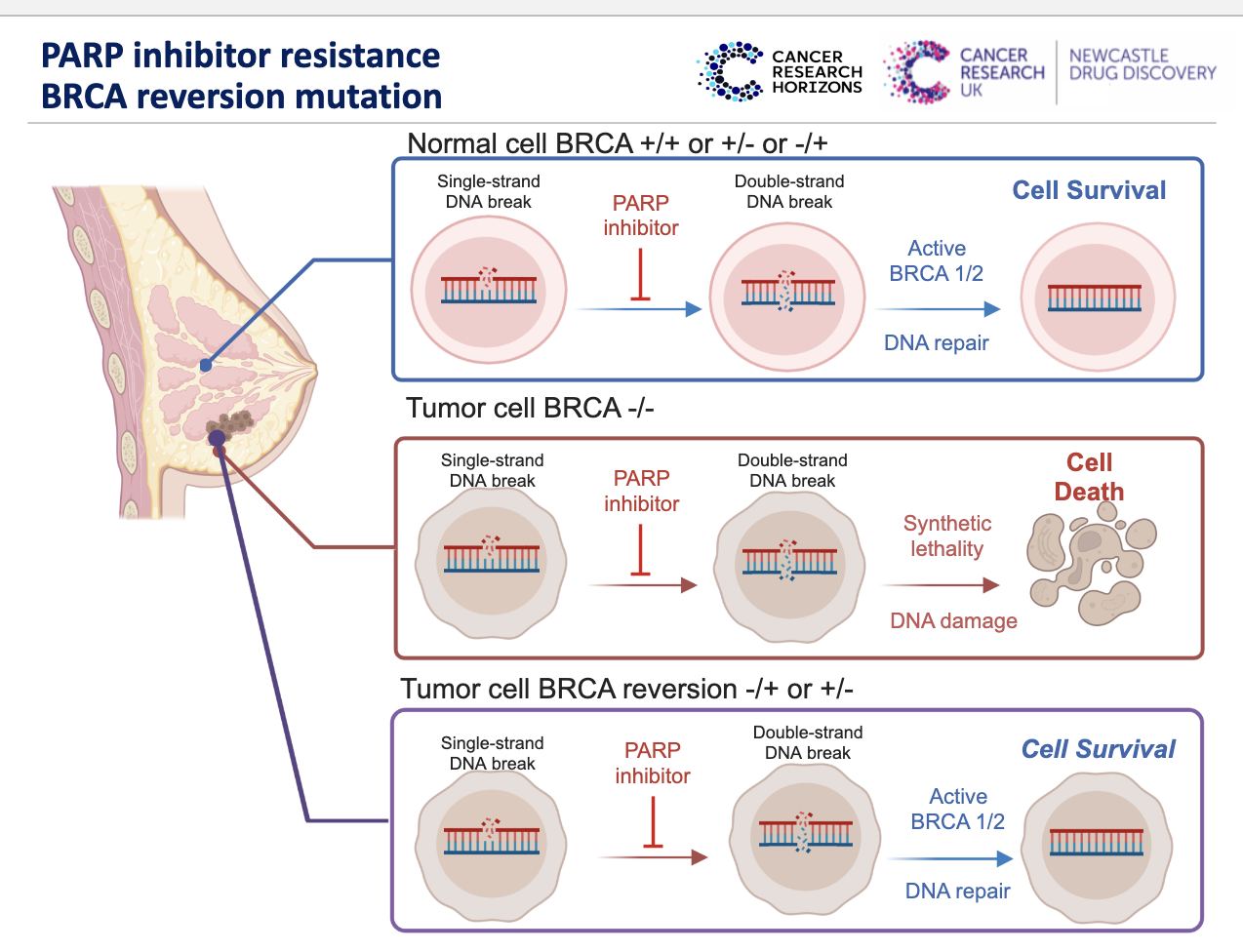
PARP inhibitors (e.g. rucaparib) block DNA repair, increasing double-strand breaks (DSBs).
BRCA-positive cells (BRCA+/+): Functional BRCA1/2 repair DSBs → cell survives.
BRCA-deficient tumour cells (BRCA−/−): Cannot repair DSBs → DNA damage accumulates → cell death.
Synthetic lethality: Combining PARP inhibition with BRCA deficiency selectively kills BRCA-deficient cancer cells while normal cells can survive.

How can BRCA reversion mutations cause resistance to PARP inhibitors
BRCA-deficient tumour cells: PARP inhibition causes DNA damage that cannot be repaired → cell death (synthetic lethality).
BRCA reversion mutation: A second mutation restores BRCA1/2 function → DNA repair resumes → cancer cells survive despite PARP inhibition → treatment resistance.
How can genetic mutations cause breast cancer resistance to PARP inhibitors?
PARP inhibitors cause DNA damage, killing BRCA-deficient cells through synthetic lethality.
Additional mutations (e.g. in TP53 and PTEN) can allow tumour cells to survive and continue evolving.
Genome instability and mutation enable cancer cells to develop resistance to growth-inhibitory signals and cell death.
BRCA reversion mutation: restores BRCA function (BRCA −/− → +/−), allowing DNA repair and causing PARP inhibitor resistance.
