Chapter 10.2: Valence-Shell Electron-Pair Repulsion (VSEPR) Theory
 Call Kai
 Learn
 Practice Test
 Spaced Repetition
 Match
 Flashcards
 Knowt Play
1/10

11 Terms

Valence-shell electron pair repulsion theory (VSEPR theory)
A model explaining that the shapes of molecules and ions result from minimizing electron-pair repulsions around a central atom
Only groups around a central atom affect shape
Bonds, lone pairs, or lone electrons can all count as one group
Ultimately derived from the Lewis structure

Electron group arrangement
The arrangement of bonding and nonbonding groups (unshared electrons) around a central atom; includes different shapes, such as:
Linear (180°)
Trigonal planar (120°)
Tetrahedral (109.5°)
Trigonal bipyramidal (90° and 120°)
Octahedral (90°)
Molecular shape
The three-dimensional arrangement of the atoms connected by bonding electron groups only
Only the same as the electron group arrangement when nonbonding groups are absent
Presence of nonbonding groups results in differing types of this, requiring AXE designation

AXE designation
A way to notate the arrangement of atoms and unshared electrons in a molecule in the form AXmEn to determine the correct electron group arrangement and molecular shape
A is the central atom
X is a surrounding atom
E is an unshared electron group (either a lone pair or lone electron)
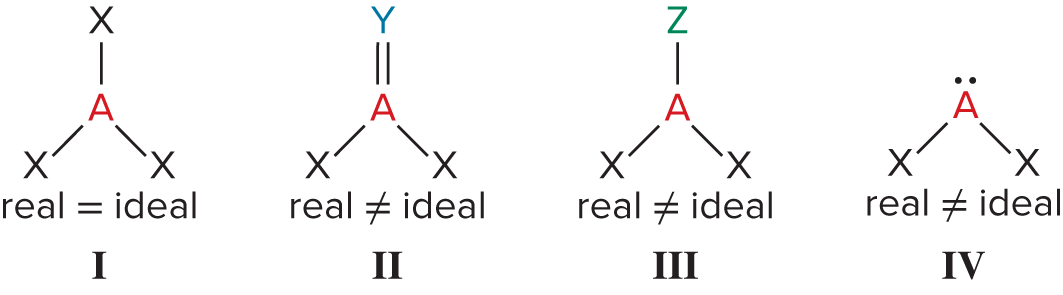
Bond angle
The angle formed by two different atom bonds joined to a central atom
Often deviate from the ideal number due to different bond types, atoms, or unshared groups

Linear arrangement
An electron group arrangement where two groups point in opposite directions, resulting in a molecule with a similarly named shape and 180° angles
Applies to class AX2 only

Trigonal planar arrangement
An electron group arrangement where three groups point to the corners of an equilateral triangle, varying with the presence of a lone pair:
AX3 gives a similarly named shape with the ideal 120° angles, such as in BF3
AX2E gives a bent shape with <120° angles due to the presence of a lone pair
Nonidentical bond types may also result in distortions, as in CH2O

Perspective drawing
A drawing made to depict a three-dimensional structure using solid and dashed wedges for bonds out of the plane of the page
Solid wedges lie above the page
Dashed wedges lie below the page
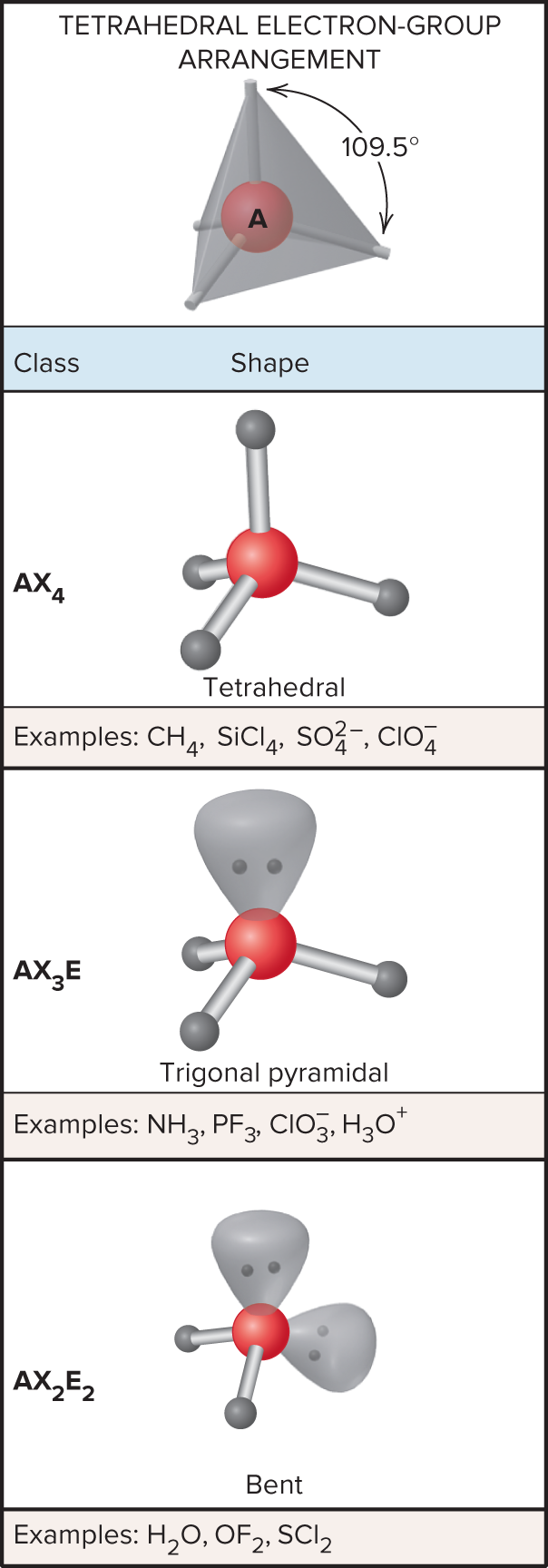
Tetrahedral arrangement
An electron group arrangement where four groups lie at the corners of a tetrahedron, varying with the presence of a lone pair
AX4 gives a similarly named shape with the ideal 109.5° angles, such as in CH4
AX3E gives a trigonal pyramidal shape with <109.5° angles as the lone pair repulses others
AX2E2 gives a bent shape with <<109.5° angles with even stronger repulsion

Trigonal bipyramidal arrangement
An electron group arrangement where five groups form two trigonal pyramids, with three equatorial groups separated by 120° angles and two axial groups separated by 90° angles
Lone pairs occupy equatorial positions when possible to minimize repulsion
AX5 gives a similarly named shape with the ideal angles
AX4E gives a seesaw shape, resulting in <120° and <90° angles
AX3E2 gives a T-shaped shape, resulting in <<120° and <<90° angles
AX2E3 gives a linear shape, resulting in the ideal angles once more

Octahedral arrangement
An electron group arrangement where six groups form an octahedron, separated by 90° angles on all sides
AX6 gives a similarly named shape with the ideal angles
AX5E gives a square pyramidal shape, with one lone pair reducing the bond angles to <90°
AX4E gives a square planar shape, with another oppositely-facing lone pair restoring the 90° angles