Complementary and Alternative Medicine (CAM)/Nutrition in Integrative and Functional Medicine (NIFM)
 Call Kai
 Learn
 Practice Test
 Spaced Repetition
 Match
 Flashcards
 Knowt Play
1/74

There's no tags or description
Looks like no tags are added yet.
75 Terms
What are two major types of studies?
Observational & Epidemiologic Human Studies
Randomized Control Trials (RCTs) aka Human Clinical Trials
What are some characteristics associated with observational and epidemiologic human studies?
help provide associations and theories about the importance of certain food compounds (ex: phytochemical) after long term exposure
cannot provide causality
risk of confounding variables
What re some characteristics associated with RCTs/Human clinical studies?
help to identify potential mechanistic functions (closer to demonstrating causality and thus is the golden standard)
tend to examine biomarkers throughout time, not usually just clinical endpoints
aimed at demonstrating physiological phenomenon in response to foods or to isolated phytochemical components
Describe the hierarchy of research study designs.

secondary research tend to be the strongest study design bc its a summary of multiple studies
Rank primary research types in terms of their strength (4).
STRONGER
RCT (golden standard)
Interventional
Observation Trials w/ Control Group
Case reports (single, or very small observations)
WEAKER
What are the different categories of research evidence? (4)
“A” Very Strong Evidence
“B” Strong Evidence
“C” Moderate Evidence
“D” Weak Evidence
What are three examples of study deigns that fall under the “A” category?
RCT
meta-analyses of RCTs
Epidemiologic Studies (cross sectional or prospective)
What are two examples of study deigns that fall under the “B” category?
cohort
case-controlled studies
What are two examples of study deigns that fall under the “C” category?
individual case studies
limited case control study evidence
What is one example of a study design that falls under the “D” category?
anecdotal evidence
How is CAM and NIFM relevant to people with diabetes?
a review shows that about ½ of individuals with diabetes reported using some complementary and alternative medicine approaches
its common but use is inconsistent
mostly self administered without professional guidance
What is one issue with taking dietary supplements if you have T2D?
many supplements can interact with their medicine resulting in
What are three potential supplement-drug interactions for those who have T2D and take supplements?
reduced effectiveness of glucose lowering medication
hypotension/low BP
increased risk of hepatic liver disease development
What is the definition of Complementary and Alternative Medicine (CAM)?
a group of diverse medical and healthcare systems, practices, and products that are not generally considered to be a part of conventional medicine
What is complementary medicine?
therapy used along with conventional medicine
What is alternative medicine?
therapy used in place of conventional medicine
What is functional medicine?
philosophy that is individualized, patient-centered, and science-based that empowers patients and practitioners to work together to address the root cause (not just the symptoms) of disease and promote wellness
focus on the whole person, lifestyle, and willingness to use a wide range of therapeutic approaches such as natural and less invasive interventions when possible
What are two core concepts under functional medicine?
dynamic balance
recognition of internal and external factors
Explain the concept of dynamic balance under functional medicine.
idea that complex interactions exist among an individual’s genetic predisposition, environmental inputs, and lifestyle
want to seek balance between mind, body, and spirit
even minor imbalance can produce a cascade of biological triggers
Explain the concept of internal and external factors under functional medicine.
internal and external factors give rise to core physiological imbalances and dysfunction in physiological systems
ex: nutrition insufficiencies influence develop of chronic diseases due to their role in cellular metabolism
Using the philosophy of functional medicine, what are 8 clinical imbalances that can arise as a result of internal and external factors?
cellular integrity
digestion
detoxification
energy metabolism
inflammation
oxidative stress
neuro-endocrine-immune
nutritional status
What is functional nutrition?
component of functional medicine, but takes the holistic person approach and emphasizes the idea of “food as medicine” and “food as healing”
What does the term “functional” mean in functional nutrition and functional medicine?
refers to chronic illnesses and sub-clincal imbalances that often don’t receive complete attention or support from the conventional healthcare system
What is Integrative and Functional MNT?
person centered nutrition interventions in health and chronic diseases that recognize the person as a holistic whole.
What are the five different components of integrative and functional MNT that surround nutrition care?
systems
food lifestyle environment
nutrition physical signs and symptoms
biomarkers
metabolic pathways and networks
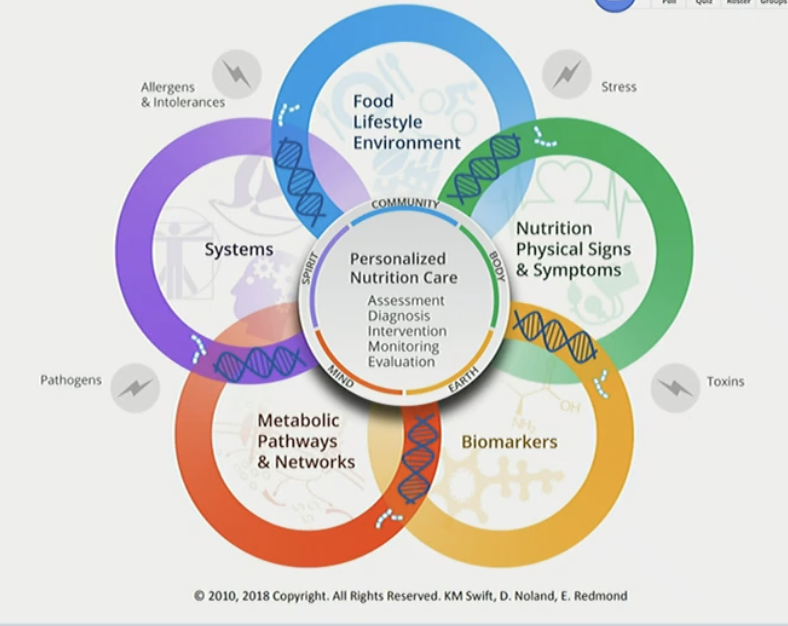
all components are connected
What are different components that would be examined under food, lifestyle, and environment of integrative and functional MNT?
food
supplements
culture and traditions
environment
relationships
sleep
stress
spirituality
What are different components that would be examined under nutrition signs and symptoms of integrative and functional MNT?
nutrition focused physical exam
What are different components that would be examined under biomarkers of integrative and functional MNT?
anthropometrics
genomics/SNPs
immune/inflammatory
organic acids
toxins
What are different components that would be examined under metabolic pathways and networks of integrative and functional MNT?
anabolic/catabolic
nutrient cofactors
cellular respiration
eicosanoid series
biotransformation
steroidogenic pathway
urea cycle
What are different components that would be examined under systems of integrative and functional MNT?
cellular integrity
digestion
detoxification
energy/metabolism
inflammation/oxidative stress
neuro-endocrine-immune
nutritional status
What two things does integrative and functional MNT recognize about people?
each client has a unique genetic make-up
each client functions in an environment with internal and external factors that influence interactions between the mind, body, and spirit
What four things are typically assessed in integrative and functional medical nutrition therapy?
biochemical biomarkers
genomic assessments
environmental toxicology
therapeutic approaches (conventional and complementary)
What is “optimal health” under integrative and functional medical nutrition therapy?
conceived as an integrated function of biology, environment, and behavior; and measured as a product of physical, mental, social, and spiritual variables
not just the absence of disease
Are functional test covered by insurance?
many functional test are NOT covered by insurance
Are functional test always validated?
NOT always validated - most are NOT
What are four issues with IFM and NIFM?
lack of standardization of training in IFM and NIFM
complexity of info
risk of misinformation
communication and education gaps
need to develop an effective and comprehensive literacy framework
Why should we study CAM?
many people in the US use CAM therapies
there can be misinformation so it’s important we understand it so that we can help them make informed choices and limit the negative impact it has on them if any
What are four reasons for the use of CAM?
historical/cultural importance
availability and relative affordability
belief that TCAM products are composed of natural, safe ingredients, are holistic and without risk of harm
dissatisfaction with conventional medicine (2/3 of CAM users don’t disclose CAM use)
Describe the mainstream use of CAM approaches in physician office visits.
data suggest growing popularity and mainstream use
2% → 8% in complementary health approaches
87% involve herbal/botanical/other dietary supplements other than vitamin and minerals
What kind of person is more likely to use CAM?
adults
more women than men (40% of women reported recent CAM use)
What are four challenges associated with CAM?
not many well-designed clinical trials (lack of scientific rigor leads to inconsistent and inconclusive findings)
no standardized credentialing of CAM practitioners
not covered by health insurance
much CAM use is unreported
What are the three different categories of CAM?
whole body systems of medicine (traditional approach to integrative medicine)
mind and body practices
natural products
What are four different types of whole body/systems of medicine that fall under CAM?
ayurvedic medicine
traditional chinese medicine (TCM)
homeopathic medicine
naturopathic medicine
What is ayurvedic medicine?
traditional medicine form India
strives for balance of 3 humors or “doshas” through lifestyle actions
ex: yoga, meditation, diet, herbal supplements
What is traditional chinese medicine?
wide range of methods that seek balance of body forces
ex: herbal supplements, acupunture, qigong, tai chi
What is homeopathic medicine?
expresses that illness is a normal response of the body as it attempts to heal itself
“like heals like”
meds contain small amounts of active substances that promote the body to heal itself
What is naturopathic medicine?
disease prevention and healing through natural holistic means including diet, herbal therapies, and other whole body and mind/body practices
Under CAM, what are mind and body practices?
focuses on the interactions among the brain, mind, body, and behavior
uses the mind to affect physical functioning and promote health
What are 8 specific therapies that address interactions of mind and body?
acupuncture
meditation
movement therapy
relaxation techniques
spinal manipulation
tai chi, yoga
healing touch
hypnotherapy
can have physiologic benefits
What are the benefits of meditation?
meditation promotes specific posture, focused attention ,adn an open attitude
benefits: to increase calmness and physical relaxation, improve physiological balance, cope with illness, and enhance overall health and well-being
What are the benefits of yoga?
yoga is a combination of physical postures, breathing techniques, meditation, and a distinct philosophy
benefits: to improve quality of life, reduce stress, lower heart rate and BP, help relieve anxiety, depression, and insomnia, and improve overall physical fitness, strength, and flexibility
Describe the effect of yoga on T2DM?
one study found improvements in BMI, measures of glycemia, measure of oxidation
one study found decrease weight, waist circ., improved BP, lipids, depression, but no difference in glycemic control
one study found yoga as effective for lowering HbA1C
decrease in HbA1C was greater in studies with greater frequency of yoga sessions
Under CAM, what are natural products?
herbs, botanicals, vitamins, minerals
most widely used CAM therapy in US
often marketed as dietary supplements
According to the FDA, what are the three criteria of dietary supplements?
to be a product other than tobacco that
is intended to supplement the diet
is intended to be taken by mouth (pill, capsule, tablet, or liquid)
contains one or more dietary ingredients (macronutrients, vitamins, minerals, aa, herbs)
What is the definition of botanicals?
a plant or any plant part valued for its medicinal or therapeutic properties, flavors, and or scent
can be fresh or as supplement
What are herbs?
subset of botanicals
generally refers to the above ground parts
What are nutraceuticals?
product isolated or purified from foods and generally sold in medicinal forms not usually associated with food
Who tends to take dietary supplements?
older adults
females
non-hispanic white
higher education level
tend to have higher nutrient intakes from food sources (therefore showing that they are not simply making up nutrients from inadequate food sources)
What are two different dietary supplement label claims?
health claims
structure/function claims
What are health claims?
describes a relationship between substance and disease, and this relationship can only determine disease risk reduction only, cannot claim cure or prevention
requires prior authorization by FDA
What are two different types of health claims?
health claim
qualified health claim
What is the difference between health claim and qualified health claim?
health claim: based on high quality data and scientific evidence
ex: “0.8 mg folic acid in a dietary supplement is more effective in reducing the risk of neural tube defects…”
qualified health claim: based on emerging but not conclusive evidence
“evidence suggest but does not prove…”
supportive but not convulsive research shows that…”
What are structure function claims?
describe the role of a nutrient or dietary ingredient intended to affect normal structure or function; but cannot claim to prevent, treat or manage a disease condition
ex: Ca builds strong bones
What is a nutrient content claim?
describes level of a nutrient in a product using terms such as free, high, and low, or more, reduced, and lite
FDA must approve before use
What are two federal agencies that have oversight over dietary supplements?
FDA
Federal Trade Commission
What is the role of the FDA in terms of dietary supplements?
in charge of labeling dietary supplements
packaging, inserts, and promotional materials at point of sale
What is the role of the Federal Trade Commission in terms of dietary supplements?
in charge of advertising of dietary supplements
print and broadcast ads, infomercials, catalogs, and direct marketing materials
Describe the marketing difference between drugs and DS/food?
DRUGS
products assumed to have toxic potential
benefits > risk under conditions of use
pre-market approval (need to be approved before put out)
DS/FOOD
products assumed to be safe
in absence of benefits, any risk is unacceptable
post-market approval (put out, don’t need approval until something happens)

Dietary supplements are regulated as food, not drugs
Due to marketing, what are the consumer expectations of dietary supplements?
products are natural and safe
products are tested and approved
substance causes no harm when used as directed
total product is safely manufactured and marketed
if harm occurs, monitoring is in place and problem can be responded in a timely manner
these expectations are not always accurate; evidence for effectiveness, safety, and quality of many supplements are often lacking
What is the Dietary Supplement Health Education Act (DSHEA)?
ensures access to supplements but does not guarantee product quality or accuracy of labeling
research has documented cases where actual supplement contents differed from label calims
How do you identify quality of supplements?
several organizations certify manufacturers for good manufacturing practices (GMP)
different certifications are USP, GMP, NSF, and UL
logos may not always appear on product label
What is the difference between NSF and USP certification?
NSF: evaluates chemical composition only
USP: assess both chemical composition and bioavailability
Why is dietary supplement (non vitamin/mineral supplement) research difficult?
whole plant or parts of plants used rather than individual components
active components usually consist of mixture of different chemical compounds found in the plant
What are six critical issues that need to be addressed in dietary supplement research?
source identification (similar looking plants)
composition, stability, contaminants, adulterants
mechanisms of action not always known
dose response
masking/blinding not always done
interactions with other stuff
food first approach remains the preferred strategy
What is St. John’s Wort?
supplement that interferes with 70% of medications