Bone repair involves hematoma and callus formation, and remodeling (clinical)
 Call Kai
 Learn
 Practice Test
 Spaced Repetition
 Match
 Flashcards
 Knowt Play
1/20

There's no tags or description
Looks like no tags are added yet.
21 Terms
Hormonal Controls
Determine when remodeling occurs.
Mechanical Stress
Determines where remodeling occurs.
Bone Mass Balance
In healthy young adults, bone deposition and resorption are roughly equal.
Factors Affecting Bone Balance – Genetics and environment can cause bone loss or bone formation.
Nondisplaced Fracture
Bone ends remain in normal alignment.

Displaced Fracture
Bone ends are out of normal alignment.

Complete Fracture
Bone is broken all the way through.
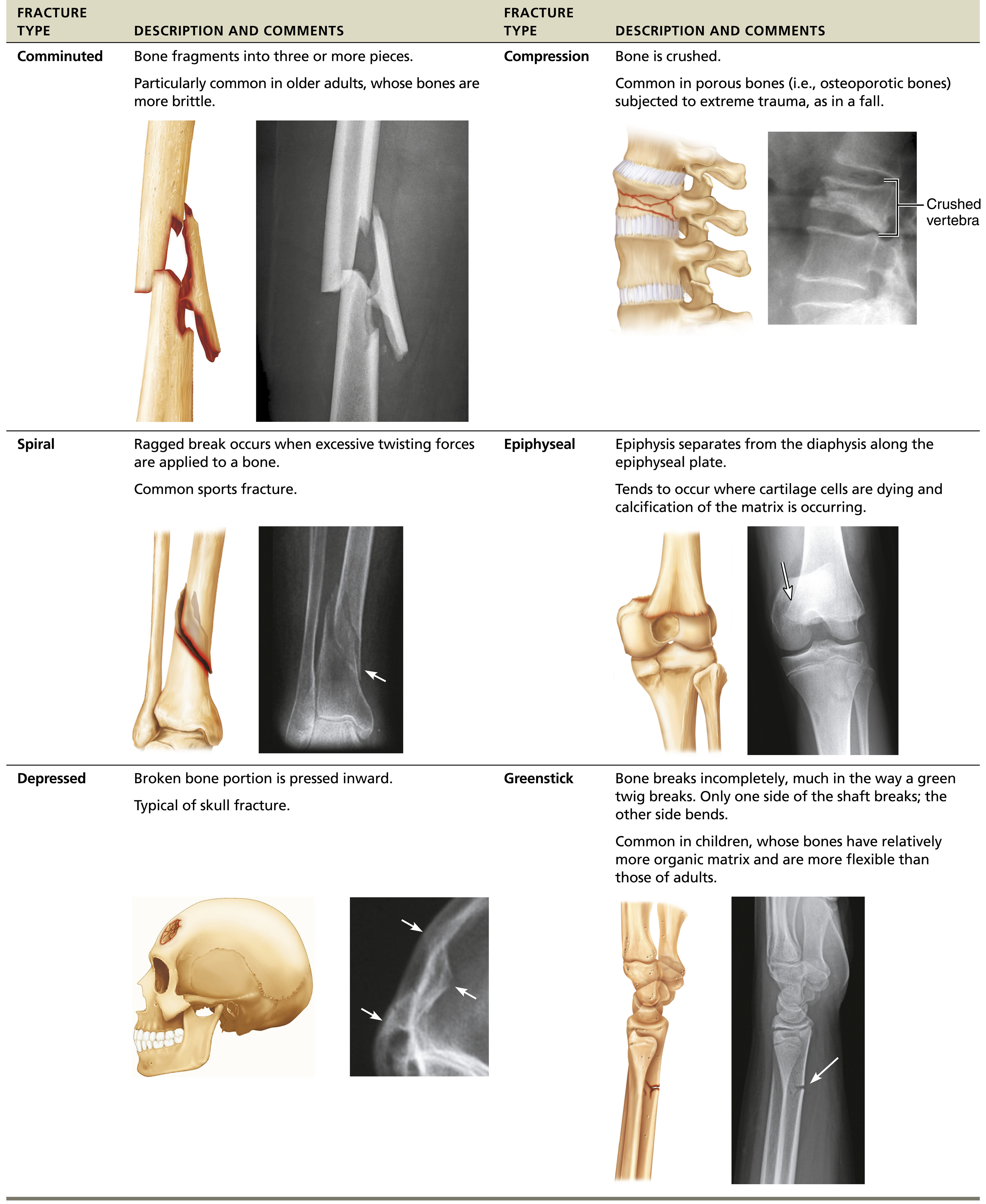
Incomplete Fracture
Bone is not broken all the way through.

Open (Compound) Fracture
Broken bone penetrates the skin.

Closed (Simple) Fracture
Broken bone does not penetrate the skin.

Fracture Treatment
Reduction
Realignment of broken bone ends.
Fracture Treatment
Closed (external) reduction
Physician manually moves bone ends back into position.
Fracture Treatment
Open (Internal) Reduction
Surgery uses screws and plates to hold broken bone ends together.
Fracture Treatment
Fracture Immobilization
A cast or traction keeps the bone in place while it heals.
Fracture Treatment
Fracture Healing Time
Simple fractures in young adults usually heal in 6–8 weeks. Larger bones and older adults take longer.
Four Stages of Fracture Repair
Stage 1
Hematoma Formation – Torn blood vessels cause blood to clot at the fracture site, forming a hematoma. Swelling, pain, and inflammation occur.

Four Stages of Fracture Repair
Stage 2
Fibrocartilaginous Callus Formation – New blood vessels grow into the clot. Fibroblasts produce collagen, and chondroblasts produce cartilage, forming a soft callus that connects the broken ends.

Soft Callus
A mass of collagen and cartilage that splints the broken bone together.
Four Stages of Fracture Repair
Stage 3
Bony Callus Formation – Osteoblasts form new spongy bone, gradually replacing the soft callus with immature bone. A firm union usually forms in about two months.

Bony Callus
Immature bone that replaces the fibrocartilaginous callus and connects the broken bone fragments.
Four Stages of Fracture Repair
Stage 4
Bone Remodeling – Excess material and dead bone are removed. Compact bone rebuilds the shaft, restoring the bone's original structure.

What Helps Guide Bone Remodeling After a Fracture?
Mechanical stresses help the repaired bone return to its original shape and structure.