Exam 3: Upper body extermities
 Call Kai
 Learn
 Practice Test
 Spaced Repetition
 Match
 Flashcards
 Knowt Play
1/123

There's no tags or description
Looks like no tags are added yet.
124 Terms
What is the function of the scapula?
It is a dynamic anchor and an origin point for muscles that attach to the humerus
What bone articulates with the scapla
The head of the humerus and the thorax
Elevation of the scapula is caused by
Levator scapulae, upper fibers of the traps, rhomboid minor and major
Abduction of the scapula is caused by
Serratus Anterior, Pec major and minor
Depression of the scapula is caused by
Lower trap, Pec minor and major, Lats, and Serratus anterior
Adduction of the scapula is caused by
Traps, Rhomboid major and minor
Downward rotation of the scapula is caused by
Rhomboid minor and major, Levator scapulae, Pec minor, Lats
Upward rotation of the scapula is caused by
Serratus anterior, Traps
Posterior tilt of the scapula is caused by
Lower traps, Serratus anterior, Caracobrachialis
Anterior tilt of the scapula is caused by
Pec minor, Biceps brachii, Levator Scapulae, Rhomoids minor and major
Forward head posture is (abnormality)
Anterior displacement of the head
Flexion of lower cervical spine
Extension of the upper cervical spine
Forward shoulder posture is (abnormality)
Protraction, elevation, and anterior tilting of the scapula
Anterior displacement of the acromion process
Winging of the scapula
What does a forward head/shoulder posture do to the body?
Requires the neck extensor muscles to work harder
fatigue of the neck extensor muscles
Implication for neck pain
What does poor scapular postioning alter?
Alters the length of the scapular muscles
length tension relationship where muscles will have an optimal length for force production
What leads to weakness during shoulder movement?
Ineffective stabilization of the scapula
Does your shoulder have a decreased range of motion?
Yes
ROM of humerus during normal shoulder elevation
Humerus externally rotates. Scapular upwardly rotates externally rotates, and posteriorly tilt
Why is the ROM of humerus limited to certain movements when elevated?
These movements allow for the greater tubercle to cear the acromion process
Forward shoulder posture causes
Humerus will rotate internally and limit scapula motion. This will cause the greater tubercle to bump into the acromion process and limit ROM
Causes of poor posture
Imbalance between the postural and phasic muscles, and spinal alignment
Postural muscles include
Cervical extensors
Pectoralis major
Upper traps
Levator scapula
Sternocleidomastoid
Cervical extensors function
Lift, control and stailize the head and neck
Pec major function
Adduction, internal rotation and flexion of the upper arm at the shoulder
Upper trap function
Primary stabilizer/mover for the shoulder blade, neck, and collarbone
Levator scapula function
elevation and downward rotation of the scapula
Sternocleidomastoid function
Laterally flex and rotate the head and neck. Elevate the rib cage during inhalation
Phasic muscles
Neck flexors
Phasic muscle
Serratus anterior
Rhomboids
Lower traps
Neutralizer muscles
muscles that contract to eliminate unwanted secondary movement
raising your arm (bicep) but not supinating your hand (pronator teres and quadratus neutralize)
Upper cross syndrome (weak)
Weak: Cervical flexors, Rhomboids, and Lower traps
Upper cross syndrome (tight)
Tight: Subocciptals, Upper traps, Levator, Pecs
Hyperlordosis (spinal alignment)
Excessive lumbar lordosis w/o compensation in the thorcic or cervical spines
Hyperlordosis (spinal alignment) includes
Forward head posture, Anterior pelvic tilt, and Knee hyper-extension, lordosis
Kypholordotic posture (spinal alignment)
Excessive lumbar lordosis with compensatory increase in thoracic kyphosis
Kypholordotic posture (spinal alignment) includes
Forward head posture, kyphosis, lordosis, anterior pelvic tilt, Knee hyper-extnesion
Swayback (spinal alignment)
Increased lumbar lordosis and thoracic kyphosis that cause the pelvis to shift anteriorly and hips extend
Swayback (spinal alignment) includes
Kyphosis of the chest, lordosis of the lower back, and anterior pelvic tilt
Flatback (spinal alignment)
Decreased lumbar lordosis and thoracic kyphosis
posterior pelvic tilt
Scoliosis (spinal alignment)
Lateral curvature of the spinal column
Structural scoliosis
Congenital bony anaomaly of the vertebrae
Functional scoliosis
Caused by muscle imbalance or leg length discrepancy
Causes of poor spinal alignment?
Congenital spinal alignment
Imbalance between sides
Lumbo-pelvic muscle imbalance (lower cross syndrome)
Lower cross syndrome tight
Tight: Erector spinae, Iliopsoas (psoas major, and iliacus)
Lower cross syndrome weak
Weak: Abdominal, Gluteus maximus
Importance of assessing spinal alignment
Pelvic/spinal alignment can affect upper body posture
Its important to asses the whole body alignment when assessing upper body injuries
What structures make up the Thoracic Outlet
Middle and Anterior Scalene
Brachial plexus
Axillary Artery
Subclavian artery/vein
First rib
Clavicle
Pec minor
Where is the Subcromial space?
The space between the humeral head and coracoacromial arch
What forms the croacoacromial arch?
Formed by the acromion, coracoacromial ligament and coracoid process
What structures make up the subacromial space?
Supraspinatus tendon
Long head of biceps brachii
Subacromial bursa
Scapula movement at 0-30 degrees of shoulder elevation
No scapular movement
Scapula movement beyond 30 degrees of shoulder elevation
2:1 ratio of glenohumeral to scapulothoracic movement
What happens at 90 degrees of shoulder elevation
The greater tubercle abuts the acromion process
What does external rotation of the humerus allow?
Allow the greater tubercle to clear the acromion and achieve full shoulder elevation
What is Scapula Dyskinesis
The alteration of the nomal scapulohumeral rhythm caused by
MUscle imbalance
Spinal alignment
Pain
What happens to the Scapula during an alteration of the normal scapulohumeral rhythm
Decreased scapular upward rotation, Scapula becomes more protracted
Narrowing of subacromial space
Compression of structures in subacromial space
How is joint stability of the Glenohumeral joint achieved?
Glenohumeral joint capsule/ligament
Rotator cuff muscles
Glenoid labrum
FOOSH
Fall On Out Stretched Hand
force applied to the hand transmitted to uper extremity bones and joints
Clavicle fracture (traumatic injury)
Occurs primarily in the middle third
Mechanism: FOOSH/Direct impact
S&S: Patient supporting injured arm, head tilting towards injured side with chin turned away, pain, swelling, and deformity

Common sites of a Humeral fracture?
Proximal humerus (surgical neck)
Epiphyseal plate
Humeral shaft
Humeral fracture (traumatic injury)
Mechanism: FOOSH, Dislocation, Direct blow
S&S: Pain, Swelling, Point tenderness, Decreased ROM
Complications: Risk damage to axillary nerve and posterior circumflex humeral artery
Sternoclavicular joint sprain/disloaction (traumatic injury)
Most dislocations are anterior
Mechanism: FOOSH, Direct blow
S&S: Pain with palpation and shoulder movement
Complications: Posterior dislocation may result in injury to the arteries, vein, and trachea
Acromioclavicular sprain (traumatic injury) is the
Damage to the capsule and ligaments around the AC joint
Acromioclavicular ligament
Coracoclavicular ligaments
“Shoulder separation”
Acromioclavicular sprain (traumatic injury)
Mechanism: FOOSH, Direct blow to the superior acromion
S&S: Pain with palpation over the AC joint and any shoulder movement, Step deformity, “Piano key” sign
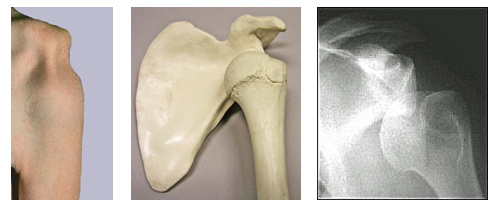
Anterior Subluxations/dislocations is the
Anterior subluxation/dislocation of the humeral head causeing extensive damage to the joint capusl and structures around the joint
has a high recurrence rate
Anterior subluxations/dislocations (traumatic injury)
Mechanism: Forced shoulder abduction and external rotation
S&S: Pain, Flattened shoulder contour, Arm carried in slight abduction and external rotation
Anterior subluxations/dislocations complications
Complications inlude
Chronic instability
Brachial plexus injury
Axillary artery injury
Rotator cuff tear
Bankart lesion
Hill-sachs lesion
Bankart Lesion
Tearung of the anterior labrum, as the humeral head dislocates anteriorly
Hill-Sachs Lesion
Damage to the posterior humeral head as the humeral head attempts to relocate
Posterior subluxations/dislocation (traumatic injury)
Less common
Mechanism: Froced adduction and internal rotation, Falling on an extended and internally rotated shoulder
S&S: Pain, Arm carried in adduction and internal rotation
SLAP Lesion stands for
Superior Labrum Anterior to Posterior lesion
SLAP lesion (traumatic injury) Mechanism
Mechanism: FOOSH
tension of the long head of the biceps tears the superior portion of the glenoid labrum
May be caused by chronis wear of the labrum (overhead athlete)
SLAP Lesion (traumatic injury) S&S
S&S: Pain during overhead activity
Throwing athletes complain of “dead arm” and difficulty generatinf ball speed
Rotator cuff strain (traumatic injury)
Mechanism: FOOSH, Lifitng or pulling heavy objects (forceful muscle contraction)
S&S: Dull ache deep in the shoulder, Limited ROM
Biceps brachii rupture (traumatic injury)
Usually near origin of muscle at bicpital groove (40-60 yr olds)
Mechanism: Powerful contraction, May be caused by chronic wear of the tendon
S&S: Audible snap and pain, Protruding muscle bulge, Weakness with elbow flexion and supination
Subcromial impingement syndrome (overuse injury)
Irritation of anatomical structures within subacromial space
Mechanism: Compression of structures within subcromial spcae due to narrowing of the space
S&S: Diffuse pain radiating to the lateral shoulder (referred pain) that worsens with shoulder elevation above 90 degrees
What could cause narrowing of the subacromial space?
Shoulder elevation during overhead activity
Imbalance of scapular muscles
Glenohumeral joint instability
Hooked acromion process
Swelling within the subacromial space
What can happen/included in a subacromial impingement?
Rotator cuff tendinopathy
Subcromial bursitis
Biceps tendinopathy
What is Rotator cuff tendinopathy (overuse injury)
Tendinosis of the rotator cudd tendon
Commonly in supraspinatus tendon
Can result in partial or complete thickness tear
Occurs near insertion on greater tuberosity (has poor blood flow)
Rotator cuff tendinopathy (overuse injury)
Mechanism: Subacromial impingement/overuse
S&S: Deep pain within the shoulder, Difficulty performing activities of daily living
Subacromial bursitis (overuse injury)
Inflammation of the subacromial bursa
Mechanism: Subacromial impingement
S&S: Diffuse pain radiating to the lateral shoulder (referred pain) that worsens with shoulder elevation about 90 degrees
Biceps tendinopathy (overuse injury)
Degenerative change in the long head of the biceps
Mechanism: Subacromial impingement, Overuse of biceps brachii
S&S: Tenderness over bicipital groove, swelling, crepitus due to inflammation, Pain with overhead activites
Thoracic outlet syndrome is the
Compression of the brachial plexus, subclavian artery and/or vein within the thoracis outlet
Common loactions of thoracic outlet compression
Between anterior and middle scalene
Between clavicle and 1st rib
Between pec minor and rib cage
Underneath cervical rib
Thoracic outlet syndrome (overuse injury)
Mechanism: Tightness of the scalene and pec minor muscle which could be due to poor posture, Repetitibe overhead activity
S&S: depends on if its Neurogenic, Venous, or Arterial
Thoracic outlet syndrom Neurogenic (overuse injury)
Compression of brachial plexus
S&S: Upper extermity heaviness, fatguability, neck shoulder and face pain, paraesthesia, weal grip strength
Thoracic outlet syndrom Venous (overuse injury)
Compression of subclavian vein, often in young athletes due to repetitive shoulder hyper-abduction with external rotation
S&S: Heavy arm and Upper extermity edema
Thoracic outlet syndrom Arterial (overuse injury)
Compression of subclavian artery
S&S: Often asymptomatic, hand and finger pain, paraesthesia, absence of distal pulse in postionas of arterial compression
Neers impingement sign (Subacromial impingement)
How: Patients shoulder placed in internal rotation, While maintaining shoulder internal rotation passively flex the shoulder to end range
Postive: Pain in subacromial space between 90-180 degree flexion
Hawkins-Kennedy test (subacromial impingement)
How: Patients shoulder placed in 90 degree flexion with elbow flexed at 90 degree, While maintaining shoulder flexion passively internally rotates the shoulder
Positve: Pain in subacromial space near end range
Empty can test (Supraspinatus pathology (impingement, RC tear, tendinopathy)
How: Patients shoulders elevated 90 dgerees in a scapular plane. With patients thumb pointing down apply downward pressure at the wrist
Positive: Weakness or pain accompanying the movement
O’Brien’s test (Labral pathology)
How: Patients shoulder in 90 degrees flexion and 15 degrees horizontal adduction. With patients thumb pointing down (placing the shoulder in internal rotation) apply downward pressure at the wrist
Positive: Pain or clicking eithin the glenohumeral joint experienced with the arm internally rotated but is decreased during external rotation
Speed’s test (Long Head of biceps tendinopathy)
How: Patient sitting with elbow extended and pal facing forward. Resists shoulder flexion while palpating for tenderness over the bicipital groove
Positive: Pain over LH biceps tendon
Yergason’s test (LH biceps tendinopathy)
How: Patient sittng with elbow flexed at 90 degrees and forearm pronated. Resist elbow flexion and supination
Positive: Pain or snapping in the bicipital groove
Roo’s test (thoraci outlet syndrome)
How: Patient abducts both arms and flexes elbows to 90 degrees. Patient opens and closes the hands for 3 minutes
Positive: Inability to maintain the testing position or replication of motor/sensory symptoms
Allen’s test (thoracic outlet syndrome)
How: Examiner palpates the patients radial pulse. Examiner abducts the patients shoulder and flex the elbow to 90 degrees and externally rotates the arm while asking the patient to rotate the head away from the shoulder that is being examined
Positive: Diminshed or disappearance of the radial pulse
Adson’s test (Thoracic outlet syndrome)
How: Examiner palpates the patients radial pulse. Examiner extends and externally rotates the patients shoulder while asking the patient to turn the head toward the shoulder that is being examined, extending the neck and take a deep breath
Positive: Diminshed or disappearance of radial pulse
Military Brace test (Thoracic outlet syndrome)
How: Patient standing, examiner palpates the patients’s radial pulse. Patient retracts and depresses the shoulders as if coming to military attention, and extend the shoulder
Positive: Diminshed or disapperance of radial pulse
Median Nerve in the hand is located
Goes to the thumb, pointer and middle fingers
Ulnar nerve in the hand is located
Goes to the pinky, and ring finger both anterior and posteriorly
Radial nerve in the hand is loacted
Posterior aspect of the thumb, pointer, and middle finger
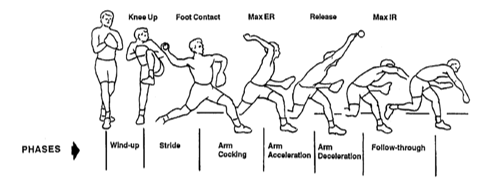
Phases of Overhead throwing motion
Wind up, Stride, Arm cocking, Arm acceleration, Arm deceleration, Follow-through