Biochemistry Exam #3
 Call Kai
 Learn
 Practice Test
 Spaced Repetition
 Match
 Flashcards
 Knowt Play
1/118

There's no tags or description
Looks like no tags are added yet.
119 Terms
What are enzymes?
biological catalysts
Draw the graph to compare energy & reaction co-ordinates for non-catalyzed & catalyzed reactions.
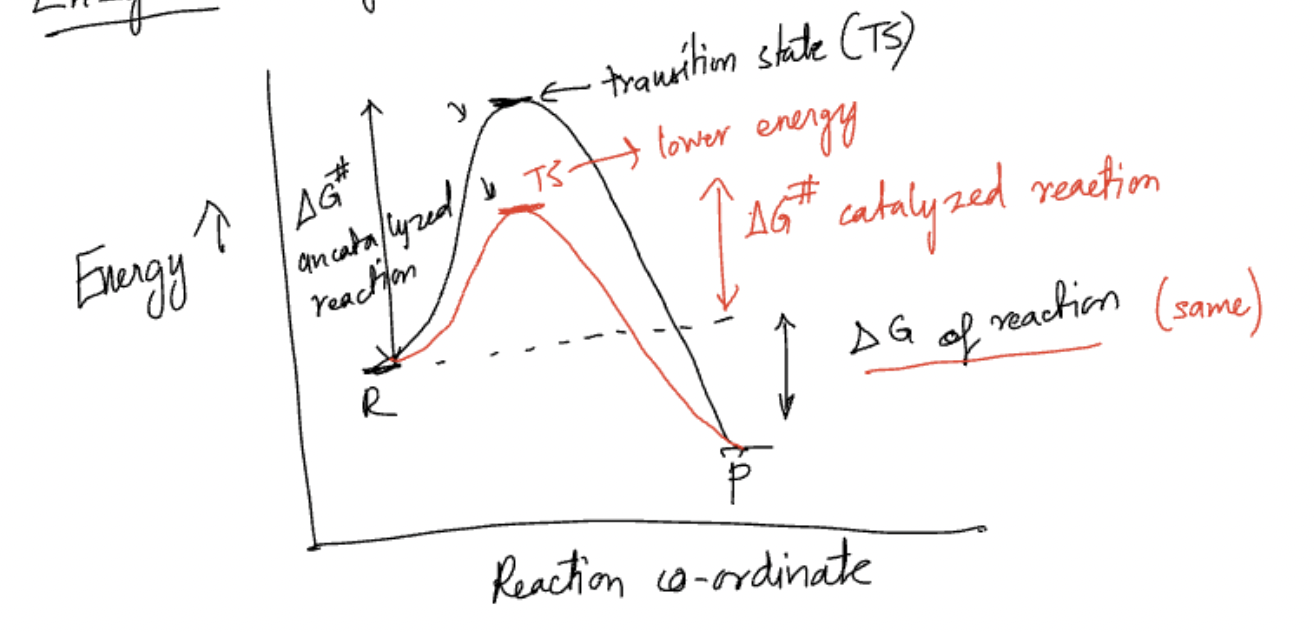
Explain the differences in the two types of energy between non-catalyzed & catalyzed reactions.
enzymes lower the activation free energy, but does not change the overall free energy
List 3 functions of enzymes that allow for lower activation energy & thus an easier reaction.
stabilizing the transition state & lowering the activation barrier
providing an alternative path for product formation which could include the formation of a stable, reaction intermediate
orienting the substrate so that it is easier for the reaction to occur (collision of substrate molecules)
What is the active site of an enzyme?
where the substrate binds & reactive groups align correctly for reaction to occur & product to form
What holds substrates in the active sites of enzymes?
multiple, weak, non-covalent interactions
What is the induced-fit mechanism?
the structure of an enzyme changes in order to accommodate substrate binding
What is a co-factor?
small molecules aiding catalytic reactions at the active site
List two examples of co-factors.
inorganic ions (Mg2+, Fe2+, Cu2+)
co-enzymes
What are co-enzymes?
co-factors with an organic component
List an example of a co-enzyme.
vitamin derived species (NAD+, FAD+)
What are prosthetic groups?
co-enzymes that are permanently associated with enzymes
List two examples of prosthetic groups.
NADP
heme
Differentiate between apoenzymes & holoenzymes.
apoenzyme: enzymes lacking their co-factors; inactive
holoenzyme: enzymes containing co-factors; active
How are enzyme classes defined?
by function of the enzyme
List six examples of enzyme classes.
oxidoreductase
transferase
hydrolase
lyase
isomerase
ligase
List the function of each class of enzyme.
oxidoreductase: catalyze redox reactions by transferring hydrogen or oxygen atoms
transferase: transfer of functional groups
hydrolase: formation of two products by hydrolyzing a substrate
lyase: cleavage of bonds via means other than hydrolysis or oxidation
isomerase: intramolecular rearrangements via transfer of groups within molecules
ligase: ligation (forming of) bonds using ATP cleavage
What is enzyme kinetics?
the quantitive study of the rate of chemical reactions catalyzed by enzymes
Describe how the relevant parameters are related in regard to enzyme kinetics.
reaction rates are related to free energy through kinetic parameters
What is the purpose of the Michaelis-Menten equation?
it calculates the rate of reaction in terms of maximum rate of reaction (Vmax) and Michaeli’s constant, Km
Write the enzyme-substrate reaction that the Michaelis-Menten equation derives from.

What does the reaction rate (v) vary with?
concentration of the substrate, [S]
What assumption is made to derive the Michaelis-Menten equation?
steady state
What is the steady state assumption?
the concentration of enzyme-substrate complex remains constant over the duration of the reaction
Express the steady state mathematically.
rate of formation of ES = rate of breakdown of ES
What is the equation for the rate of formation of ES?
rate of formation = k1 [E] [S]
What is the equation for the rate of breakdown of ES?
rate of breakdown = k2 [ES]+ k3 [ES]
What is the simplified equation for the rate of breakdown of ES?
rate of breakdown = (k2 + k3) [ES]
At steady state, what is the relationship between equations of rate of formation of [ES] & rate of breakdown of [ES]?
k1 [E] [S] = (k2 + k3) [ES]
What is the next step for deriving the Michaelis constant?
divide by (k2+ k3) → k1 [E] [S] / k2 + k3 = [ES] and then divide by k1 to get → [E] [S] / k2 + k3/k1 = [ES]
What is Michaelis constant, km?
k2 + k3 / k1
Now substitute km in.
[E] [S] / km = [ES]
Rearrange km again.
[E] [S] = km [ES]
What is the Michaelis constant determined by?
the reaction rates of the formation & breakdown of the enzyme-substrate complex
Draw a graph describing the relationship between rate of reaction (v), substrate concentration [S], and maximum rate of reaction, vmax
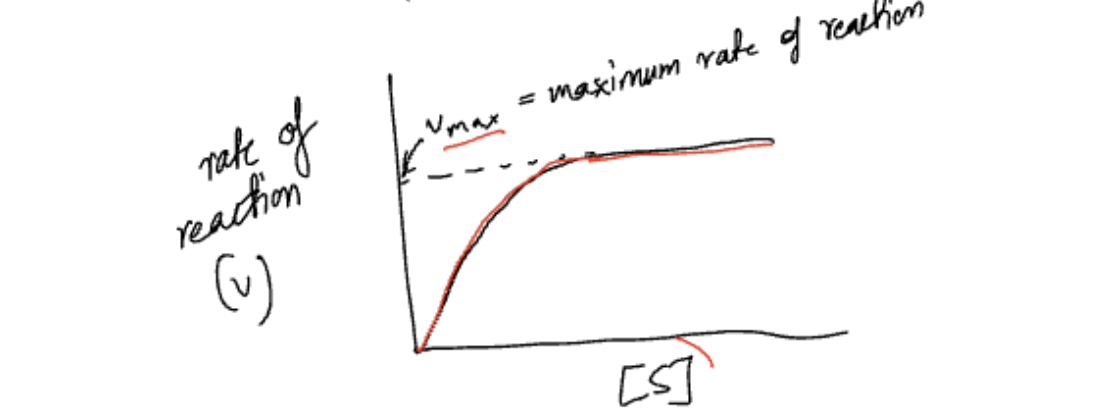
Describe what is happening at the maximum rate of reaction.
when substrate concentration becomes high, all available enzymes become saturated with substrate and make max. product, P
What is the equation for vmax?
vmax= k3 [Et]
What is [Et]?
total enzyme concentration, ( [E] + [ES]
What is the Michaelis-Menten equation?
v0 = vmax [S] / km + [S]
What is v0?
initial reaction rate
Derive the equation for km when v0 is equal to vmax/2

Define the enzyme-substrate reaction using k-1 notation.

What is the general equation for km, Michaelis constant?
k-1 + k2 / k1
What is the equation for km in the circumstance that k2 is much smaller than k-1 ?
km = k-1/k1
What is this defined as?
the disassociation constant, kD
In this situation, what is km a measure of?
an approximate measure of affinity of enzyme for substrate
What does a lower km mean?
the enzyme is better at working at low substrate concentrations, hence it has a higher affinity for the substrate
What does a higher km mean?
the enzyme is better at working at high substrate concentrations, hence it has a lower affinity for the substrate
What is km related to?
catalytic efficiency
What is catalytic efficiency?
the enzyme’s efficiency in catalyzing the reaction
What is kcat?
how many substrate molecules an enzyme can turnover into product in one second
What is the equation for kcat including units?
kcat = vmax (moles/s) /Et (moles)
What is the unit for kcat?
1/s or s-1
What measure determines catalytic efficiency?
the specificity constant
What is the equation for the specificity constant?
kcat/km
What is the relationship between different enzymes & catalytic efficiency?
each enzyme has a different catalytic efficiency
For greater catalytic efficiency, is a higher or lower kcat better? What about km?
higher kcat, lower km
What do you need to do to determine which of two different enzymes for the same reaction is more efficient?
compare the catalytic efficiency of both using kcat/km; the higher value is the more efficient enzyme
Describe how enzymes perform in regard to temperature & pH conditions.
enzymes perform at optimal pH & temperature
Explain the function of pepsin & its optimal pH condition.
function: breaks down dietary proteins
optimal pH condition: high acidic environments ~ 1.6 pH
Explain the function of glucose-6-phosphatase, where it is present, and its optimal pH conditions.
function: breaks down glucose-6-phosphate
location: endoplasmic reticulum
optimal pH condition: ~7.8 pH
Explain the function of arginase, where it is present, and its optimal pH conditions.
function: involved in urea cycle in the kidney
location: mitochondria
optimal pH conditions: ~9.7 pH
Explain generally how pH can affect the functionality of an enzyme.
pH can change the charges on an amino acid side change due to acceptance or donation of H+, which can affect the structure, binding & catalytic reactions of that enzyme, causing the enzyme to be less active
Explain the difference in optimal pH conditions between E. coli DNA polymerase & tag DNA polymerase.
E.coli DNA polymerase optimal temperature: 37°C
tag DNA polymerase optimal temperature: 80°C
What is tag DNA polymerase used in? What is it derived from?
PCR
hot-spring bacteria
Explain generally how temperature can affect the functionality of an enzyme.
usually, increasing temperature increases molecular movement, allowing more frequent, productive collisions, but when temperature becomes too high, the enzyme can denature, losing the shape required for catalysis
What is the function of the Lineweaven-Burke plot?
it converts the Michaelis-Menten equation into a linear equation
Draw the Lineweaven-Burke plot using the Michaelis-Menten equation.

Where is km on this graph?
at the halfway point to vmax.
Why is it beneficial to invert this graph into linear form?
to more accurately determine the values of vmax & km.
Derive the inverted Michaelis-Menten equation.

Now align each part of the equation with the linear form, y=mx+c.
y = 1/vo
m = km/vmax
x = 1/[S]
c = 1/vmax
What is the y-intercept?

What is the x-intercept?

Graph the Lineweaven-Burke plot showing all values.

What are enzyme inhibitors?
molecules that decrease or inhibit enzymatic activity
List the two types of enzyme inhibitors.
irreversible enzyme inhibitors
reversible enzyme inhibitors
Describe the functionality of irreversible enzyme inhibitors.
forms a covalent bond or a very strong non-covalent interaction at the enzyme active site with catalytic groups which kills (permanently inactivates) the enzyme
What are catalytic groups?
chemical groups, often amino acid side chains, that are directly involved with catalysis of substrate
Explain the functionality of reversible enzyme inhibitors.
have non-covalent interactions w/ the enzyme
How many types of reversible enzyme inhibitors are there & what are they classified based on?
3
their interactions w/ the enzyme & enzyme-substrate complex
List the 3 reversible enzyme inhibitors.
competitive inhibitors
uncompetitive inhibitors
mixed inhibitors
Describe the functionality of competitive enzyme inhibitors.
competitive inhibitors inhibit the free enzyme by competing with the substrate for binding at the active site, preventing substrate binding

How can competitive enzyme inhibitors be overcome?
excess substrate addition
Describe the functionality of uncompetitive enzyme inhibitors.
uncompetitive enzyme inhibitors bind to the enzyme-substrate complex, preventing product from being formed

Describe the functionality of mixed enzyme inhibitors.
a mix of competitive & uncompetitve; can bind to both the enzyme itself to prevent substrate binding or the enzyme-substrate com
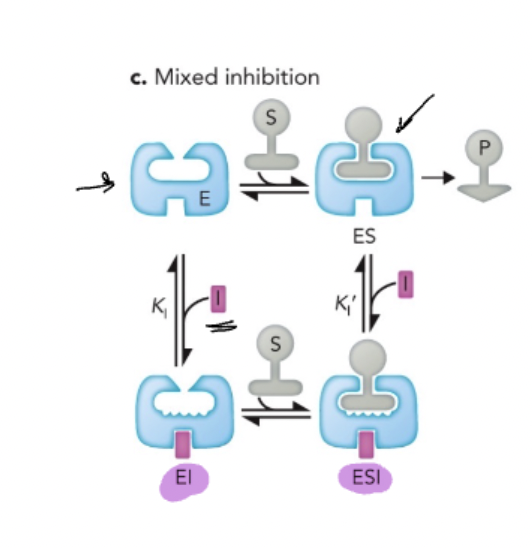
plex to prevent product formation
What is noncompetitive enzyme inhibition?
a type of mixed enzyme inhibition in which the inhibitor binds with equal affinity to both the free enzyme & the enzyme-substrate complex
Describe the active site of an enzyme (2).
sequestered microenvironment that provides the optimal orientation of the substrate w/ the functional groups that interact w/ the substrate to catalyze the reaction
What results from binding of the substrate & enzyme?
formation of the transition state
What is the transition state?
a high energy arrangement of atoms that occurs as reactants are turned into products
How many different types of catalysis mechanisms are there?
3
List the 3 types of catalysis mechanisms.
acid-base catalysis
covalent catalysis
metal-ion catalysis
Describe the functionality of acid-base catalysis.
involves proton transfer from water or a functional group on the enzyme
What is frequently involved in acid-base catalysis & why?
amino acid, histidine (his) because its side chain has a pka of 7, meaning it can form either an acid or a base easily
What is an example of acid-base catalysis?
RNA cleavage by ribonuclease
Explain the functionality of covalent catalysis.
a nucleophile group on the enzyme attacks an electrophile on the substrate to form a covalent enzyme-substrate intermediate
What is an example of covalent catalysis? Briefly explain how this mechanism works.
G3P dehydrogenase, which is an enzyme that contains cysteine whose sulphydryl group forms a covalent bond w/ glyceraldehyde-3-phosphate
Explain the functionality of metal-ion catalysis
a metal ion is used to promote the proper orientation of the bound substrate & help in re-dox reaction
What is an example of a metal-ion that aids in enzyme catalysis?
Zn2+ in carbonic anhydrase
Explain chymotrypsin mechanism. Which catalysis mechanisms are involved?
serine is converted via proton removal to form a highly reactive nucleophile that helps in the cleavage of amide bonds
covalent catalysis & acid-base catalysis