PhD
 Call Kai
 Learn
 Practice Test
 Spaced Repetition
 Match
 Flashcards
 Knowt Play
1/58

There's no tags or description
Looks like no tags are added yet.
59 Terms
Bit-Flip (X)

SPAM
State preparation and Measurement
Gate set tomography (GST)
Protocol to reconstruct the actual quantum operation implemented by a quantum device WITHOUT assuming perfectly calibrated SPAM (state preparation and measurement)
→ self-sonsistent (do not assume that any other part of the quantum operation is already perfectly calibrated)
Gate set: {rho, G_1, …, G_k, E_m}
rho = prepared density matrix
G_i = quantum channel implementing gate i
E_m = measurement for outcome m
Liouville representation of a state
n-qubit density matrix is an operator rho \in C^{d x d} with d= 2^n
Liouville representation as a d^2 vector:
rho → | rho »
different basis choice:
computational basis: rho = [[a,b],[c,d]] → (a c b d)^T
Pauli basis: rho = ½ (r_I I + r_x X + r_y Y + r_z * Z) → (1 <X> <Y> <Z>)
Liouville representation of a gate
arbitrary quantum channel with Kraus operators K_a:
E(rho) = sum{K_a rho K_a^dagger}
Liouville representation: G = sum{K_a* \otimes K_a}
For 1 qubit: Pauli transfer matrix representation
Code switching and lattice surgery are Gauge fixing
The central idea is that two different stabilizer codes can be interpreted as two different gauge choices of a common subsystem code.
Universal gate set
A universal quantum gate set is a set of gates whose compositions can approximate any quantum unitary to arbitrary precision, up to global phase.
Ex.: {H, T, CNOT}, {H, T, CZ}, {Clifford Gates, T}, {H, Toffoli}
Eastin-Knill theorem
The Eastin–Knill theorem states that no finite-dimensional quantum error-correcting code capable of detecting arbitrary single-qubit errors can have a universal set of transversal logical gates.
Universal fault-tolerant quantum computation therefore requires additional techniques, such as magic state injection, code switching or gauge fixing.
Subsystem Codes
[[n,k,r,d]] code with k logical qubits and r Gauge qubits. By interpreting some degrees of freedom (logical qubits) as Gauge qubits, the distance can increase because we can interpret low-weight logical operators as Gauge operators that act trivially on the logical information. The Gauge group G contains all operators that act trivially on the codespace, hence S \subseteq C
Via Gauge switching, we can obtain a universal gate set.
Ex.: [[4,1,1,2]] Bacon-Shor-code with S= <XXXX, ZZZZ>
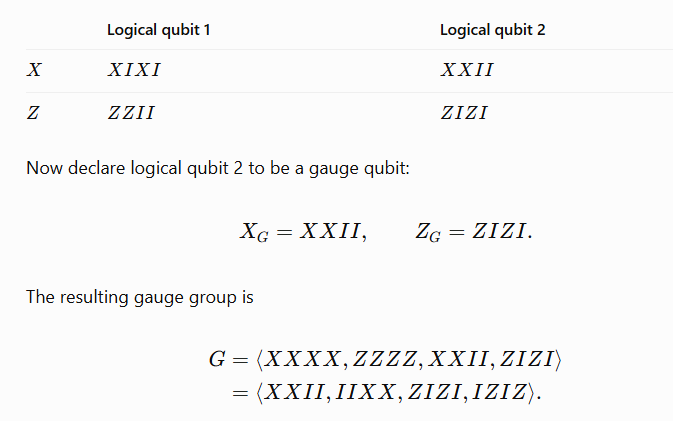
Gauge fixing
Fixing the algebraic degree of freedom that arises from Gauge qubits by measuring a Gauge operator. The measurement fixes a gauge degree of freedom by imposing an additional stabilizer constraint. This doesn’t harm the logical information
Coherent error
Unwanted unitary transformation, e.g. overrotation. Preserves purity
Rotation ON the Bloch sphere
SPAM
State preparation and measurement
Incoherent error
Introduces mixedness or decoherence e.g. depolarizing channel
Moves the quantum state towards the center of the Bloch sphere
Code-capacity noise
Simplest/most idealized noise model: only X, Y, Z errors on data quits
(No measurement noise/ error propagation)
Hook error
Data error created by propagation of ancilla error during stabiliser measurement
Topological code
QEC code where checks & logical operators have a geometrical structure (e.g. surface or colour codes)
Asymptotically good quantum code
Code family with both code rate k/n = const and d/n = const for increasing n
Phase-Flip (Z)

Pauli Y-error

Depolarising Noise Channel

Quantum Channel
Completely Positive, trace preserving map between operator spaces.
Zusammenhang k, n, r
k = n - r
k, Zusammenhang mit codespace C
Number of logical qubits,
dim(C) = 2^k
r, Zusammenhang mit H
number of stabilizer generators
r = rank(H)
n, Zusammenhang mit H_phys
Number of physical qubits
dim(H_phys) = 2^n
normalizer group
N(S) = {p in Pauli^n, pSp^-1 = S}
All n-qubit operators that commute with all stabilisers in S
centralizer group of S
Same as normalizer group of S if S is a stabilizer group, since conjugation and commutation act as the same.
All n-Pauli operators that commute with all stabilisers in S
Syndrome equation
H * e = s
quantum distance
mini
Undetectable error
Error commuting with all stabilizers, either a stabilizer or a logical error
Detectable error
Error commuting with at least one stabilizer producing a nonzero syndrome
Code rate R
T= k/n
Stabilizer group S
Abeliean subgroup of Pauli^n with -id notIn S
Symplectic product of Pauli representations a =(x | z) and b = (x’ | z’)
Meaning
<a,b> = x * z’ + z * x’
a and b commute if symplectic product is 0
Depolarising channel
Simple noise model: X, Y, Z error with probability p/3
id with prob. 1 - p
Phenomenological noise
Compared to code-capacity: both data errors AND syndrome-measurement errors are included
Circuit - level- noise
Most realistic error model: idling errors, gate errors, initialisation noise, measurement errors
Threshold
physical error rate below which increasing code size decreases logical error rate asymptotically
BP
Belief propagation: measage- passing decoder on Tanner graph that estimates likely errors from syndrome constraints
Fault-tolerance
Design principle ensuring that a small number of physical errors cannot propagate into uncontrollable high-weight error
Transversal gate
Logical gate implemented as independent operations across corresponding qubits
LDPC codes
Low density parity check codes
Stabilizers have low/ bounded weight
Tanner graph
Bipartite graph connecting qubit nodes to check nodes
Bipartite = set of nodes can be separated into two not-connected sets of nodes
Maximum error weight t correctable in a code with distance d
t = (d - 1) / 2
degeneracy
2 or more distinct states correspond to the same energy level
QML
Quantum Machine Learning:
Use quantum computers instead of classical ones for machine-learning tasks
QML algorithm
Training data D = {(x_i, y_i)}^N
Optimise parameters in parametrised function f_t (x) to approximate relationship btw x and y
Implement f by Quantum circuit and rerun the circuit until f_t(x) are close to y
CC Code
Clustered-cyclic QEC code:
Clifford Hierarchy
Classification of Quantum Gates by how they conjugate Pauli operators:
C_1: Paulis (I, X, Y, Z)
C_2: Clifford gates (H, S, CNOT, CZ)
C_3: Maps Paulis to Clifford gates (T, CCZ, Toffoli, sqrtS)
C_4: Lvl 4 gates (sqrtT, CCCZ)
… progressively smaller rotations
Only C_1 and C_2 are groups, others are not closed under multiplication
Clifford gates alone are not universal
T-gate
Introduces relative phase of pi/4:
(45° rotation about Z axis)
T |0> → |0>
T |1> → e^{i pi/4} |1>
T= {{1,0}, {0, e^{i pi/4}}
CCZ-Gate
3-qubit gate: applies -1 only to |111>
CCZ|a,b,c> = (-1)^{abc}|a,b,c>
CCZ = diag(1,1,1,1,1,1,1,-1)
Toffoli/CCX gate
3-qubit gate that flips 3rd qubit only if qubit 1&2 are |1>
CCX |a,b,c> = |a,b,c XOR ab>
E.g.
|110> → |111>
|111> → |110>
Bravyi–König theorem
In D-dimensional topological stabilizer codes, locality-preserving logical gates belong to the D-th level of the Clifford hierarchy. (E.g. in 2d surface code, only Clifford gates preserve locality)
locality-preserving: operations on an error-correcting code that implement a logical gate without spreading local errors over arbitrarily large distances (bisschen wie fault-tolerance)
Bloch sphere

Weyl operators
Generalization of Pauli operators to qudit systems:
X | j > = | j+1 (mod d)>
Z | j >=w^j * | j >, w=e^{2\pi i/d}
Commutation relation:
ZX = w XZ
Routing
moving quantum information between physical qubits so that the required multi-qubit gates can be executed. results from connectivity
XYZ- Codes
non-CSS qLDPC codes with additional (non-redundant) Y-checks resulting in better error-correction performance