BILD 1: Exam #1
 Call Kai
 Learn
 Practice Test
 Spaced Repetition
 Match
 Flashcards
 Knowt Play
1/159

There's no tags or description
Looks like no tags are added yet.
160 Terms
what are the 3 concepts of the cell theory definition of life?
all living organisms are composed of one or more cells (structure-based definition)
the cell is the basic unit of structure and organization in organisms
cells arise from pre-existing cells
all cells have…
plasma membrane- an outer covering that separates the cell’s interior from its surrounding environment
cytoplasm- consisting of a jelly-like region within the cell in which other cellular components are found
DNA- the genetic material of the cell
ribosomes- particles that sythesize proteins
what are the two types of cells?
prokaryotes and eukaryotes
what are the characteristics/examples of prokaryotes?
bacteria, anchaea
no membrane-bound nucleus
no membrane-bound organelles
usually, single-celled
what are the characteristics/examples of eukaryotes?
animals, plants, fungi, amoebas
has membrane-bound nucleus
has membrane-bound organelles
usually bigger, often multi-cellular
what organelles are found in prokaryotes?
dna (not in nucleus)
ribosomes
what organelles are found in eukaryotes?
dna (in nucleus)
membrane bound organelles: chloroplasts, mitochondria, endoplasmic reticulum and golgi apparatus, lysosomes
what is the structure of viruses?
proteins and RNA
no ribosomes, no energy metabolism, do not grow independently of host cells
are viruses considered living things?
NO; viruses do not have a cell membrane-their outer shell is only made of proteins. they are not cells
what are all organisms composed of?
matter
what does matter consist of?
chemical elements in pure form and in combinations called compounds, each element consists of unique atoms
what are the characteristics of atoms?
smallest unit of matter that retains properties of an element
protons, neutrons, electrons
basic building blocks of matter
ex: hydrogen, oxygen, nitrogen
what are the characteristics of elements?
elements consist of one type of atom and can be identified by their atomic numbers
cannot be broken down to other substances by chemical reactions
what are molecules?
formed when two or more atoms join together by covalent bonds. can be the same atoms
what are compounds?
found when two different elements join together
how does a compound’s properties compare to those of the elements it is composed of?
a compound has characteristics (emergent properties) different from those of its elements
what are valence electrons?
those on the outermost shell/valence shell
what determines the chemical behavior of an atom?
mostly determined by the number of valence electrons
how to determine the valence/bonding capacity of elements?
usually the number of unpaired electrons
what does the the formation and function of molecules and ionic compounds depend on?
chemical bonding between atoms
what usually occurs with atoms with incomplete valence shells?
they can transfer valence electrons with other atoms
these interactions usually result in atoms staying close together, held by attractions called chemical bonds
what is a covalent bond?
the sharing of a pair of valence electrons by two atoms
the shared electrons count as a part of each atom’s valence shell
what is a single covalent bond (single bond)?
the sharing of one pair of valence electrons
what is a double covalent bond (double bond)?
the sharing of two pairs of valence electrons
what is electronegitivity?
the capability of an atom to attract electrons to itself
how does electronegativity affect attraction?
an atom with high electronegativity has a stronger attraction than an atom with low electronegativity
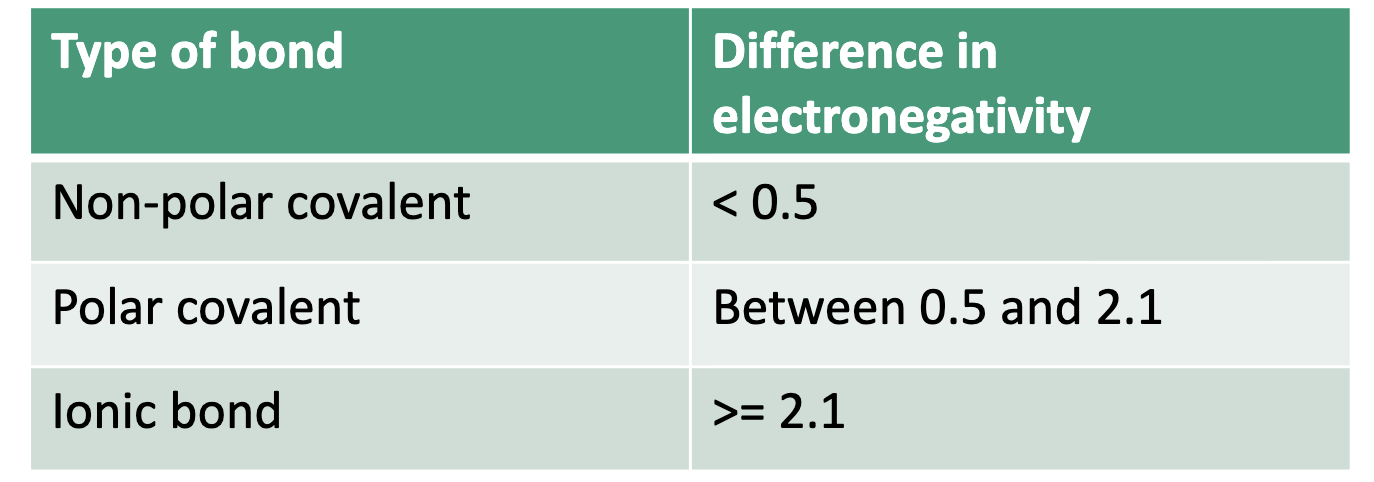
what determines polarity of covalent bonds?
difference in electronegativities

what forms nonploar covalent bonds?
occurs when two atoms share electrons equally because the electronegativity of both atoms is relatively equal
what forms polar covalent bonds?
occurs when one atom is more electronegative, and the atoms do not share the electron equally.
how do electrons interact with atoms that are more electronegative?
it has a stronger attraction for electrons, so electrons spend more time in the electron cloud of that atom
what causes partial charges on atoms/molecules?
unequal sharing of electrons
the atom with the higher electronegativity will gain the partial negative charge.
what elements are most common in covalent bonds?
carbon, oxygen, nitrogen, and hydrogen
essential for living organisms
account for 96% of atoms in our bodies
what are sugars (glucose and fructose) held together by?
covalent bonds
what is an ionic bond?
a chemical bond that involves the transfer of electrons from one atom to another so that both atoms will be left with a full valence shell.
the two resulting oppositely charged atoms of molecules are called ions
what are compunds formed by ionic bonds called?
salts
what are properties of salts?
often found in nature as crystals
most are stable when dry, but dissociate quite easily in water
what is the function of sodium ions?
used to help regulate blood volume and blood pressure
what is the function of chloride ions?
udes to help balance the pH of the body and to transmit nerve impulses
how are hydrogen bonds formed?
formed when a hydrogen atom covalently bonded to one electronegative atom is also attracted to another electronegative atom
usually oxygen or nitrogen
what do hydrogen bonds require?
a hydrogen with a partial positive charge due to it being covalently bonded to a much more electronegitive atom, such as O or N
a highly electronegitive terminal atom with a partial negative charge due to it being covalently bonded to a much less electronegative atom
both hydrogen-bonding functional groups must be within approximately an atomic diameter for the hydrogen bond to form
how are polar covalent bonds formed in water?
covalent bonds are solid lines because they are within a molecule
because of polar covalent bonds
how are hydrogen bonds formed in water?
attraction between molecules
partial + attracts partial - form polar bonds
what kind of compounds are hydrophilic?
ionic compounds
polar covalent compounds
ex: salts, molecules with charges, and mostly polar covalent bonds
what kind of compounds are hydrophobic?
nonpolar covalent compounds
ex: oil, fats
what are van der waals interactions?
attractions between molecules that are close together as a result of these charges
how are electrons distributed in covalent, ionic, and hydrogen bonds?
covalent- shared
ionic- transferred
hydrogen- not shared nor transferred
what is the solvent of life?
water
what constitutes a solution?
a liquid that is a completely homogeneous mixture of substances
what is the solvent?
the dissolving agent of a solution
what is the solute?
the substance that is dissolved
what is an aqueous solution?
water is the solvent
why do hydrophilic substances have an affinity to water?
when an ionic compound is dissolved in water, each ion is surrounded by a sphere of water molecules called a hydration shell
what are hydrocarbons?
organic molecules consisting of only carbon and hydrogen
can undergo reactions that release a large amount of energy
what molecules make up prokaryotes and eukaryotes?
carbohydrates
proteins
nucleic acids
lipids
what is a polymer?
a molecule consisting of an infinitely long chain of similar building blocks called monomers
how does a dehydration reaction occur?
when two monomers bond together through the loss of a water molecule
the synthesis of carbohydrate and protein polymers
how are polymers disassembled?
hydrolysis; a reaction that is essentially the reverse of the dehydration reaction
the breakdown of carbohydrate and protein polymers
what is the function/purpose of nucleic acids?
store, transmit, and help express hereditary information
what are the two types of nucleic acids?
deoxyribonucleic acid (dna)
ribonucleic acid (rna)
what provide for dna replication?
dna provides for its own replication
explain the process of gene expression
dna directs synthesis of messenger rna and, through mrna, controls protein synthesis
what do two dna molecules together form?
a double helix
what makes up the rail of a double helix?
phosphate and sugar
what makes up half step of double helix?
nitrogenous base
what is the structure of dna?
there are four bases, which can be in any order on a stand (T,G,C,A)
true or false: the sequence of bases along a DNA or polymer is unique for each gene, and does not change the double helix shape
true
whata does pairing a purine with a pyrimidine result in?
uniform width consistent with double helix structure
what kind of bonds hold stair steps (bases) together?
hydrogen bonds
what os antiparallel structure of dna?
the backbones run in opposite 5’-3’' directions from each other
what are chargaff’s rules of base pairing in dna?
the base composition of dna varies between species
in any species the number A and T bases equal the number of G and C bases is equal
what does the rna monomer consist of?
sugar is ribose (with an OH)
bases can be adenine (A), uracil (U), guanine (G), cytosine (C)
U pairs with A

what does a dna monomer consist of?
sugar is deoxyribose (with an H)
bases can be adenine (A), thymine (T), guanine (G), cytosine (C)
is rna double or single stranded?
single-stranded
where can complementary pairing occur in rna?
between two rna molecules or between parts of the same molecule
what does the OH instead of an H mean in rna?
rna can take a variety of shapes
it can base-pair with itself and with dna but it can take other shapes too
OH is more chemically reactive, so different rnas can have different functions
what are some example functions of rna?
carry genetic information
bind and regulate the function of dna
bind to other molecules and carry them around
what consists of the backbone of proteins? what is its function?
ALWAYS THE SAME
+NH3-CH-COO-
how amino acid links to other amino acids to form a peptide
what is the structure/function of an amino acid side chain?
structure: variable (always attached to the alpha carbon)
function: its chemistry give proteins their shape and function
what is the amine group of an amino acid?
NH2 or NH3+
binds to the carboxyl of another amino acid
what is the alpha carbon of an amino acid?
will always be bound to: the carboxyl, the amine, and the side chain
what is the carboxyl group of an amino acid?
COO- or COOH
binds to the amine of another amino acid
what are the types of chemistry of amino acids?
nonpolar
polar
acidic (- charged)
basic (+ charged)
what kind of bonds join together amino acids?
peptide bonds (covalent bonds)
what does a functional protein consist of?
one or more polypeptides precisely twisted, folded, and coiled into a unique shape
what determines a protein’s three dimensional structure?
the sequence of amino acids
what does a protein’s function depend on?
its ability to recognize and bind to some other molecule
what is the primary structure of proteins?
sequence of amino acids
determined by inherited genetic information
what is the secondary structure of proteins?
coils and folds
results from hydrogen bonding between repeating constituents of the polypeptide backbone
side chains not involved
what is the tertiary structure of proteins?
shapes a strand’s overall 3-D shape
hydrogen bonds, ionic bonds, hydrophobic interactions, van der waals interactions
strong covalent bonds called disufide bridges may reinforce the proteins structure
what are disulfide bridges?
one special type of bond that can be involved in tertiary (and quarternary) structure
occurs when the sulfurs in side chains of two cysteine amino acids interact to form a covalent bond
what is the quaternary structure of proteins?
same kind of side chain interactions as tertiary structure: disulfide bridges, hydrogen bonds, hydrophobic interactions, ionic interactions
Difference: side chains are on different polypeptides
what is the one class of large biological molecules that does not include true polymers?
lipids
what is the unifying feature of lipids?
they mix poorly, if at all with water
what do lipids mostly consist of?
hydrocarbon regions
what are the most biologically important lipids?
fats, phospholipids, steroids
what are the functions of lipids?
storing energy
make membranes to make compartments around and within cells
insulation
what is the structure of a phospholipid?
two fatty acids and a phosphate group re attached to glycerol
the two fatty acid tails are hydrophobic, but the phosphate group and its attachements form a hydrophilic head
phospholipids in water:
the heads will contact the water (polar)
the tails will contacts each other and not the water (nonpolar)
what consitutes a phospholipid bilayer?
double layered sheets called bilayers
hydrophobic facing interior
forms a boundery between the cell and external environment
what are amphipathic molecules?
molecules containing hydrophobic and hydrophilic regions