Physics of Sound: Wave Mechanics, Acoustics, and Psychoacoustics
 Call Kai
 Learn
Learn Practice Test
 Spaced Repetition
 Match
Match Flashcards
 Knowt Play
1/38

Earn XP
Description and Tags
Comprehensive vocabulary flashcards covering the physics of sound, simple harmonic motion, wave mechanics, phase alignment, acoustic boundary interactions, the harmonic series, and instrument envelopes.
Name | Mastery | Learn | Test | Matching | Spaced | Call with Kai | Chat |
|---|
No analytics yet
Send a link to your students to track their progress
39 Terms
Mechanical Wave
A wave that transfers energy through material from adjacent particle to particle by requiring both a physical medium (such as air or water) and an initial input of energy.
Atmospheric Pressure
The force exerted against an object by the weight of the air above it to the top of the Earth's atmosphere, which equals approximately 14.7lbs per square inch at sea level.
Compression
The temporary increase in the density of air molecules relative to constant atmospheric pressure during the cycle of a sound wave.
Rarefaction
The temporary reduction in the density of air molecules relative to constant atmospheric pressure during the cycle of a sound wave.
Simple Harmonic Motion
A steady oscillation characterized by equal excursion in both positive and negative directions (such as a suspended weight bouncing on a spring) that plots as a sine wave over time.

Amplitude (A)
The distance a wave displaces from zero-crossing in positive or negative directions, where higher amplitude creates greater pressure variation and perceived intensity.
Peak Amplitude Level
The maximum positive or negative displacement level of a waveform measured directly from the zero-crossing.
Root-Mean-Square (RMS) Value
A measure of the average level of a waveform over time obtained by squaring amplitudes along the wave and calculating their mathematical mean, closely modeling human loudness perception.
Peak to RMS Conversion
Mathematical conversions where Peak amplitude is multiplied by 0.707 to find the RMS level, and RMS is multiplied by 1.414 to obtain Peak amplitude.
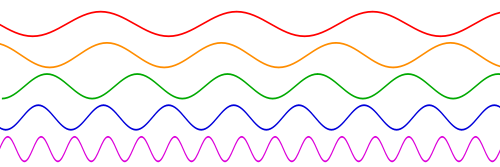
Frequency (f)
The number of occurrences of a repeating event or completed cycles per unit of time (t).
Hertz (Hz)
The acoustic unit of frequency defined as cycles per second, measuring how many times a sine wave travels through its positive and negative crests back to zero in 1second.
Velocity of Sound
The speed of sound through air, which is 1126ft/sec (343m/sec or roughly 750mph) at 68∘F (20∘C), increasing by 1.1ft/sec per 1∘F (2ft/sec per 1∘C) temperature rise.
Wavelength (λ)
The physical length of one complete cycle of a sine wave, calculated by dividing velocity by frequency: Wavelength=FrequencyVelocity.
Phase
The relative comparison of where two sine waves of identical frequency are positioned in their cycle at the same point in time, measured across 360∘.

Constructive Phase Interference (0∘ In-Phase)
The acoustic summation that occurs when two identical waves align at 0∘ of phase, keeping frequency constant while doubling amplitude to produce an increase in volume.

Phase Cancellation (180∘ Out-of-Phase)
The total acoustic cancellation resulting when two identical sine waves combine 180∘ apart, causing equal and opposite positive and negative excursions to eliminate all sound.

Microphone Phase Shift
A timing and phase issue that occurs when two microphones record the same source from different distances, causing arrival time delays that cancel out specific frequencies when summed together.
DI vs. Mic Phase Discrepancy
The timing disparity where a direct input (DI) signal from an electric instrument reaches recording equipment before the amplifier microphone signal, causing phase cancellation that results in a thin, weak sound if uncorrected.

Specular Reflection
The mirror-like reflection of a wave from a flat, smooth boundary where the angle of incidence equals the angle of reflection in the opposite direction.
Convex Boundary Reflection
The scattering of incident sound wave reflections across many different directions caused by an outwardly curved boundary surface.
Concave Boundary Reflection
The acoustic focusing of reflected sound waves inward toward a concentrated focal point caused by an inwardly curved boundary surface.

Corner Boundary Reflection
The reflection pattern produced by a 90∘ room corner that directs sound straight back toward its source with a lateral displacement, producing strong reflections that can degrade nearby microphone pickup.

Diffraction
The ability of sound waves to bend around physical barriers or spread out past small openings with minimal energy loss, functioning effectively whenever the wavelength exceeds the obstacle dimensions.
Ultrasonic Echolocation
A navigational and hunting method used by bats employing high-frequency sound with wavelengths smaller than small prey (such as moths) to ensure waves reflect off obstacles rather than diffracting around them.

Frequency Response
The charted output amplitude of an audio device (such as a microphone) across the human hearing range of 20–20,000Hz when provided with an input of equal reference level.
Fourier Transform
A mathematical principle discovered by Joseph Fourier proving that any complex waveform can be decomposed into a series of individual sine waves, distinct amplitudes, and phase relationships.
Fundamental Frequency (f)
The lowest frequency sine wave present in a complex periodic musical tone, generally acting as the primary pitch reference.
Partials
Any individual sine waves that constitute a complex tone, encompassing the fundamental as well as all harmonic and inharmonic components.

Harmonics
Partials whose frequencies are exact positive integer multiples of the fundamental frequency (2f,3f,4f,5f, etc.), adding richness and warmth to musical timbre.
Overtones
Any partial present in a complex tone other than the fundamental frequency (f), which can include both harmonic integer multiples and non-integer inharmonic partials.

Harmonic Series Musical Intervals
The series of natural acoustic intervals where lower partial ratios produce stable intervals (such as 1:1 octaves, 2:3 fifths, and 3:4 fourths) and higher partials create unstable intervals (such as 7:10 tritones and 10:11 minor seconds).
Odd Harmonics
Harmonics that are odd multiples of the fundamental (3rd,5th, etc.) that produce a stopped, blanketed, or covered timbre, imparting an annoying metallic edge when prominent at higher levels.
Even Harmonics
Harmonics that are even multiples of the fundamental (2nd,4th,6th, etc.) that create choral or singing qualities, adding body, fullness, and depth to a musical sound.
Edge Harmonics
High-order harmonics above the 7th (7th,9th,11th, etc.) that provide bite and sharp attack definition, serving as a critical psychoacoustic cue for loudness.

Spectrogram
A visual representation showing acoustic frequency distribution over time, displaying continuous horizontal lines for harmonic instruments (like a flute) and broad broadband bursts for inharmonic percussive impacts.

Acoustic Envelope
The characteristic profile of an instrument's amplitude change over time, divided into attack, internal dynamics, and decay.
Attack
The initial onset phase of an acoustic envelope, which may range from sharp transient bursts to gradual builds.
Internal Dynamics
The middle sustain portion of an acoustic envelope during which a musical sound holds, increases, or decreases its amplitude.
Decay
The concluding section of an acoustic envelope describing the rate and manner in which a sound ceases.