Ch 11
 Call Kai
 Learn
Learn Practice Test
 Spaced Repetition
 Match
Match Flashcards
 Knowt Play
1/303

There's no tags or description
Looks like no tags are added yet.
Name | Mastery | Learn | Test | Matching | Spaced | Call with Kai | Chat |
|---|
No analytics yet
Send a link to your students to track their progress
304 Terms
Skeletal muscles of the body can be
subdivided into:
axial and appendicular musculature
Axial musculature
muscles that position the head and vertebral column
muscles that move the rib cage
Appendicular musculature
muscles that stabilize or move the appendicular skeleton
Amount of skeletal muscles
over 600
What moves skeletal muscles?
motor neurons
How are skeletal muscles controlled/ innervated?
one neuron controls the action of that muscle
How are muscles innervated?
nerves
Four groups of the axial muscles
head and neck
vertebral column
rib cage, lateral walls of the abdominal and pelvic cavities
pelvic floor
Muscles of head and neck (general)
face, tongue, larynx, eyes
Muscles of the vertebral column (general)
flexors and extensors of the axial skeleton
Muscles of the rib cage, lateral walls of the abdominal and pelvic cavities (general)
respiration and separation of cavities
Muscles of the pelvic floor (general)
control the movements of material
Components of muscles of the head and neck
➢Muscles of facial expression
➢Extra-ocular muscles
➢Muscles of mastication
➢Muscles of the tongue
➢Muscles of the pharynx
➢Anterior muscles of the neck
Function occipitofrontalis
rises eyebrows and wrinkles forehead

O occipitofrontalis
epicranial aponeurosis
I occipitofrontalis
skin of eyebrows, bridge of nose
Function occipitalis
tenses and retracts scalp

O occipitalis
superior nuchal line
adjacent region of mastoid of the temporal bone
I occipitalis
epicranial aponeurosis
Function temproparietalis
moves auricle of ear
*more superficial than temporalis
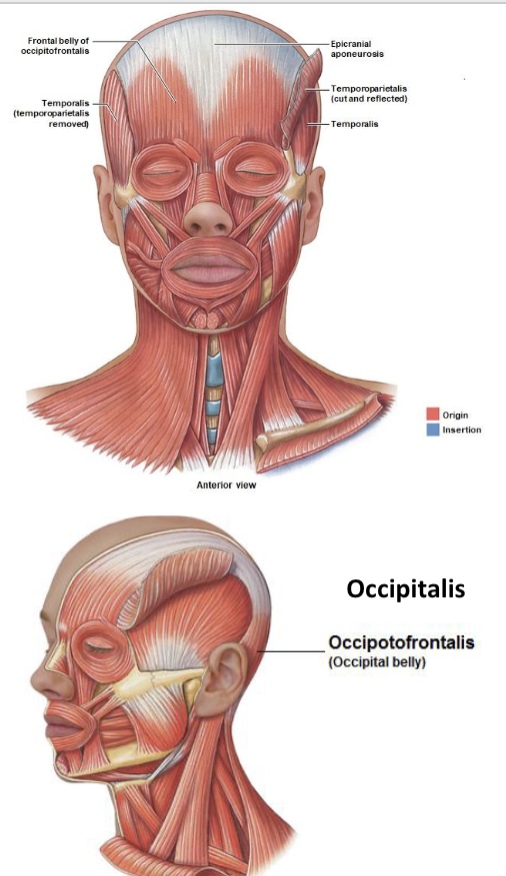
O temporoparietalis
fascia around external ear
I tempororparietalis
epicranial aponeurosis
CN VII
Cranial Nerve VII, also known as the facial nerve, controls the muscles of facial expression and provides taste sensations from the anterior two-thirds of the tongue.
Function orbicularis oculi
closes eyes

O orbicularis oculi
medial margin of orbit
I orbicularis oculi
skin around eye lids
Function corrugator supercilii
wrinkles eyebrows

O corrugator supercilii
medial end of the supericiliary arch
I corrugator supercilii
eyebrow
Function procerus
wrinkles and move nose, horizontal wrinkles frowning

O Procerus
lateral nasal cartilages
I Procerus
aponurosis at bridge of nose and forehead
Function nasalis
dilate nostrils
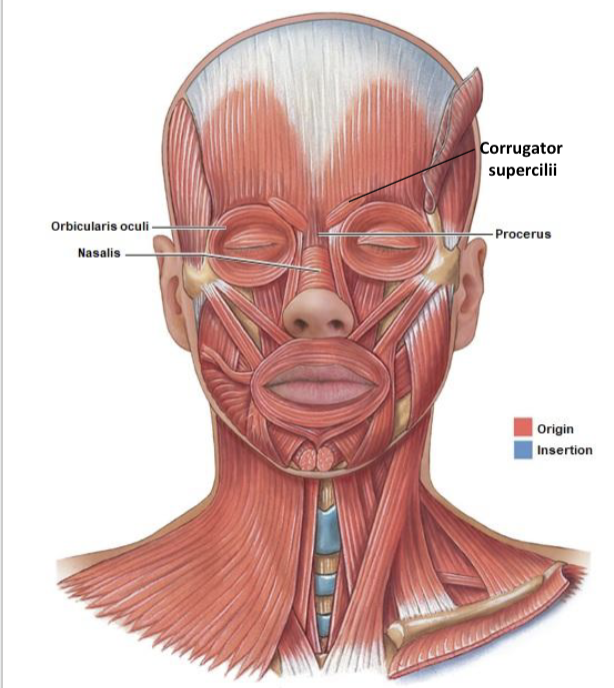
O Nasalis
maxilla and alar cartilage of the nose
I nasalis
bridge of nose
Function orbicularis oris
compresses and purses lip

O orbicularis oris
maxilla and mandible
I orbicularis oris
lips
Function buccinator
compresses cheeks
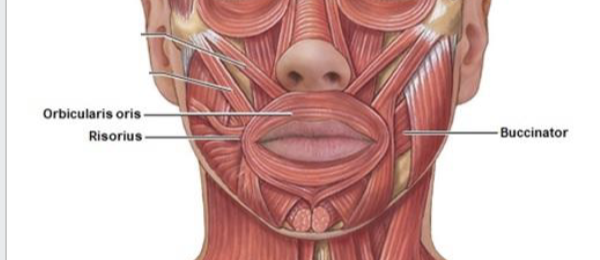
O buccinator
alveolar processes of the maxilla and mandible
I buccinator
into fibers of orbicularis oris
Function risorious
contracting with smiling

O risorious
fascia surrounding parotid salivary gland
I risorious
angle of the mouth
Function zygomaticus
smiling

O Zygomatic major
zygomaticotemporal suture
I zygomatic major
skin at corners of the mouth
O zygomaticus minor
zygomaticomaxillary suture
I zygomaticus minor
skin at corners of the mouth
Function platysma
thin superficial muscle
open mouth, tenses skin of neck

O platysma
fascia covering the superior parts of the pectoralis major and deltoid
I platysma
mandible and skin of cheek
Function mentalis
protrudes lower lip

O mentalis
incisive fossa of mandible
I mentalis
skin of chin
Muscles of facial expression: raised eyebrows/ wrinkled forehead
frontal belly of epicranius
Muscles of facial expression: angry eyebrows
corrugator supercilii
Muscles of facial expression: blink
orbicularis oculi
Muscles of facial expression: tense neck
platysma
Muscles of facial expression: pout
mentalis
Muscles of facial expression: pucker
orbicularis oris
Muscles of facial expression: smile
zygomaticus major
Extra-ocular muscles also known as
oculomotor or extrinsic eye muscles
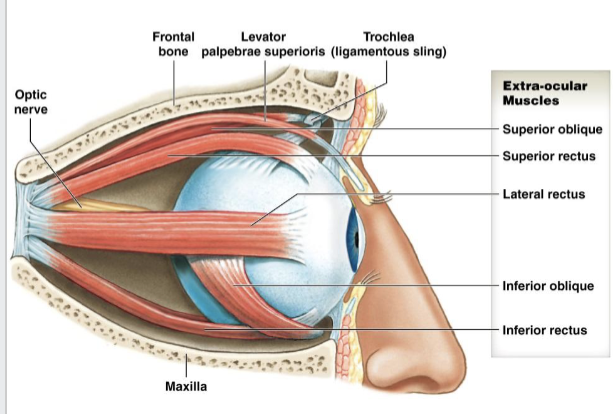
O extra-ocular muscles
orbit of the eye
I extra-ocular muscles
sclera
Diagram of extra-ocular muscles

All the extra-ocular muscles
superior rectus
superior oblique
lateral rectus
medial rectus
inferior oblique
inferior rectus

Movement of superior rectus
upward
Movement of superior oblique
down and laterally
Movement of medial rectus
medially
Movement of inferior rectus
downward
Movement of inferior oblique
up and laterally
Movement of inferior oblique
up and laterally
Movement of lateral rectus
laterally
Which nerves control the eyes?
III, IV, VI
CN III
oculomotor
controls almost all eye muscles
CN IV
trochlear
superior oblique
CN VI
abducens
lateral rectus
What muscle movement of oblique eye muscles?
opposite of the names
Muscles of mastication
temporalis
masseter
pterygoids
Function temporalis
elevates mandible and closes jaw

O temporalis
temporal lines (parietal bone)
I temporalis
coronoid process of the mandible and anterior border of the mandible
Function masseter
synergistic muscle with mandible
crosses TMJ
clench teeth

O masseter
zygomatic arch
I masseter
lateral surface and angle of mandibular ramus
CN V
trigeminal nerve responsible for sensation in the face and motor functions such as biting and chewing.
Function pterygoids
medial and lateral are antagonists
move mandible side to side
ie. chewing gum
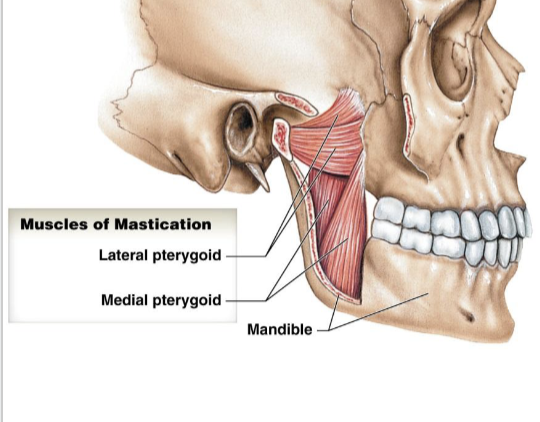

Function medial pterygoid
closes jaw
O medial pterygoid
medial pterygoid plate and portions of palatine bone and maxilla
I medial pterygoid
medial surface of the mandibular ramus
Function lateral pterygoid
opens jaw

O lateral pterygoid
surface of the lateral pterygoi and greater wing of the sphenoid
I lateral pterygoid
mandibular condyle
Function of intrinsic tongue muscles
move the tongue
Parts of intrinsic muscles of the tongue
longitudinal (superior and inferior)
transverse
vertical muscles
O and I of intrinsic tongue muscles
inside the tonuge
Function extrinsic tongue muscles
speech, move food

O extrinsic tongue
outside of tongue
I extrinsic tongue
tongue