AP BIO- Unit 4-8: Plasma Membranes and Permeability
 Call Kai
 Learn
 Practice Test
 Spaced Repetition
 Match
 Flashcards
 Knowt Play
1/43

There's no tags or description
Looks like no tags are added yet.
44 Terms
Amphipathic
Composed of both Hydrophilic and Hydrophobic
Glycolipids
Carbohydrates bonded to lipids
A membrane carbohydrate.. important for cell-to-cell recognition
Glycoproteins
Carbohydrates bonded to proteins.
most abundant
A membrane carbohydrate.. important for cell-to-cell recognition
Fluid Mosaic Model
A model used to describe the structure of cell membranes
fluid: membrane held together by weak hydrophilic interactions and can therefore move and shift
Integral proteins
Located in the membrane. Proteins embodied into the lipid bilayer
Amphipathic
aka transmembrane proteins
MAJOR CATEGORY
Peripheral proteins
Proteins that are not embodied into lipid bilayer.
loosely bonded to surface
major membrane protein
Hydrophilic
“Water loving” - head of phospholipid
Hydrophobic
“Water-fearing” - tails of phospholipids
Purpose of Plasma Membrane?
To regulate the cell by managing the temp, and controlling what goes in and out of the cell by delegating external environment from internal
How is membrane fluidity maintained in varying temps?
Cholesterol located and embedded in the membrane maintains the fluidity.
Cold→ Reduce tightly packed phospholipids
Hot→ Reduce movement
Selective permeability
Property of cell membranes that allow certain molecules and ions to pass through while blocking others
Polar
Uneven distribution of electron charge.
Asymmetrical
Creates partial - and +
EX: H20 and NH3 and Glucose
Nonpolar
Share electrons equally
Symmetrical
EX: CO2 and CH4 and oxygen
Nonpolar molecules are…
Hydrophobic! They can easily pass through the plasma membrane because they can easily mix and dissolve
“Like dissolves like”
Polar molecules are…?
Hydrophilic! They face a chemical barrier because the interior of the lipid bilayer is hydrophobic and Nonpolar
Passive transport
Transport of a molecule that does not require energy from the cell because a solute is moving with its concentration or electromagnetic gradient
happens at different rates
EXAMPLES: Facilitated/ Diffusion, osmosis
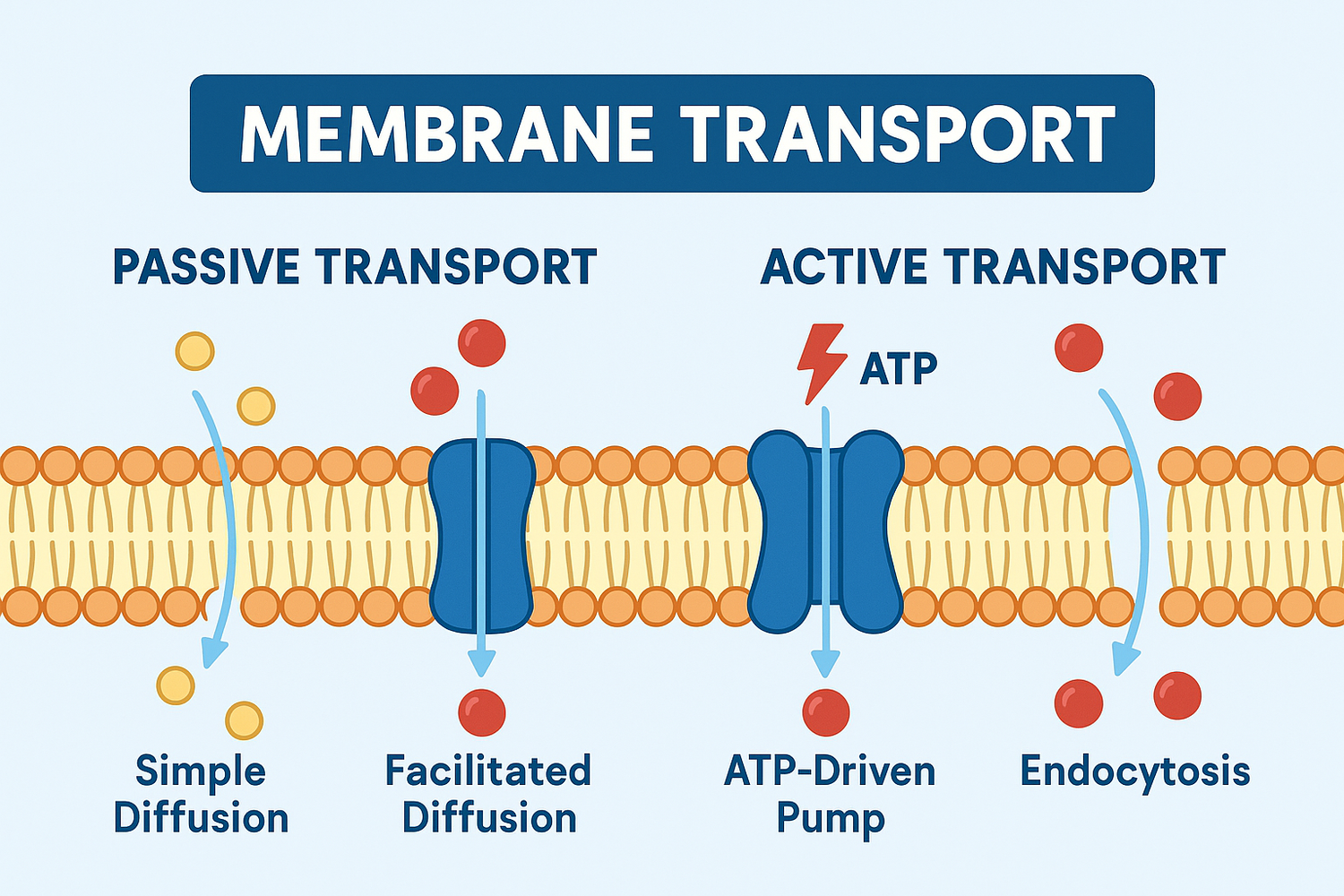
Active transport
Requires energy because it moves a solute against its concentration gradient
EXAMPLE: pumps, cotransport, exocytosis, endocytosis
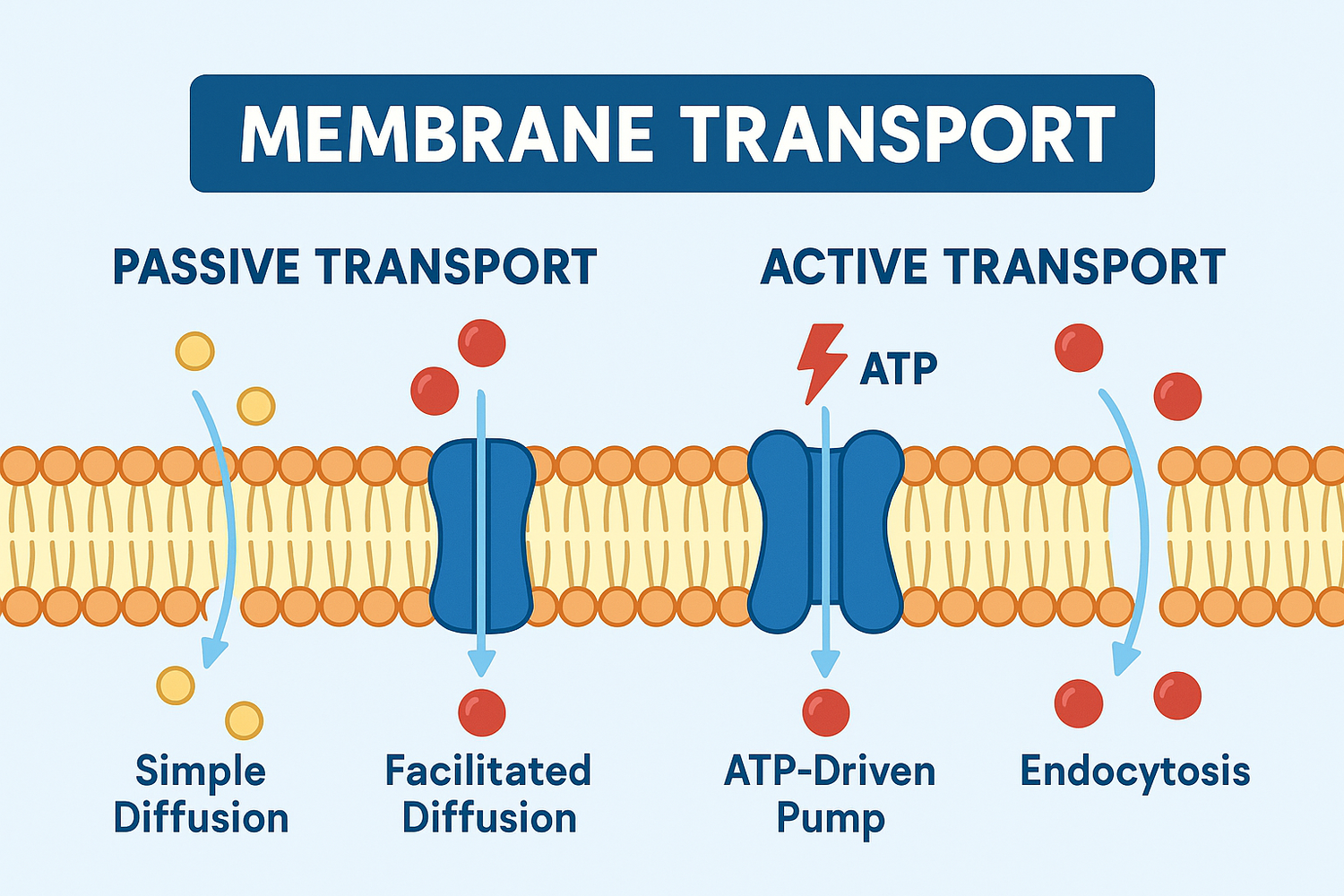
Active Transport: Endocytosis
The uptake of molecules from vesicles fused from the plasma membrane
pinocytosis, phagocytosis, receptor mediated

Active Transport: Exocytosis
The secretion of molecules via vesicles that fuse to the plasma membrane
vesicles form a bilayer to membrane

Pinocytosis
Non-specific uptake of fluid containing dissolved molecules
protein coat helps mediate transportation
Diffusion
Spontaneous process resulting from the constant motion of molecules
high to low concentration

Molecules move from __ to _ concentration
High to low
Passive Transport: Facilitated Diffusion
Diffusion of molecules through its membrane via transport molecules
INCREASES the rate of diffusion
passive because the proteins are helping move down their concentration gradient and no energy is required

Passive Transport: Carrier Proteins
Used to undergo conformational changes for substances to pass
Transport molecule

Passive Transport: Channel Proteins
Provides a channel for molecules and ions to pass
transport molecule

Passive Transport: Aquaporins
Specific channel protein for water
Active Transport: Pumps
Maintain membrane potential
Membrane potential: unequal concentrations of ions across the membrane results in an electrical charge (electrochemical gradient)
thank you to ATP!

ATP
Energy source used by cells that can transfer the terminal phosphate group to the transport protein → changes the shape of the transport protein to better move a protein
Adenosine Triphosphate
If there was a mutation that changed the amino acid sequence of the proteins that make up aquaporins?
It would disrupt the cell's ability to regulate water balance (osmoregulation), potentially leading to cell death or severe dysfunction.
Concentration gradient
The gradual difference in the concentration of a substance (such as solutes, ions, or gas molecules) between two regions, space, or across a cell membrane
How can a chemical gradient be a source of energy for the cell?
It can act as potential energy because ions and molecules naturally want to move from an area of high concentration to an area of low concentration
Chemical gradient
The difference in the concentration of a chemical substance (solute or ion) between two regions, such as across a cellular membrane or within a fluid
Concentration gradient vs Chemical gradient?
Concentration gradient is the general difference in the amount of a substance (solute or gas) between two areas. A chemical gradient is simply a concentration gradient specifically applied across a biological membrane (like a cell wall)
Osmosis
Diffusion of water down it’s concentration gradient across a selectively permeable membrane
low to high solute concentration

Tonicity
The ability of an extracellular solution to cause a cell to gain or lose water
depends on concentration of solutes
Hypertonic
Mixture with higher concentration of solutes and higher osmotic pressure compared to another solute
concentration is higher outside the cell
cells immersed in this lose water to their extracellular surroundings
Plasmolysis
Vacuole shrinks and the plasma membrane pulls from the cell wall

Isotonic
“Same”— A fluid that has the same concentration of dissolved substances (solutes) and water as the inside of a cell. Flaccid
concentrations outside the cell is equal to the inside
Cells immersed in this have NO NET MOVEMENT OF WATER
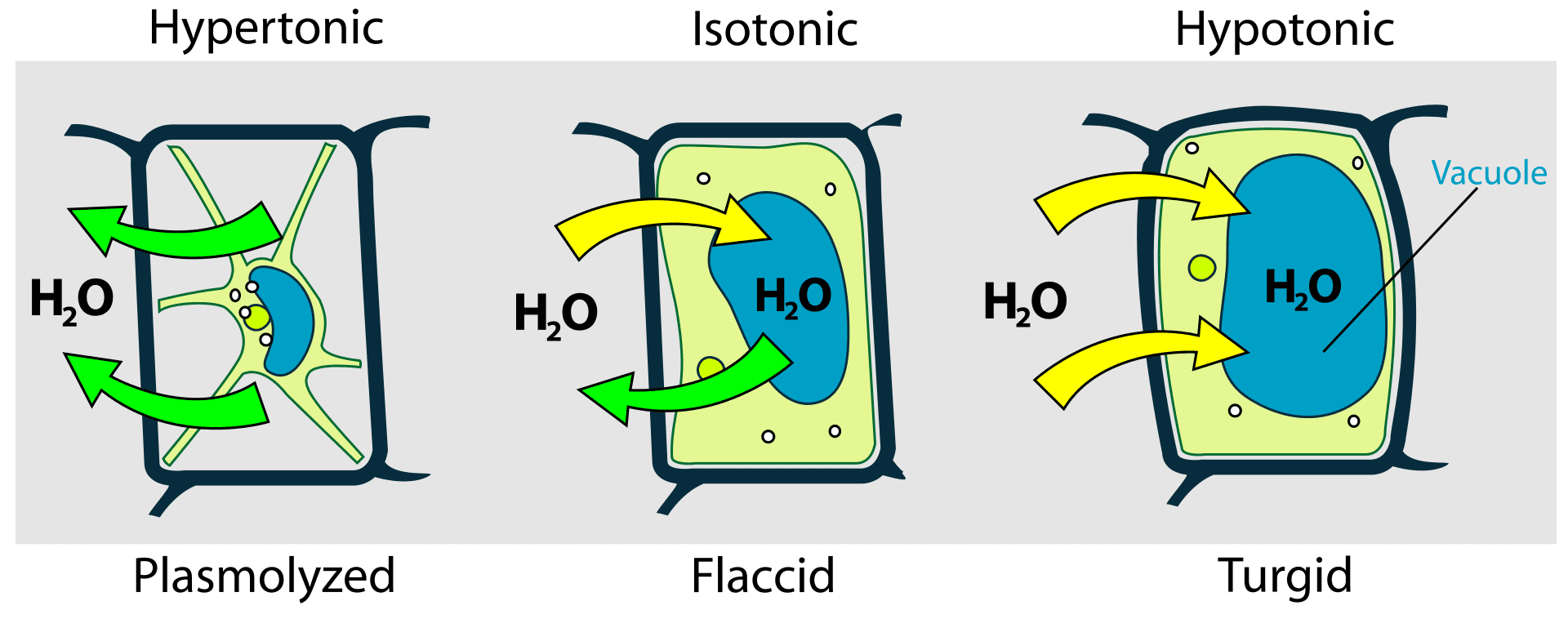
Flaccid
A cell that is soft, limp, or lacking rigidity because water has left the cell or is in equal movement
typically isotonic

Hypotonic
Liquid that has lower concentration of solutes and higher concentration of water.Turgid
Cells immersed in this gain water
concentration is lower outside the cell
Turgid
A cell that is swollen, distended, and firm because it has absorbed water
typically hypotonic
Osmoregulation
Cells must be able to regulate their solute concentrations and maintain water balance
animal cells react differently then cells with walls
Hypertonic, Isotonic, and Hypotonic in terms of solute concentration, movement of water, and cell size
Hypertonic →High concentration, water outwards, size shrink
Isotonic → Equal concentration, water equal flow, same size
Hypotonic → Low concentration, water inwards, size swell
Ѱs = -iCRT
Solute= -(1)(mol/L)(0.0831)(273+Co)