Animal Biology Exam
 Call Kai
 Learn
Learn Practice Test
 Spaced Repetition
 Match
Match Flashcards
 Knowt Play
1/168

There's no tags or description
Looks like no tags are added yet.
Name | Mastery | Learn | Test | Matching | Spaced | Call with Kai | Chat |
|---|
No analytics yet
Send a link to your students to track their progress
169 Terms
How old is animal life?
About 3.8 billion years ago. Estimate keeps being pushed back. 4-4.1 with molecular clocks.
What evidence do we have for the earliest animal life on Earth?
Lit et al. (2014) described the first clearly metazoan fossil from Ediacaran fauna. %60 mya.
Ecological changes
Arms race driven by predatory animals
Genetic changes
Rapid appearance of new genetic information
Environmental changes
Rapid changes in the physical environment
Were animals responsible for the Earth’s first mass extinction?
Darraoch et al (2016) showed that Ediacarans overlapped with metazoans, including possible larval predators (anemones) and ecosystem engineers that may have destroyed adult populations directly or indirectly
Ecological revolution leading to an evolutionary arms race?
Probably not: too localized
Genetic evolution leading to an evolutionary arms race?
New genes? No. Animals all have some genetic tool kit.
What factor could change on a global scale to trigger an evolutionary arms race that continues today?
Temperature, oxygen, geological movement
Oxygen
Some relate to increase in animal life but some don’t. More oxygen = better fossilization as animals grow larger so easier to detect. As you get bigger, volume increases faster than surface area. small = high surface area to volume. large = low surface area to volume. Improve flow of oxygen. lungs have increased surface area to take oxygen from air.
Did a failure of the Earth’s magnetic field increase oxygen levels?
Reduced strength of earth’s magnetic field. loss of hydrogen gas through the weakened magroe to sphere. relative increase in oxygen in earth’s atmosphere allowing animal life to diversify
Combination of biological innovation and environmental change?
Vertical migration : when swim up and down taking water + oxygen in water with them. Allows oxygen to go lower, nutrients from poop go lower. (cambro-ordovicion). Late devorianian. Biological moment charges chemistry of earth’s oceans. Vertical changes cause temperature change? We don’t know.
Anaximander
Greek philosopher. First to suggest that species change over time. Life started as slime in the oceans.
Xenophanes
Greek philosopher. Worlds first paleontologist. Credited with first recognition of marine fossil on land and inferring ancient flooding by seas.
Aristotle
Studied the old testament to determine chronology. Createddated to october 23rd 4004 BC.
William Paley
Natural theology. Analogy of creator as watchmaker. Argument from design. Equates evolution with chancel randomness.
Carlolus Linnaeus
Linnean system of classification. Proponent that species are immutable over time. No transmutation of speciesNo transmutation of spe
Jean-Baptiste de Lamarck
Strong proponent of evolution. Inheritance of acquired characteristics. A physiological mechanism for evolution based on us/disuse.
Erasmus Darwin
Grandfather of Charles Darwin. Zoonomia. Discussed common descent but not natural selection. The temple of nature.
Darin and the ova
The ova were capable of self motion and larvae
Darwin and Wallace
Joint paper by Darwin and Wallace read at the Linnean society. The origin of species is published and sold out on first day
Three schools of thought
A) Linnaeus - special creation. no transmutation of species
B) Lamarck - evolution but no common descent
C) Darwin/Wallace - “ the origin of species” is a tree to show common ancestors
What is the theory of evolution? Broad definition
Evolution is the theory that the universe is not constant but instead changing over the course of time
What is the theory of evolution? Biological Evolution
A change in the frequencies of genes found in natural populations over generations
What is Darwin’s theory of evolution?
organisms are transferred over time
every group of organisms descended from a common ancestor
species have multiplied over time
Gradual changes
Natural selection
What is natural selection? four tenets
individuals within populations are variable
some of the variation among individuals is heritable
an excess of offspring are produced
survival and reproduction of these offspring is nonrandom
Four forces of darwinian evolution
Natural selection
Mutation - random, heritable change in a gene or chromosome
Gene flow - exchange of genetic material between populations
Genetic drift - random change in allele frequency across generations
Modern Synthesis Geneticists vs Naturalists
Geneticists (Theodosius Dobzhasky is one) - Understand population genetics thanks to rediscovery of Medels work (how traits are passed from one generation to the next) and through formulations of Fisher, Haldone and Wright.
Naturalists (George Gaylord Simpson, Ernest Mayr) - understand species concept
Modern Synthesis Naturalists
Understand species concept
Modern Synthesis proximate causes
“How” e.g. biochemical mechanism of translating genetic program into a phenotype
Modern Synthesis ultimate causes
“Why” e.g. historical
Modern Synthesis R.A. Fisher, Sewell Wright and S.B.S Haldone
developed the mathematical theory of population genetics
mutation is not an alternative to natural selection but instead provides raw material (variation)
mutations of small effect
Modern Synthesis Theodosius Dobzhasky-Russian born geneticist
pioneered genetic studies in natural populations are not uniform
conveyed mathematical population genetics
Modern Synthesis George Gaylord Simpson - Vertebrae paleontologist
showed that paleontologist data are consistent with population genetics and natural selection
tempo and modern evolution
not a constant change. proposed notion of “quantum”
Modern Synthesis Ernest Mayr - naturalist/systematist describe a mechanism for speciation (the origin of species)
consistent with natural selection and population genetics
systematics and the origin of species
Where does the Modern Synthesis leave us?
-Darwin ignored cell biology and genetics
-His own students summary of Mendels work and his own copy of the journal in which a lengthy summary by Mendal was published
-The theory ignored units of selection (genes vs organisms vs group) and development
Punctuated Equilibrium
Stephen Jay Gould
Niles Eldredg
The history of a lineage is full of long periods of stasis (equilibrium) that are interrupted (punctuated by rapid bursts of morphological change
Responses to critiques that is non-darwinian
entirely consistent with typical microevolutionary processes
consistent with an allopatric model of speciation (Mayr)
no need to invoke species - level selection
radualism of darwin is consistent with P.E.
Other responses to Darwin: s-xual selection
Darwin published an entire book on sexual selection but Robert Trivers extended the theory in the 1970’s to show that
the sex making the greater investment in offspring (usually female) will be choosier
the remaining sex (usually male) will compete for matings and female preferences can lead to runaway sexual selection
Other responses to darwin: kin selection
how do naked mole rats make this work? Inbreeding
high levels of inbreeding lead to high genetic relatedness among colony mates
Hamilton’s rule
Hamilton’s rule
An organism may benefit from altruistic acts when rB-C>0
r = genetic relatedness of the recipient to the actor
B = the reproductive benefit that acures to the recipient
C = the reproductive cost to the actor
Other responses to darwin: selfish gene theory
Richard Dawkins
-organisms are vehicles for replicators (genes)
-adaptations are for replicators, not vehicles
-inclusive fitness (individual reproductive success + effects on success of relatives) is how to determine fitness (i.e. at the gene level, not individual level
Where do we stand now on? What is the appropriate unit of selection?
Darwinian natural selection explains all or nearly all cases of adaptation, using the organism as the unit of selection (Mayr’s view)
In some cases, this must be modified to include inclusive fitness to explain altruism or sexual selection (a special case of natural selection) both of which can yield runaway traits that appear maladaptive
What’s natural evolution? What is the neutral theory of evolution?
Neutral theory: Proposed by Motoo Kimura most genetic variations at the molecular level are neutral, meaning they do not affect an organism's fitness.
Natural evolution: rooted in Darwinian principles, emphasizes that natural selection drives the evolution of species. Evidence based but controversial.
Complex Life Cycles in Marine Invertebrates

Rhizocephalan Barnacles
kicking feet up to feed
parasite zombified host

Williamson’s view
Lots of diversity in animals that have metamorphosis but didn’t understand how larvae can turn into that animal through evolution. Thinks that two organism mated, genomes fused, now these two types of animals appearing in the same life cycle
Tests of Williamson’s Ideas
Rhizocephalans have the smallest genome size of all barnacles
Insects with larvae have similar genomes than those without
Phylogenetic analysis shows insects with and without larvae are much more similar than either is to oncychophorans
Onychophoran genomes are larger than those for insects with larvae
Tunicates have comparable (or smaller) genome size than larvaceans
Williamson not a new idea. Hart wrote a paper. What genes would you look for if mom is a sea squirt?
Mitochondrial DNA. What he says came from sea squirts did not.
Jerry Coyne
William and Mary. Grad work with Ddozhansky than Lewantin.
Professor at University of Chicago
Author of “why evolution is true”
Called Williamson’s work the worst paper of the yera
Led to changes in PNAs “track” system
Is what Williamson wrote scientific?
Not really because it’s ignoring evidence that exists. Can’t pick and choose evidence
What data did Williamson present in his paper?
None
Do scientific papers require data?
Most papers have some original data, but some review papers don’t. If he had synthesized the data he wouldn’t have published as he’d see it was wrong.
What do scientific papers require?
Testable hypothesis and predictions, fairly present existing evidence not ignoring data that refutes you
After nearly 20 years of research into Williamson’s hypothesis…
he provided few experimental data to support the idea that the transfer of genomes by interpretation hybridization explains the discard between the morphology of larval and adult forms of marine invertebrate animals
Lynn Margulis
Egged Williamson on, blurbed his books, collaborated with Ryan on that horrible biography and forced Williamson’s PNA’s article through the review mill
Why was development left out of Modern Synthesis?
seen as old fashioned and unscientific to genetics. not quantitative
geneticists and developmental biologists distained each other
agreed on haeckle’s biogenetic law
Haeckle’s biogenetic law
Drew lots of embryos. Noticed whether it’s human/bird/fish in early development stages. Fudged some of drawings to make them looks even more similar which led to a controversy of evolution not being real. Evidence of common ancestors if you look early. Ontogeny recapitulates phylogeny picture.
When did development come back?
Following Gould’s ontogeny and phylogeny and renew interest in homology
What is homology?
Equivalence of parts among different organisms due to descent from a common ancestor. Found in the limbs of vertebrates, Even with different functions, the bones that comprise the limbs are the same. picture
Expanded study of homology to homeotic mutants-
genes responsible for homeotic mutants share 180 bp domain (homeobox) and are homologous
vertebraes and drosophilia share homologous genes controlling vision, grastrulation, heart formation, etc.
Batson discovered a long time ago and sai it’s important for evolution
What is a morphogen?
Gradient of diffusible gene products. High concentration to low concentration. Genes producing as it diffuses out to send signals and the signals can change embryotic development, morphogensis and the way an organism forms. Change the way set up interactions through diffusion
List of developmental processes
Cells divide
Cells differentiate (endogenously via differential gene expression or exogenously via induction)
Cells orient
Cells move (via cytoskeletal elements like actin/myosin and tubuin)
Cells stop (via adhesion proteins)
Cells die (programmed cell death aka apoptosis)
Development Question 1
What are the major differences between protostomes and deuterostomes?
Deuterstomes
butt to head
humans, cows, frogs
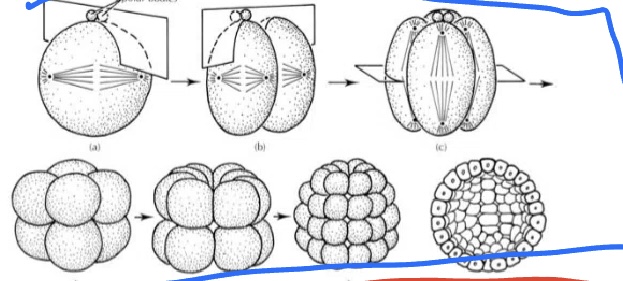
radial cleavers
indeterminate
“second mouth”
Protostomes
head to butt
anemones, earthworms
determinate
“first mouth”
Radial cleavage
equal cell divisions. initial cell division. those two cells are equal
Spiral cleavage
cells that are dividing into unequal parts. not two fully equal organisms
Indeterminate
How you get twins to form. cell fates haven’t been decided uet
Determinate
cell fates get determined right away
Dueterstomes type of coelom formation
Protostomes type of coelom formation
picture

Mosaic (mollusc)
Differentiated before split.

Regulative (sea urchin)
when pulled apart you get four normal larvae because they haven’t yet differentiated. Stops working at 8 cell

Protostome (first mouth) spiral cleavage

Deuterostome (second mouth) radial cleavage

Can you think of an ecological cost to this aspect of deuterostome vs protostome?
If you’re a protostome and you get your mouth first, you can start eating first and get nutrition first even if you don’t have an anus. If you’re trying to develop as quickly as possible and need food for development, then making a mouth first would be a good idea even before finishing construction of body
Levis and Pfennig. What is their model of plasticity first evolution. A.
Colors represent different genotypes of tadpoles

Levis and Pfennig. What is their model of plasticity first evolution. B.
Genomes show different phenotypes because of environment change. Genotypes hasn’t changed because their color hasn’t changed. Genotype reacting to novel environment creating new phenotypes from cryptic variation.

Levis and Pfennig. What is their model of plasticity first evolution. C.
Natural selection has acted. One of them (the blue round one) had the favorable trait/was more fit for the environment. The other traits were less fit so the phenotypes died out.

Levis and Pfennig. What is their model of plasticity first evolution. D.
Natural selection has happened. The trait was worked on and improved/refined to continue to fit well in this novel environment

Levis and Pfennig. What is their model of plasticity first evolution. E.
From D to E the environment changes back to the ancestral environment. Genes became canalized. They no longer need the novel environment to be this phenotype. The blue tadpole doesn’t have plasticity to go back. Phenotypic change becomes prevalent in the population for generations so you no longer need the environment to change to produce that trait

Levis and Pfennig. How do we test this new model? A
Lineages 2 and 3 are more closely related to each other than they are to lineage 1 because of the ay the phylogenetic tree is set up

Levis and Pfennig. How do we test this new model? C
Difference between the induced novel phenotype and the canalized phenotype that can be seen after time has passed and the environment has stayed the same. Canalized trait has done through genetic accommodation and has through selection been improved and refined after spending time in the new environment while the plastic phenotype is not as refined and improved in comparison

Levis and Pfennig. How do we test this new model? Lineage 1
Pre existing plasticity
Ancestral phenotype plastic but in a random way
One good, one bad, one not changed

Levis and Pfennig. Spadefoot toads in SW US
Depressions fill up by spring rains that are usually in a desert
Phenotype width mouth/length of gut/size of head change between environments as well as carnivorous and omnivorous frog type
Levis and Pfennig. Spadefoot toads in SW US. What is polyphenism?
One morph or another, not a smooth gradient
Levis and Pfennig. Spadefoot toads in SW US. Could kin selection play a role here"?
Pretty likely. Other frogs are probably siblings in the pond
From the Hamilton rule, would we expect them to distinguish among tadpoles?
Yes because they’re cannabilizing their own species and they can distinguish up to second cousins. They’d aslo determined based on closest relative. They’d eat cousin over brother
Plasticity
Environment changes without genetic change leads to a new phenotype
Non-plastic trait here
Number of fingers, number of limbs (mostly)
Plastic
Height and weight are plastic, how long you can grow, etc
Development Question 2
What are the three types of animal tissues and how are the related to embryos?
What are the three types of animal tissues and how are the related to embryos?
Endoderm (inside)
Ectoderm (outside)
Mesoderm (middle)
Animal tissues develop directly from the primary germ layers formed inside early embryos during a stage called gastrulation

Development Question 3
What is a coelom and how is it related to animal tissue types?
What is a coelom?
A coelom is the body cavity between the body wall and the gut that is lined with mesoderm
Peritoneum - in human, where organs are
Endoderm
Endoderm is the innermost of the three primary germ layers in an embryo. It plays a crucial role in development, primarily giving rise to the epithelial linings of the body's internal organs and systems.
Develops into the lining of the gastrointestinal tract, including the esophagus, stomach, and intestines.
Ectoderm
The outermost layer of cells or tissue of an embryo in early development, or the parts derived from this, which include the epidermis and nerve tissue.
Mesoderm
The middle germ layer in animal embryos. It plays a crucial role in development, giving rise to various structures and tissues in the body.:
Formation of Tissues
It is responsible for developing all three types of muscle tissue: skeletal, smooth, and cardiac.
This layer contributes to the formation of organs such as the heart, kidneys, and reproductive systems.
The mesoderm forms during the process of gastrulation
Acoelomate
No coelom
