Ch 5 Eukaryotic Cells, Fungi, and Protozoan Microbiology
 Call Kai
 Learn
Learn Practice Test
 Spaced Repetition
 Match
Match Flashcards
 Knowt Play
1/61

There's no tags or description
Looks like no tags are added yet.
Name | Mastery | Learn | Test | Matching | Spaced | Call with Kai | Chat |
|---|
No analytics yet
Send a link to your students to track their progress
62 Terms
When did the first eukaryotic cells appear on Earth?
2 to 3 billion years ago
What is the precursor from which bacteria and eukaryotes evolved?
The last common ancestor
What are organelles in eukaryotic cells derived from?
Primitive cells that became trapped in eukaryotic cells
What is endosymbiosis?
A theory that explains the origin of eukaryotic cells from symbiotic relationships between different species

What type of organisms evolved from single-celled eukaryotes?
Multicellular organisms
What are the basic features found in all eukaryotic cells?
Cytoplasmic membrane, nucleus, mitochondria, endoplasmic reticulum, Golgi apparatus, vacuoles, cytoskeleton, glycocalyx
What is the function of the glycocalyx?
It serves as an outermost boundary that comes into direct contact with the environment and is composed of polysaccharides.
What is the difference between eukaryotic and bacterial flagella?
Eukaryotic flagella are 10x thicker, structurally more complex, and covered by an extension of the cell membrane.
What are cilia and how do they differ from flagella?
Cilia are shorter and more numerous than flagella and function as feeding and filtering structures.
What is the role of the nucleus in a eukaryotic cell?
It acts as the control center, housing genetic information and regulating cellular activities.

What is chromatin?
The material of eukaryotic chromosomes, consisting of long, linear DNA molecules bound to histones.
What are the two types of endoplasmic reticulum?
Rough endoplasmic reticulum (with ribosomes) and smooth endoplasmic reticulum (without ribosomes).
What is the function of the Golgi apparatus?
It modifies and transports proteins, adding polysaccharides and lipids before packaging them into vesicles.

What is the significance of the nucleolus?
It is the site for ribosomal RNA synthesis and stains more intensely due to its RNA content.
What are the components of the cytoplasmic membrane?
A bilayer of phospholipids embedded with protein molecules, containing sterols for stabilization.
What is the role of the rough endoplasmic reticulum?
It holds ribosomes on its surface for protein synthesis and packaging.

How are proteins transported from the endoplasmic reticulum to the Golgi apparatus?
Through transitional vesicles formed at the endoplasmic reticulum.
What materials make up the cell wall in fungi and algae?
Chitin in fungi and cellulose in algae.
What is the structure of eukaryotic flagella?
A long, sheathed cylinder containing regularly spaced hollow microtubules arranged in a 9+2 pattern.

What happens during meiosis in eukaryotic cells?
It is the process of producing sex cells.
What is the function of vacuoles in eukaryotic cells?
They serve various roles including storage and maintaining turgor pressure.
What is the extracellular matrix?
Another name for the glycocalyx, composed of polysaccharides.
What is the primary function of the cytoskeleton in eukaryotic cells?
It provides structural support and helps in cell movement.
What are lysosomes?
Organelles that originate from the Golgi apparatus and contain enzymes for intracellular digestion and protection against microorganisms.
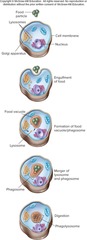
What is the function of vacuoles?
Membrane-bound sacs that contain fluids or solid particles for digestion, excretion, or storage.
What is the primary role of mitochondria?
To supply the bulk of the energy for a cell.

What are the two main structural components of mitochondria?
Cristae (folds on the inner membrane) and the matrix (contains ribosomes, DNA, and enzymes).
What unique characteristics do mitochondria possess?
They divide independently, contain circular DNA, and have 70S ribosomes, indicating they were once independent cells.
What is the primary function of chloroplasts?
To convert sunlight into chemical energy through photosynthesis.

What do chloroplasts produce?
Organic nutrients and oxygen gas.
Where are ribosomes found in a cell?
In the cytoplasm, attached to the rough endoplasmic reticulum (RER), and inside mitochondria and chloroplasts.
What are polyribosomes?
Short chains of ribosomes that work together in protein synthesis.
What is the size of eukaryotic ribosomes?
80S, composed of 60S and 40S subunits.
What are the main functions of the cytoskeleton?
Anchoring organelles, moving RNA and vesicles, and allowing shape changes and movement.

What are the three main types of cytoskeletal elements?
Actin filaments, intermediate filaments, and microtubules.
How many species of fungi are there approximately?
About 5 million species.
What are the two groups of fungi?
Macroscopic fungi (e.g., mushrooms) and microscopic fungi (e.g., molds, yeasts).
What is the shape of yeast cells?
Round to oval shape.
What are hyphae?
Long, thread-like cells found in filamentous fungi or molds.

What are pseudohyphae?
Chains of yeast cells.
What does dimorphic mean in fungi?
Some fungi can exist in either yeast or mold form.
What type of nutrition do fungi exhibit?
Heterotrophic nutrition, acquiring nutrients from a variety of substrates.
What are saprobes?
Organisms that obtain substrates from dead plants and animals.
What are parasites in the context of fungi?
Fungi that live on the bodies of living animals or plants.
What is mycelium?
The woven, intertwining mass of hyphae that makes up the body or colony of a mold.
What are septa?
Cross walls that divide hyphae into segments.
What are spores?
Fungal reproductive bodies.

What is fragmentation in fungal reproduction?
A process where a separated piece of mycelium can generate a whole new colony.
What are sporangiospores?
Asexual spores formed by successive cleavages within a sporangium.
What are conidiospores or conidia?
Free spores not enclosed by a spore-bearing sac.
What is the purpose of sexual spores in fungi?
To create genetic variations that may be advantageous for adaptation and survival.
How are fungi identified in medical specimens?
By isolation on special media and microscopic/macroscopic observation.
What are the three types of pathogenic fungi?
Community-acquired infections, hospital-associated infections, and opportunistic infections.
What are some medical conditions caused by fungi?
Allergies and neurological conditions due to toxin production.
What is the impact of fungi on agriculture?
Pathogenic to crops, consuming 40% of the fruit crop each year.
What positive role do fungi play in the ecosystem?
Decomposing organic matter and returning essential minerals to the soil.
What is the significance of fungi in industrial processes?
Production of antibiotics, alcohol, organic acids, vitamins, and food flavoring.
What are protozoa?
Single-celled organisms that contain all major eukaryotic organelles except chloroplasts.
What is the study of protozoa and helminths called?
Parasitology.
What nutritional requirements do protozoa have?
Heterotrophic, requiring food in complex organic form.
What do free-living protozoan species do?
Scavenge dead plant or animal debris and graze on live cells of bacteria and algae.
How do parasitic protozoa obtain nutrients?
By living on fluids of the host, such as plasma and digestive juices.