Week 3 - quantitative traits
 Call Kai
 Learn
 Practice Test
 Spaced Repetition
 Match
 Flashcards
 Knowt Play
1/46

There's no tags or description
Looks like no tags are added yet.
47 Terms
What influences quantitative traits?
Quantitative traits are influenced by many genes and the environment and can be quantified:
•Milk (yield, butterfat, protein) in dairy cows
•Feed efficiency/Average daily gain/Meat quality,
•Speed/athleticism in horses
•Gastrointestinal nematodes, growth, Fleece weight in sheep
•Egg laying for hens (16-55 weeks of age)
Name three types of traits
1. Quantitative traits
2. Multifactorial traits
3. Complex traits
What is population genetics?
It deals with frequencies of alleles and genotypes
What is a phenotype?
It is the physical manifestation of the genotype
What is Quantitative genetics?
It concentrates on the ways that variation in genotype and environment contribute to variance in phenotype.
What is a phenotypic value and its formula?
This is the performance of an individual animal for a particular trait: P = G+E
What does G stand for in the phenotypic value formula?
G is the genotypic value and is the combined effect of all the loci that affect the trait
What does E stand for in the phenotypic value formula?
E is the environmental deviation and is the combined effect of all non-genetic factors that affect the trait

What does genetic variance involve?
Genes at multiple loci, dominance and epistasis
What do genes at multiple loci do?
Many genes influence a trait in an additive manner
In genetic variance, what is dominance?
The masking effect of different alleles of the same gene on a particular phenotype
In genetic variance, what does epistasis explain?
The masking effects of one gene on the phenotype of another gene
What does environmental variance refer to?
Nutrition
Temperature
Rainfall
Sun light
Stocking density
Management practices (age at castration, age/BW 1st parturition

What is genotype by environment interaction?
It is the ability of one genotype to produce more than one phenotype when exposed to different environments
Match animals to the environment
Develop husbandry practices to improve the environment
Data collected in one environment may not translate
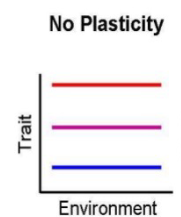
No plasticity
No plasticity means a specific genotype produces the exact same phenotype across different environmental conditions.

Plasticity
is the ability of a single genotype to produce different observable traits or phenotypes when exposed to different environmental conditions.

Highly variable plasticity, strong genotype by environment interaction
Mean that different genetic strains or individuals respond to environmental changes in widely different, unpredictable ways.

Genotype by environment interaction example
What is phenotypic variance?
Vp stands for the total phenotypic variance.
It is the full tange of the trait measured and expressed in animals of that population
What is the formula of phenotypic variance?
VP = VA + Vde + VE
VA = additive genetic variance
Vde = effect of dominance and epistasis
VE = variance among individuals in different environment
How are the three categories of quantitative trait distribution?
Continuous traits
Categorical traits
Threshold traits
How is a continuous trait of distribution graphed?
Example - Milk yield

What are categorical traits in quantitative distribution?
One of a number of discrete categories: litter size
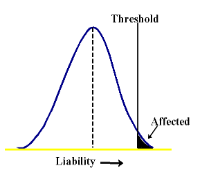
What are threshold traits in quantitative distribution?
A special case, traits are defined as present or absent, so if value is high enough is expressed: KC elbow and hip dysplasia scoring in dogs, twinning in cattle.
What is the graph for frequency distribution of milk yield resulting from variation at a single locus and at two loci

How does one describe a quantitative trait in a population?
Mean or average is the peak of the distribution
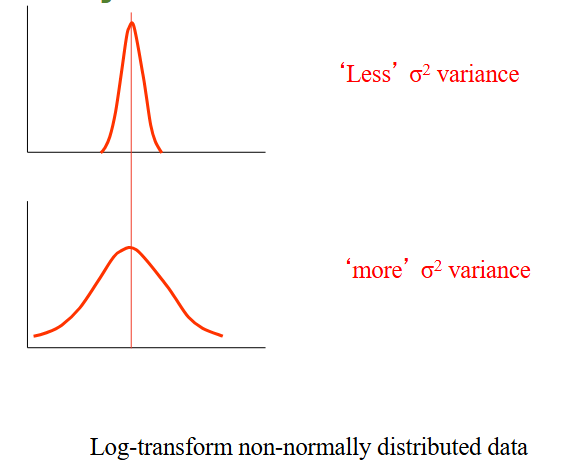
Variance (σ2) is a measure of the spread of the distribution and is estimated in terms of the squared deviation (difference) of each observation from the mean
How do you calculate the standard deviation of normalised data?
The standard deviation is the square root of the variance

Genetic variance table of comparison

Normally distributed data focusing on variance.
What is the goal of a selective breeding programme?
The goal is to change the mean and variance

What is heritability?
A statistic that estimates proportion of the total variance
in a phenotypic trait in a population that is due to the
additive genetic variance between the individuals in
that population
VP = VA + Vde + VE
Heritability is always population specific
Broad and narrow sense heritability?
small h2 has removed the dominate side of heritability?

Heritability has a range from 0 to 1
Fertility has a heritability of 0.03

When the heritability is high
Gene complement of breed for this trait is it’s greatest asset. This means there’s lots of selection potential for improvement
Change (by selection) will be relatively fast
Results (of a selection programme) are more predictable
The animal’s individual performance is a reliable guide to it’s future breeding potential i.e. the Phenotype is a good estimator of the Genotype
Conditions more uniform for the trait i.e. environmental variance low
When the heritability is low
Changes due to selection will be slow
Individual performance is a poor guide to future breeding potential
Phenotype is a poor estimator of genotype
Trait heavily influenced by environmental variance.
Jumping ability has a very low heritability in horses
What are the two types of selection of animals?
Natural and artificial
What is the aim of selection of animals?
The aim is to change gene frequency
It needs to be applied each generation to maintain progress
What happens to the unselected animals?
They are culled
Culled does not always mean kill - can mean castrate, or just remove from the herd
What is selection?
Selection means making choices in breeding stock, male and female
The choices are about the measured values of the economic traits
We need to know the h2 of a trait to optimise the best way to select for it.
What are the 3 main testing an d selection systems in animal breeding?
Pedigree selection
Performance testing
Progeny testing
What does Pedigree mean?
It’s the traditional first step taken by breeders in selecting sires or dams.
It’s a reliable guide when the trait has a HIGH heritability.
If the trait selected for has a LOW h2, then the relatives in the pedigree need lots of records to back up the pedigree.
Commonly ends up as emphasis on 1 or 2 famous ancestors
What are performance tests?
These are “first past the post” tests
The h2 of the trait should be HIGH
It is a contemporary test – housed, fed, time-limited together
Feed efficiency, growth rate (beef cattle/ICBF/Tully)
Studbook young-horse assessment (e.g. Irish Sport Horse/Horse Sport Ireland 2-3yo evaluations)
Shouldn’t be used; if h2 is LOW; if trait expressed in just one sex; if trait expressed late in life
What is progeny testing?
It is selecting parents on the basis of their progeny’s average value
It is the most accurate way to get at the real genotypic value of an individual
Used for traits of LOW heritability e.g. fertility, jumping ability
Down-side; its slow / very expensive / need a lot of progeny / need to test a lot of sires
What is Estimated breeding values?
EBV (Estimated Breeding Value): combines pedigree, own performance and progeny records — plus genomic data where available — into a single predicted breeding value for a trait.
How is EBV expressed?
Expressed in the trait's own units (e.g. kg milk, days to slaughter), with an accuracy (%) showing how reliable the estimate is — accuracy rises as more relatives/records are added
Multiple EBVs are combined into an overall index for easy comparison, e.g. ICBF €-Star ratings (EBI) for dairy/beef cattle, Sheep Ireland's Replacement/Terminal Index
This is what AI catalogues actually rank sires on: pedigree, performance and progeny testing aren't alternatives — they're the building blocks that feed into the EBV
For vets: accuracy is the key to good advice — how much weight should a breeder put on a young, low-accuracy genomic sire versus an older, high-accuracy proven one?
Summary