Labor/Delivery
 Call Kai
 Learn
Learn Practice Test
 Spaced Repetition
 Match
Match Flashcards
 Knowt Play
1/129

There's no tags or description
Looks like no tags are added yet.
Name | Mastery | Learn | Test | Matching | Spaced | Call with Kai | Chat |
|---|
No analytics yet
Send a link to your students to track their progress
130 Terms
30 yr old G2P1 at 37 wks comes in for routine visit. With leopold maneuver you feel firm round mass at top of uterus (fundus) and softer part down below. Ultrasound shows hips flexed and knees extended. This pt has
Frank breech
What part presents in frank breech
Buttocks
What type of breech presents with the buttocks and feet first
Complete breech
This type of breech presents with 1 foot or both feet
Incomplete (footling) breech
This breech is where hips are flexed and knees sitting Indian style
Complete breach
This breech is where one or both hips are extended
footling/Incomplete breech
This breech is highest risk of cord prolapse
Footling/incomplete breech
what raises the odds of breech presentation
prematurity, twins, polyhydramnios
this type of breech has the highest risk for cord prolapse
footling. feet don’t fill the pelvis so the cord can slip
what are leopold maneuvers
feeling the firm head at the top instead of the bottom. confirm with US
How to dx breech confirmatory
US
When do you preform ECV in a pt with breech presentation
37 wks
laboring patient at 39 weeks on continuous fetal monitoring. With each of her contractions (about 3 in 10 minutes), the fetal heart rate dips — but the dip starts after the contraction peaks and returns to baseline only after the contraction is over. this type of FHR is
reprepetitive late decels
what concern is raised in a pt whos FHR shows repetitive late decels
uteroplacental insuff
What is fetal distress
Baby shows signs that it isn't producing enough oxygen
How do you determine if pt has fetal distress
Fetal heart rate (FHR) - tracing of shape and timing tells you cause
2 tests to determine fetal distress
Non stress test, contraction stress test
What is a non-stress test
Watching heart rate @ rest, no contractions needed
What do you want to see in a good nonstress test
A reactive test
What is a reactive NST
At least 2 accelerations in 20 minutes each a rise of >15 beats per min, lasting >15 secs
What does a nonreactive NST mean
Not enough acceleration → more to contraction stress test
What does contraction stress test mean
Now baby handles stress of contractions
What is a negative CST
Good. No late decelerations with ≥3 contractions in 10 mins. This is reassuring
What are positive contractions on CST
Bad. Repetitive late decelerations with contractions. worrying esp if NST was non reactive. move to delivery
what does early decels mean
dip mirrors contraction
early decels are caused by
head compression - benign
abrupt, sharp drop with no fixed relationship to contractions
variable decels
what does variable decels mean
caused by cord compression
dip in FHR starts after the contraction peaks and recovers after it ends
late decels
late decels are caused by
uteroplacental insuff
what is the most concerning FHR pattern
late decels. baby can be hypoxic
What is veal chop
Variable → cord compression
Early- head compression
accelerations-okay
late-placental insuff
When do you do APGAR scoring
Quick newborn check
What does APGAR stand for
Appearance, pulse, grimace, activity, respiration
When do you test APGAR scoring
1 and 5 mins after birth
What values are given to APGAR scoring
0,1,or 2, w max score of 10
Normal APGAR scoring
At least 7
What does APGAR scoring 4-6 mean
Needs some help
What does APGAR scoring of 3 or less mean
Needs resuscitation
TX fetal distress
Intrauterine resuscitation = roll mom on left give 02, IVF stop oxytocin. if doesn’t work then delivery

what is this FHR
early decels

what is this FHR
late decels
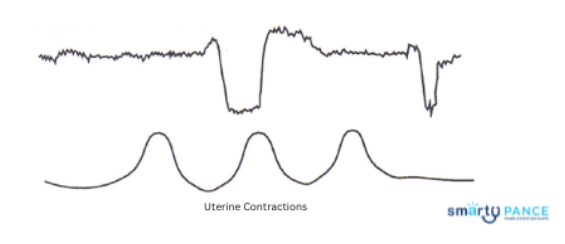
what is this FHR
variable decels
28-year-old G1P0 in active labor who has been stuck at 6 cm for the past 4 hours despite an intrauterine pressure catheter showing strong, adequate contractions. The baby’s head is not descending. She is diagnosed with an arrest of dilation and prepared for cesarean. this is an example of
labor dystocia
What is labor dystocia
Labor too slow or stopped
What are the 3 p's for labor dystopia
Power, passenger, passage
What is the power issue of labor dystocia
Contractions are too weak (most fixable cause)
What is the passenger issue regarding labor dystocia
Baby too big (macrosomia) or poorly positioned (malposition, like occiput posterior)
What is the passage issue of labor dystopia
Mom's pelvis is too small or shaped unfavorably
What is protraction of labor
Labor is moving, just slowly
What is arrest of labor
Labor stopped- no cervical change for >4 his with adequate contractions
What is shoulder dystocia
After head delivers shoulder gets stuck behind pubic bore and head retracts "turtle sign”
How to dx labor dystocia
Serial cervical exams to see if its protraction vs arrest. also check contraction strength w IUPC), and baby's size and position
Tx labor dystocia if contractions are too weak
Oxytocin to strengthen them ± breaking water, amniotomy
tx a true arrest in labor
C section
How to tx shoulder dystocia
McRoberts maneuver (sharply flex Mom's hips onto belly + suprapubic pressure first
laboring pt at full dilation whose baby is occiput anterior. as she pushes the baby’s head tucks its chin, rotates to face the floor, then extends under the pubic bone to deliver, followed by the shoulders. what are these movements called
cardinal movements of labor
step by step way a baby turns and tucks to fit through the pelvis
cardinal movements of labor
what is the most favorable position for delivery
occiput anterior
what is occiput anterior position
back of head toward the mom’s front
sequence of cardinal movements
engagement —> descent —> flexion (chin tucks) —> internal rotation —> extension (head delivers under the pubic bone) —> external rotation (restitution) —> expulsion (shoulders and body)
pneumonic for mechanisms for delivery
every decent family is really excited easter
what movement does the fetus do to present the smallest part of the head to the pelvis
flexion
how will a occiput posterior position present in a pt
sunny side up, longer labor and lots of back pain
how does the pt present with a transverse arrest
head stopped while sideways and didn’t complete internal rotation
26 y G1P0 at 39 wks gestation has regular contractions every 3-5 mins for the past 2 hrs. bloody snow and spontaneous rupture of membranes. cervical exam shows 4cm dilation, 80% effacement, station -1. fetal heart rate tracing is reassuring with no decelerations
normal labor and delivery
regular uterine contractions that produce progressive cervical dilation and effacement, ending in delivery of the baby and placenta
labor
what are the 3 things that describe the cervix on every exam
dilation, effacement, station
what is dilation when describing the cervix
how open the cervix is, 0-10 (10cm = fully dilated)
what is effacement when describing the cervix
how thin the cervix is, 0-100%
what is station when describing the cervix
how far the baby head come down relative to ischial spines
0 = at the spines, negative = above, positive = below
what is the first stage of labor
onset of labor to full dilation (10cm). longest stage, where first baby can take 6-20 hrs, and later babies taking 2-14 hrs
what is the second stage of labor
full dilation to delivery of baby (first baby = 30m-3hr, later = mins)
what is the third stage of labor
delivery of baby to delivery of placenta. cord has 2 arteries 1 vein
APGAR scoring
fast newborn check done at 1 to 5 mins after birth. each item 0-2
what does APGAR scoring stand for:
appearance (color)
pulse (HR)
Grimace (reflexes)
Activity (muscle tone)
Respiration
is pt gets APGAR score of 2 for appearance what does that mean
pink all over
if pt gets APGAR score of 2 for pulse what does that mean
>100 BPM
if pt gets APGAR score of 2 for grimace what does that mean
pulls away, sneezes, or coughs
if pt gets APGAR score of 2 for activity what does that mean
active movement
if pt gets APGAR score of 2 for respirations what does that mean
baby is crying
what is a normal APGAR score
7 or more
what does an APGAR score of 4-6 indicate
needs intervention
what does an APGAR score 3 or less mean
needs immediate resuscitation
normal fetal HR
110-160 BPM
antepartum fetal testing consists of
checking baby before labor. NST, CST, biophysical profile (BPP)
what is considered a reactive non stress test (good)
at least 2 accelerations (at least 15 bpm for at least 15 s) in 20 mins
what occurs in a positive contraction stress test (worrying)
late decelerations with contractions.
what is a positive contraction stress test suggestive for
uteroplacental insuff
what consists of a BPP
US + NST scoring 5 things: NST, fetal breathing, movement, tone, fluid). 2 pts each. ≥8 = reassuring
a reactive NST and a negative CST are
reassuring
late decels or a positive CST are suggestive of
uteroplacental insuff
station of the baby is measured against what part of the body
the ischial spines (0 = at the spines)
29 yr old G1P0 who is now 42 wks and 1 day by reliable first tri US. feels good but preg is post term. what should you counsel on
rising stillbirth risk, induction should happen
what is the cut off to consider a preg post term
42 wks (294 d) or more
why do we care about a post term preg
placenta ages and works less
risk of macrosomia, lo amniotic fluid, meconium, dysmaturity, stillbirth inc
most reliable due date is determined how
early US
late term is how many wks
41 wks
dx post term preg
early first tri US, antenatal screening @ 41 wks
tx post term preg
induce labor by 41-42 wks to lower risk for stillbirth, fetal surveillance