PPAR Lec Colloidal Systems and Coarse Dispersions
 Call Kai
 Learn
 Practice Test
 Spaced Repetition
 Match
 Flashcards
 Knowt Play
1/53

There's no tags or description
Looks like no tags are added yet.
54 Terms
Pharmaceutical dispersions
These are systems where one substance is dispersed within another substance (homogenous and heterogenous)
In heterogenous system, the dispersed phase is physically distinguishable from the medium in which it is dispersed.
Examples ranges from very large molecules like Macromolecules (albumin and polysaccharides), to liquid suspensions of “nano-” sized crystals, and of “micro” –sized droplets, to coarse suspensions and emulsions.
suppositories and medication sticks, solid drug suspensions
classification based on phases
dispersion medium: solid
dispersion phase: solid
gels
classification based on phases
dispersion medium: solid
dispersion phase: liquid
solid foam, marshmallow, whipped candy
classification based on phases
dispersion medium: solid
dispersion phase: gas
crystal suspensions
classification based on phases
dispersion medium: liquid
dispersion phase: solid
smoke, aerosolized spray powder, inhalation dry powder
classification based on phases
dispersion medium: gas
dispersion phase: solid
emulsions
classification based on phases
dispersion medium: liquid
dispersion phase: liquid
foams
classification based on phases
dispersion medium: liquid
dispersion phase: gas
mist, unevaporated liquid sprays
classification based on phases
dispersion medium: gas
dispersion phase: liquid
none
classification based on phases
dispersion medium: gas
dispersion phase: gas
pearls, opals
solid + solid = solid sol
cheese, butter
solid + liquid = solid emulsion
pumice, marshmallow
solid + gas = solid foam
jelly, paint
liquid + solid = sol, gel
milk, mayonnaise
liquid + liquid = emulsion
whipped cream, shaving cream
liquid + gas = foam
smoke, dust
gas + solid = solid aerosols
clouds, mist, fog
gas + liquid = liquid aerosols
discontinuous or internal
dispersed particles (dispersed phase)
continuous or external
dispersing medium (dispersing phase)
molecular, colloidal and coarse dispersions
Dispersed particles (dispersed phase) = discontinuous or internal
Dispersing medium (dispersing phase) = continuous or external
true solutions <1nm
defined as a mixture of two or more components that form a homogenous molecular dispersion or one-phase system.
ex: glucose, oxygen, and ordinary ions
colloidal dispersions 1nm-0.5um
represents a systems having a particle size intermediate between that of a true solution and a coarse dispersion.
ex: colloidal silver soln, natural and synthetic polymers, cheese, butter, jelly, paint, milk, shaving cream
coarse dispersions
diameter of particles being larger than 0.5 µm.
examples: emulsions and suspensions, grains of sand
colloidal dispersions
defined as the intermediate between solutions and precipitates
a colloid, also called a colloidal dispersion, is a two-phase heterogenous mixture made up of a dispersed phase of tiny particles that are distributed evenly within a continuous phase.
colloid
also called as colloidal dispersion, is a two-phase heterogenous mixture made up of a dispersed phase of tiny particles that are distributed evenly within a continuous phase.
1-1000nm
because of thier size, _____, colloidal particles may be separated from molecule and ion particles by dialysis
types of colloidal system
this classification is based on the interation of particles, molecules or ions of the dispersed phase with the molecules of the dispersion medium.
lyophilic and lyophobic colloids
association colloids
lyophilic colloids
colloidal particles that interact to an appreciable extent with the dispersion medium referred to as lyophilic (solvent-loving) colloids.
since for most pharmaceutical dispersions the medium is water, the terms hydrophilic and hydrophobic are used.
thermodynamically stable
method of production: hydration and solvation
acacia or gelatin
most lyophilic colloids are organic molecules of gelatin, acacia, insulin, albumin, rubber, and polystyrene.
____ in water or celluloid in amyl acetate leads to the formation of a sol.
hydrophilic colloids
these colloids have polar regions that enable them to become hydrated in contact with aqueous environments
ex: macromolecules (proteins and polysaccharides)
second class of colloids
is composed of materials that have little attraction, if any, for the dispersion medium.
hydrophobic colloids
do not have sufficient surface hydrophilicity to enable them to interact well with water.
thermodynamically unstable
condensation
deffloculation/peptization
lyphobic colloids
these are generally composed of inorganic particles dispersed in water namely: gold, silver, sulfur, arsenous sulfide, and silver iodide.
association colloids
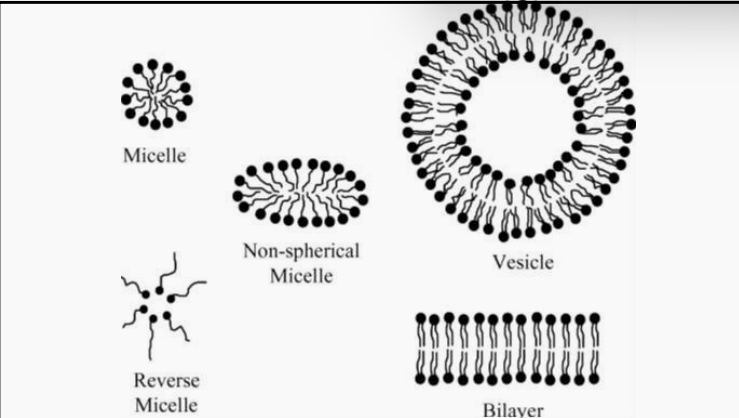
are formed by the association of dissolved molecules of a substance to create particles of colloidal dimensions.
includes micelles and the CMC Association, or amphiphile colloids
amphiphiles or surface-active agents
characterized by having surface-active agents are characterized by having two distinct regions of opposing solution affinities within the same molecule or ion.
amphiphiles, subcolloidal
when present in a liquid medium at low concentrations, the _____ exist separately and are of such a size as to be _____
increased, micelles
as a concentration is _____, aggregation occurs over a narrow concentration range.
these aggregates, which may contain 50 or more monomers, are called _____
association colloids
critical micelle concentration
the monomers interact so as to minimize contact between the lipophilic portion of the amphiphile and water, usually resulting in spherical shape.
the concentration of monomer at which micelles form is term the ______, or CMC.
aggregation number
the number of monomers that aggregate to form a micelle is known as the _____ of the micelle.
microemulsion
another example of association colloids is ____, which are dispersion of oil droplets in water.
difference form conventional emulsion is that the droplets of ____ (1) have a diameter of 10-100nm, the dispersions are transparent, and thermodynamically stable.
properties of colloids
Optical Properties
Faraday Tyndall Effect
Kinetic Properties
Brownian Motion, Diffusion, Osmotic pressure, Sedimentation, Viscosity, Electrokinetic phenomena
Electrostatic Properties
Nernst Potential, Zeta Potential
Faraday Tyndall Effect
when an intense converging beam of light is passed through a colloidal solution kept in dark, the path of the beam gets illuminated with a bluish light.
a solution, on the other hand, will appear clear even when a light is shown through it.
6 kinetic properties of colloids
Brownian motion
Diffusi
brownian motion
describes the random and irregular movement of colloidal particles caused by the momentum induced by being bombarded with molecules of the dispersion medium.
the erratic motion, which may be observed with particles as large as about 5um, was explained as resulting from the bombardment of the particles by the molecules of dispersion medium.
brownian motion
this type of particle movemenr depend on many factors: temperature, medium viscosity, and dispersed particle size.
decrease in temperature will decrease Brownian motion
increase in dispersed particle size and viscosity of the medium can also decrease Brownian motion
diffusion
particles diffuse spontaneously from a region of higher concentration to one lower concentration until the concentration of the system is uniform throughout.
this can be thermally induced.
osmosis
movement of solvent accross a semi-permeable membrane
but does not allow passage from the pure solvent. this can be thermally induced.