biochem - chymotrypsin
 Call Kai
 Learn
Learn Practice Test
 Spaced Repetition
 Match
Match Flashcards
 Knowt Play
1/13

There's no tags or description
Looks like no tags are added yet.
Name | Mastery | Learn | Test | Matching | Spaced | Call with Kai | Chat |
|---|
No analytics yet
Send a link to your students to track their progress
14 Terms
These proteins are important during __.
Chymotrypsin is secreted in the __.
digestion of dietary proteins.
anterior portion of the intestine.
There are several key factors that we will focus on in looking at the chymotrypsin reaction.
First, there is something called the catalytic triad, which is part of the enzyme active site and it explains how __.
There is a hydrophobic pocket that plays a central role in ?, there is an oxyanion hole that ?, and last, the protein forms an __.
this protein (a serine protease) activates a serine so that it can be an effective nucleophile.
the specificity of the protein.
stabilizes key intermediates.
important covalent intermediate with the substrate as part of its catalytic cycle.
Very early on it was found that chymotrypsin can catalyze the __ of p-nitro phenylacetate to give p-nitrophenol as a product.
You should recognize that product from our discussion of the ELISA assay. This material gives a bright yellow color that is very easy to measure using spectrophotometry. When we look at the data from this reaction with chymotrypsin we see __ distinct phases.
deacetylation.
two. In this data you see that there is what is referred to as a pre-steady state burst phase and a steady-state phase of the reaction.
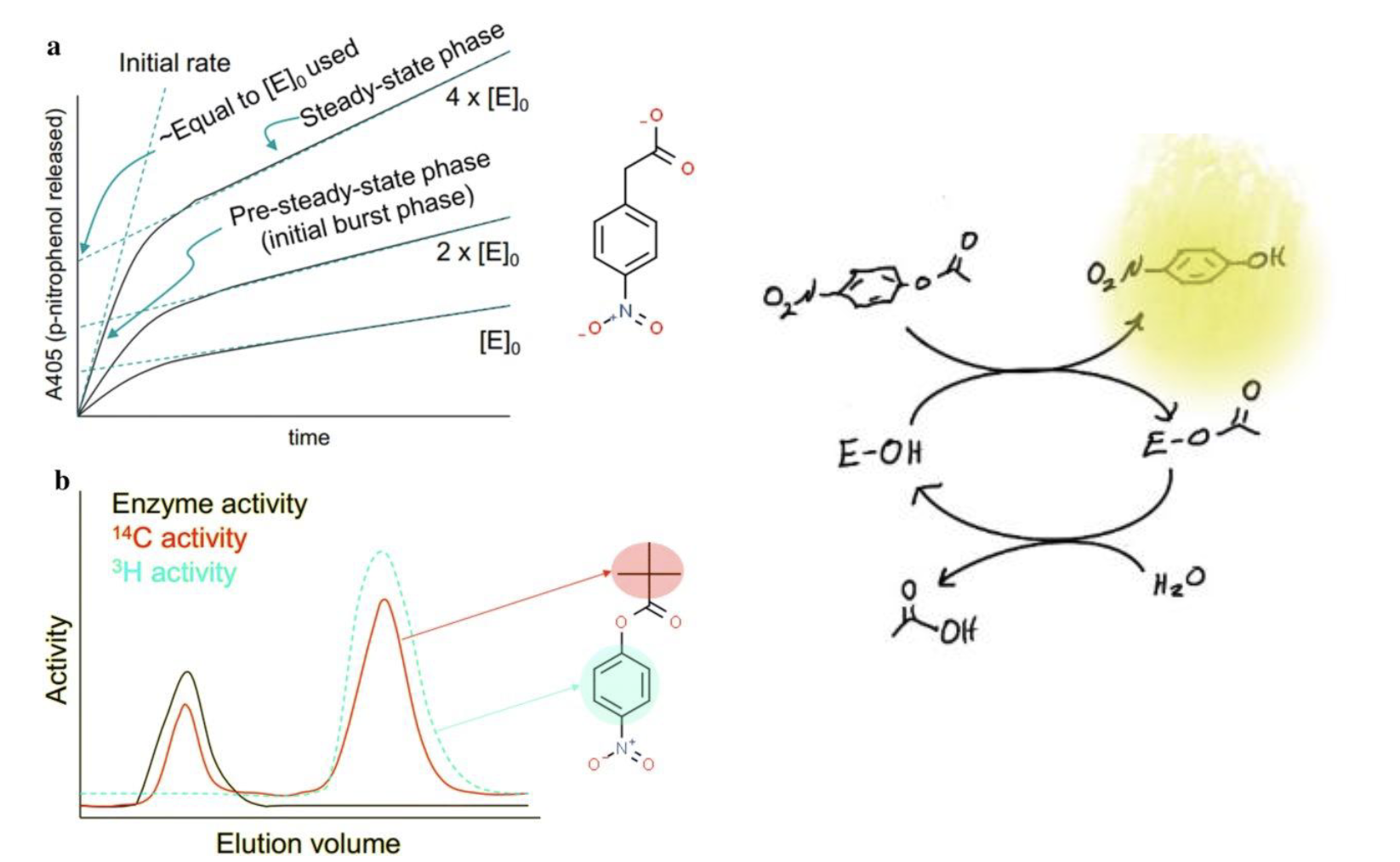
Also notice that the size of the pre-steady state burst is proportional to __. This indicates that there are two distinct phases in the reaction and it suggests that there is an initial fast step followed by a slow/fast step.
This is represented by the diagram to the left of the data. What we see here is that the first step is fast, and the steady state rate is dependent on the rate of the first/second step.
the amount of enzyme that is added.
slow.
second.
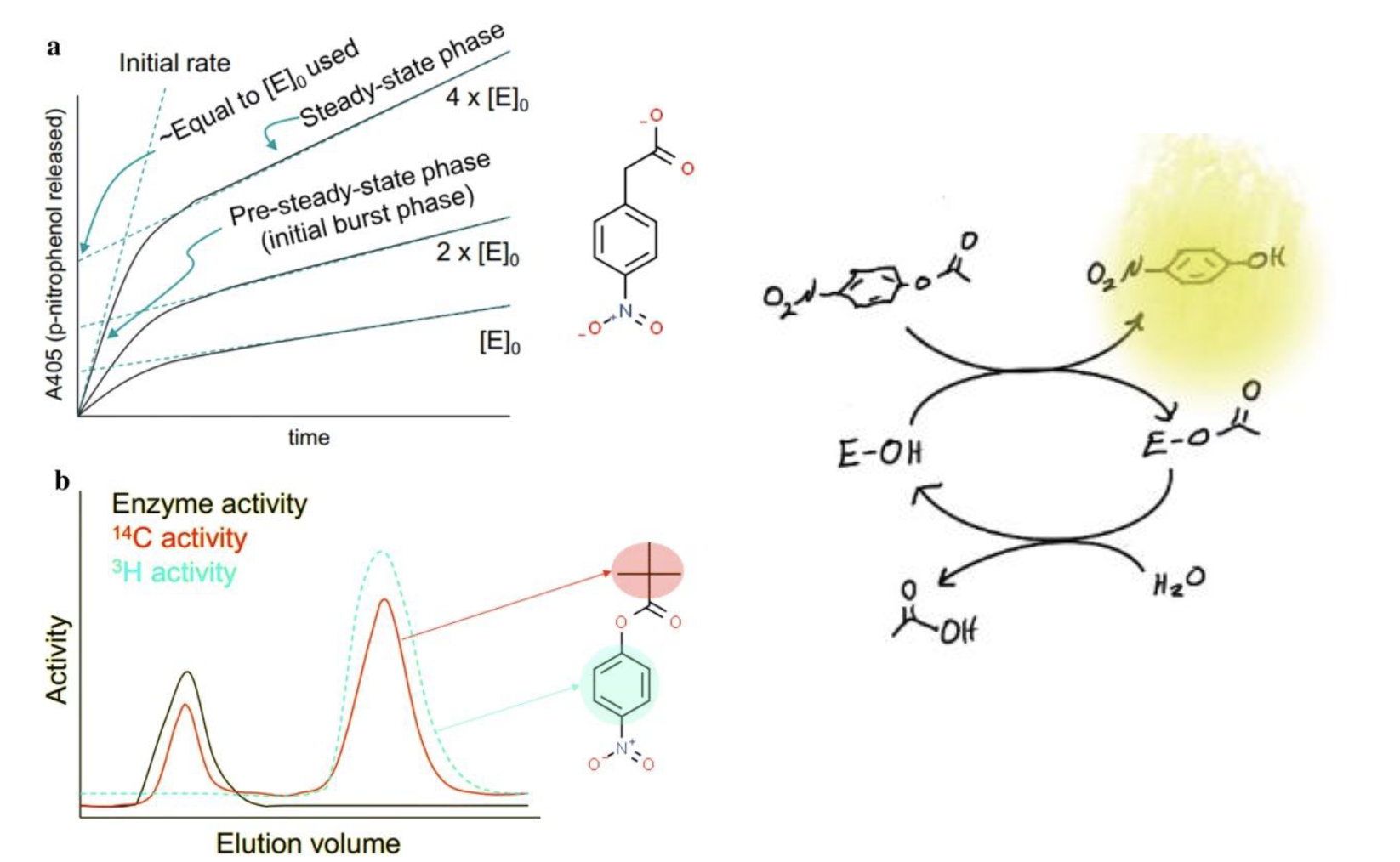
What we see here is that the first step is fast, and the steady state rate is dependent on the rate of the second step.
We only see this because we are measuring the p-NO2-phenol. If instead we measured the production of acetate this pre-steady state burst would be __ to us.
invisible.
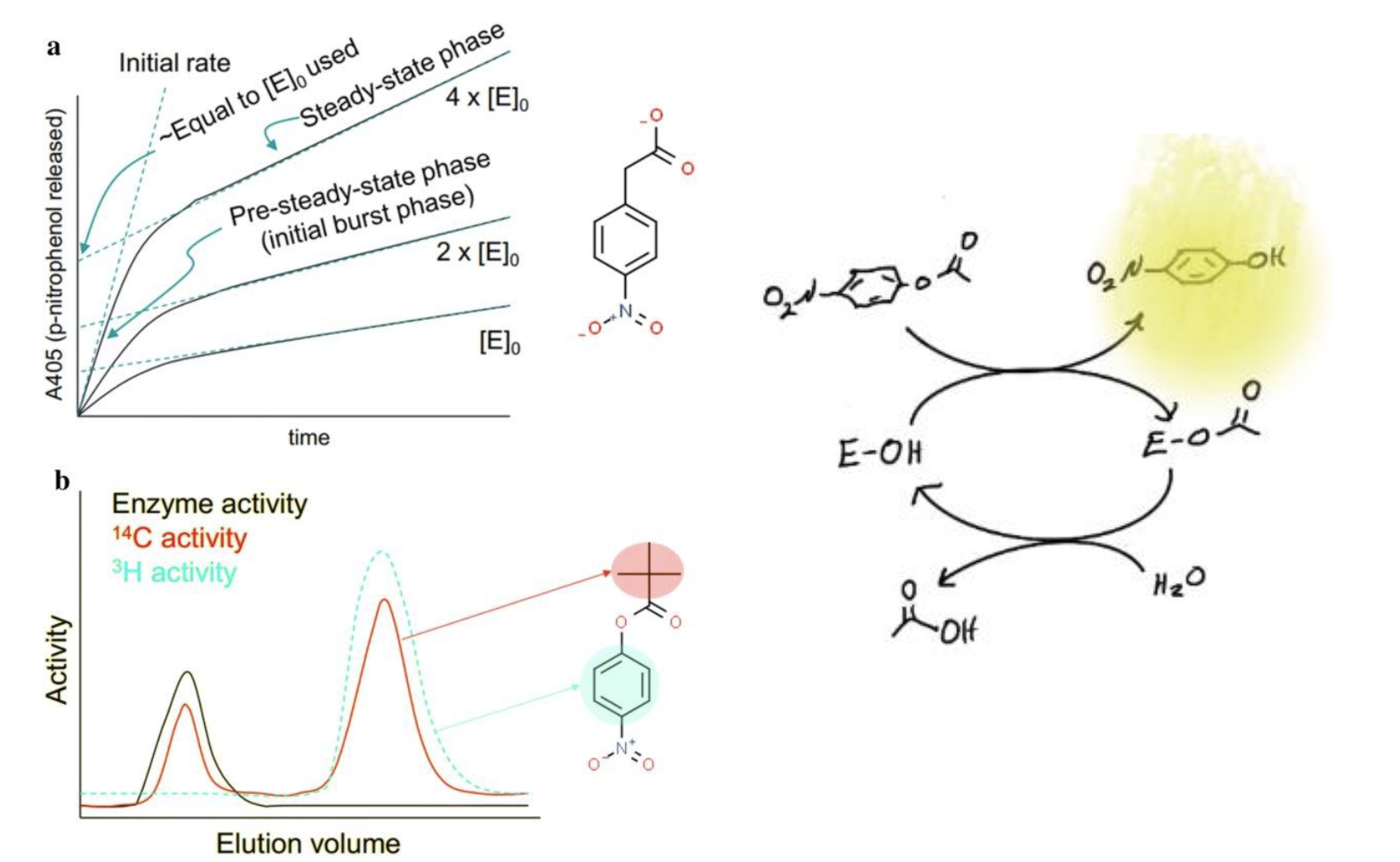
This data suggests that the enzyme is first converted to some other form (think ping-pong mechanism) then when all enzyme is in this new form, we start to see the __.
steady-state rate.
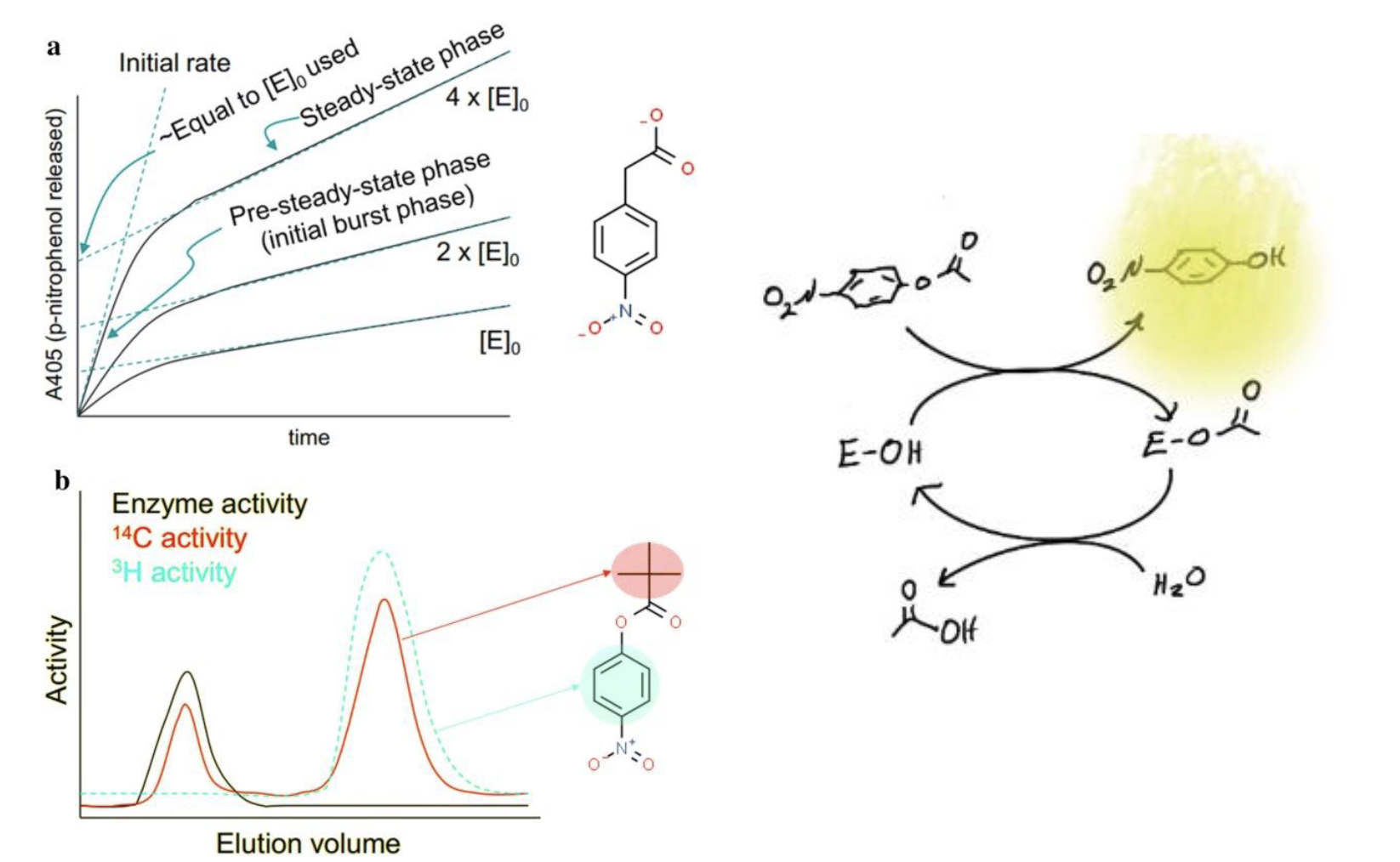
In the diagram below E-OH represents the __. This data was some of the first data suggesting that an ? was formed.
Researchers went further with this using a radiolabeled p-nitrophenyl acetate. A reaction was prepared and the intermediate form was trapped and the protein was analyzed by __. The ring was labeled with tritium (3H) and the acetyl group was labeled with 14C. What you see in the SEC is a large peak at the beginning where fractions were associated with ? and these same fractions had the 14C label.
Smaller molecular weight species came off the column later that were just associated with the 3H and 14C label with no __ activity. Together this data strongly suggested the existence of a covalent intermediate in the chymotrypsin reaction.
enzyme with the catalytic serine OH group.
enzyme intermediate.
SEC (Size Exclusion Chromatography).
chymostrypsin activity.
enzyme.
Chymotrypsin is a 25 kDa protein that is primarily made up of __ and it enhances peptide hydrolysis by a factor of at least 10^9.
beta sheets.
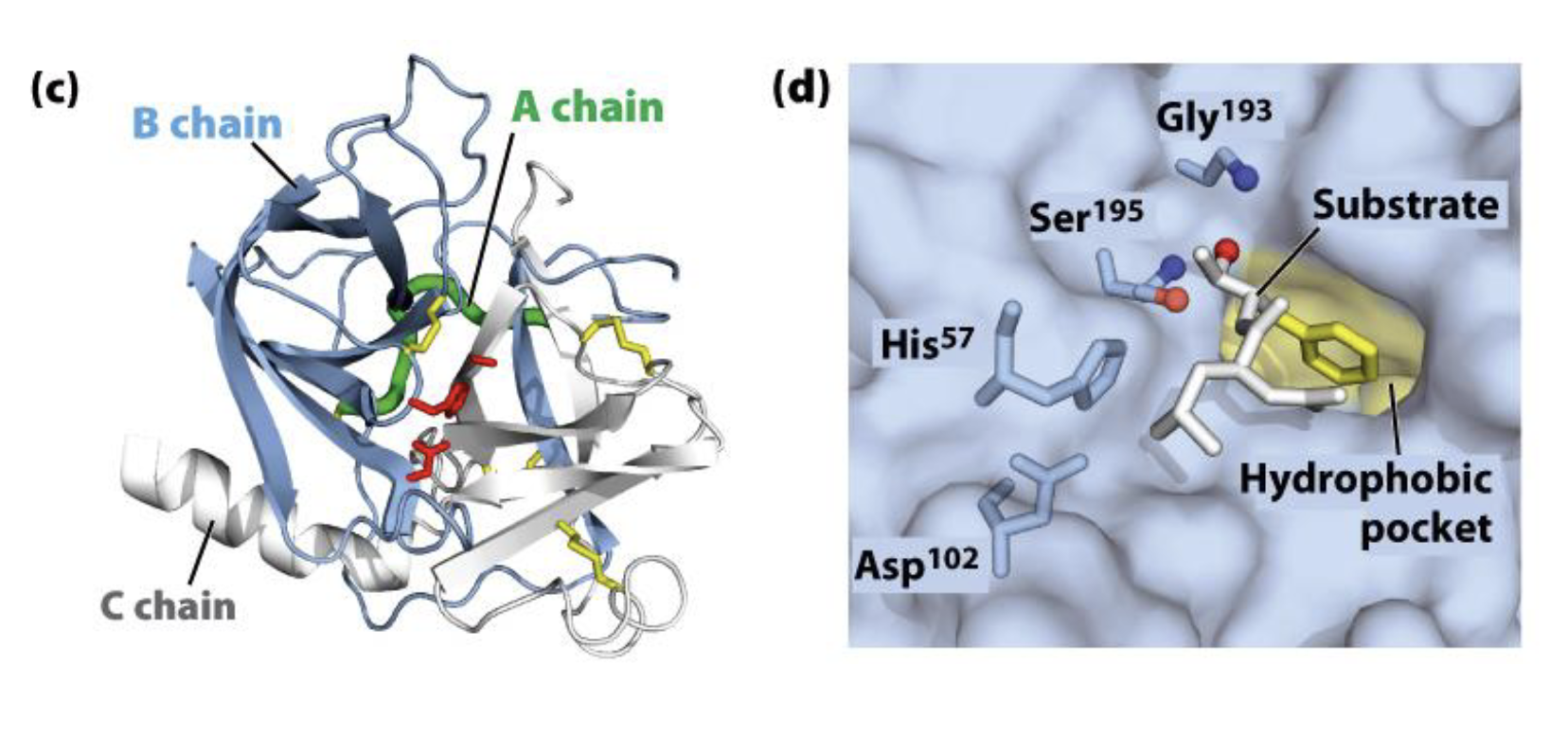
Chymotrypisin is initially synthesized from a __ as an inactive protein chymotrypsinogen that is then ? to activate the protein.
The inactive form is called a proenzyme and specifically for a protease it is called a __.
The A, B and C chains shown above represent different polypeptides that are the result of the proteolytic cleavage of the protein. In the active site on the right you see the catalytic triad made up of __.
single gene.
proteolytically cleaved by trypsin.
zymogen.
D-H-S amnio acids [D: Aspartate, H: Histidine, S: Serine].
The key to understanding the catalytic mechanism of an enzyme is to think about 1) how does it achieve the specificity that it has, 2) How does it stabilize transition states, and 3) what type of chemistry is used to promote the reaction. The first thing to consider is how it achieves its specificity.
Within the active site of the enzyme a small hydrophobic pocket is positioned near the catalytic serine residue. This hydrophobic pocket interacts directly with the __ amino acid that is targeted and positions the peptide bond to be cleaved in close proximity to the catalytic serine residue.
The interaction of the substrate protein with the enzyme is dependent on the same __ forces that we have talked about a million times in this class. The hydrophobic effect is heavily involved as well as pi-stacking type interactions with aromatic amino acids positioned around the active site.
If you mutated this hydrophobic pocket to aspartates and glutamates or lysines and arginines how do you think that might change the specificity of the enzyme? Once the target protein is in position the first reaction can take place.
aromatic.
weak.
If you mutate the hydrophobic residues to aspartate (D) or glutamate (E): Aromatic hydrophobic side chains would no longer fit favorably. But now the pocket might attract positively charged residues like Lysine (K) or Arginine (R).
If you mutate the pocket to lysines (K) or arginines (R): The pocket becomes hydrophilic and cationic. It might now attract negatively charged side chains such as Aspartate (D) or Glutamate (E).
This first step of the chymotrypsin reaction involves the catalytic triad made up of a D, H and S residue where the S residue is the key __ (and why the protein is considered a serine protease, it is not because it targets serine).
When a substrate binds to chymotrypsin a conformational change occurs compressing the space between D102 and H57. This compresses the hydrogen bond between these residues making it significantly stronger. This leads to an increase in the pKa of H up to greater than 12 making H a general base that is strong enough to remove the __ of the catalytic S residue S195.
The O of S195 can then attack the carbonyl of the target aromatic residue. Just below the binding site of the substrate protein there is a G residue. The amide backbone NH of this G residue and the catalytic S residue stabilizes the tetrahedral intermediate forming what is referred to as an __.
This stabilization is key to the transition state stabilization for this first part of the reaction and the tetrahedral intermediate formed is very __.
catalytic residue.
hydroxyl proton.
oxyanion hole.
short lived.
The negative charge on the tetrahedral intermediate collapses back down displacing the C-terminal end as a leaving group, which is protonated by the newly protonated H residue. This leaves the Ser linked intermediate where the enzyme is covalently bound to the N-terminal half of the protein through the carboxyl end of the aromatic amino acid.
This is what is being mimicked by the intermediate formed in the p-NO2-phenylacetate reaction where we have the acyl intermediate linked to the catalytic Ser. In the Ping-Pong nomenclature E was the free enzyme. A was the protein to be cleaved. The first product released would be the C-terminal half of the protein. F would be the acyl-enzyme intermediate formed.
The first half of the reaction has been completed at this point, and so now we need for the second __ to bind to the enzyme.
The second substrate in this case is __. The Ser residue linked to the peptide is slightly displaced leaving just enough room for a water molecule to bind to the active site of the protein (think about the hexokinase reaction with xylose vs glucose). The water orients in a similar way to how the OH of the Ser residue was initially oriented and this activates the water through the interaction with His which is associated with the Asp.
So, here the Asp---His interaction increases the pKa of His still and this leads to deprotonation of the water (exactly the same way that it did this with Ser in the first step). The O-attacks the carbonyl of the ester linked substrate peptide forming a new tetrahedral intermediate that is again stabilized by the oxyanion hole formed by the backbone N atoms of Gly and Ser. Like before the tetrahedral intermediate stabilized by the oxyanion hole is short-lived and the O- collapses back displacing the N-terminal half of the protein. This regenerates the __ of the enzyme and product dissociates.
substrate.
water.
active site.
This mechanism describes how simple acid/base chemistry is used to catalyze an enzymatic reaction.
Now consider the following: The HIV protease that is responsible for cleaving large proteins synthesized off a host ribosome into individual functional proteins is an aspartyl protease. Can you propose a potential mechanism for how that protease enzyme would work? The protease primarily targets the N-side of Pro when it follows a Phe or Tyr. This protease is of particular interest because once it was discovered, and the mechanism was determined, researchers recognized that it would follow a mechanism very similar to the mechanism of a __.
HIV protease was one of the first targets for structure-based drug design based on both knowledge of the reaction mechanism and the solved crystal structure.
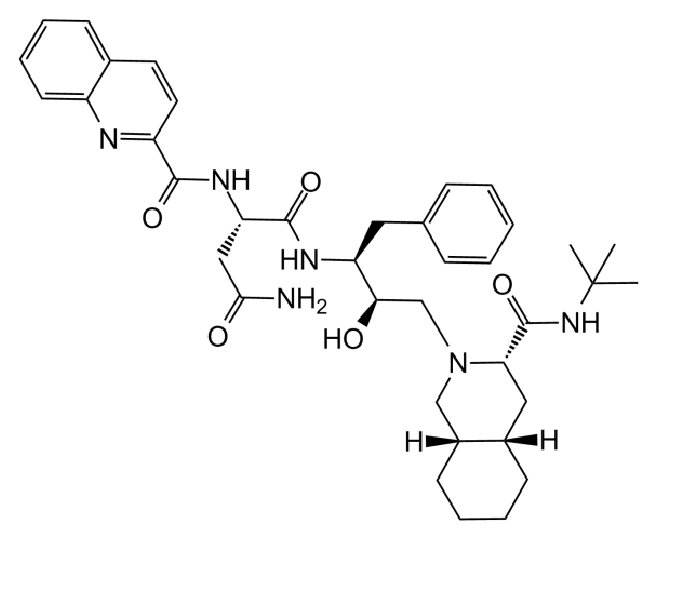
Saquinavir was one of the first HIV protease inhibitors approved by the FDA, and its structure is shown. This type of compound is often referred to as a __ and if you look closely you should notice why. You should see what appears to be an asparagine/phenylalanine like component in the middle. Interestingly, all of the FDA approved drugs targeting HIV protease have that phenylalanine-like component. Based on this knowledge what kind of reversible inhibitor do you suspect these drugs might be?
serine protease.
peptide mimic.