exam two
 Call Kai
 Learn
 Practice Test
 Spaced Repetition
 Match
 Flashcards
 Knowt Play
1/58

There's no tags or description
Looks like no tags are added yet.
59 Terms
seven steps of problem presentation method (PPM)
given, find, representation, model, assumptions, solution, validation
3 common examples of assumptions for PPM
frictionless / no drag / no air resistance
massless strings and wheels
modeling objects as particles
brainstorming
dynamic problem-solving process that builds upon spontaneous ideas generated by a group with the purpose of ideation (idea generation)
what are 4 sources of brainstorming
nature, prior art, random input, and the problem itself
what are 4 methods of brainstorming
plain brainstorming, random entry sheet, brainwriting, and ‘the worst method'‘
what are the 4 rules for quality brainstorming
focus on quantity, withhold criticism, welcome unusual ideas, combine and improve ideas
decision matrix (QFD: Quality Function Deployment)
tool to provide evaluation of completing needs, generative and unbiased, weighing importance factor based on performance data and normalizing functions (nice to have=5, good to have=10, must have=15)
normalizing function equation
(1-) (performance data value)/(upper bound on performance)
classic mechanics
describes how engineering systems behave at the human scale
particle model
set of assumptions that simplifies analysis of engineering systems in motion (point masses, forces, linear momentum)
kinematics (of a particle)
geometry/shape of motion in space under influence of forces
Newton’s first law of motion
law of inertia: if ΣF=0, then there is no change in motion of object (static equilibrium)
Newton’s second law of motion
law of force: if ΣF≠0, then ΣF=ma
Newton’s third law of motion
law of action+reaction: FA on B=-FA on B (equal but opposite)
what four components do free body diagrams (FBDs) contain
object chosen to analyze, all external forces acting on object (normal, friction, applied, etc.), any geometric info, set of coordinate axes
6 steps of solving force problems
1. Draw a picture
2. Construct a free body diagram for all bodies
3. Define axes on each FBD
4. Define knowns and unknowns
5. Set up sum of forces in x and y directions
6. Solve for unknowns; use kinematic equations to solve for position and velocity
spring/elastic forces
stretching/compressing of certain types of objects (usually metal)
direction and forces properties of spring forces
direction is always parallel to spring and opposite of change in length, forces tensile or compressive (depending on deform)
two equations of magnitude properties of spring forces (Δl and |Fspring|)
Δl = |current length - L0|
aka change in length = |current length - unstretched length|
|Fspring| = k * Δl (Hooke’s law)
aka magnitude of spring force = spring constant (elastic stiffness) * change in length
friction forces
forces that arise due to contact between rough surfaces (static vs. kinetic)
static friction equation
|f|=|F|=μs|N| because the block is in static equilibrium (f and F have opposite directions)
kinetic/sliding friction equation
|f|=μk|F| (direction of f is opposite that of motion, |f| is constant but <|F|)
static/kinetic friction coefficient
constant value in which μs>μk
êr
time-dependent unit vector that points in radially outward direction from origin (in polar coordinates, points at particle)
êθ
time-dependent unit vector that points perpendicular to êr in direction of increasing angle
r(t) equation in polar coordinates
r(t) êr(t) + z(t) k̂
v(t) equation in polar coordinates
ṙ(t) êr(t) + r(t)ɵ̇(t) êθ(t) + ż(t) k̂
a(t) equation in polar coordinates
{r ̈(t)-r(t)ɵ̇2} êr(t) + {r(t)Ɵ̈(t)+2ṙ(t)ɵ̇(t)} êθ(t) + z ̈(t) k̂
centripetal acceleration
-r(t)ɵ̇2
Euler acceleration
r(t)Ɵ̈(t)
Coriolis acceleration
2ṙ(t)ɵ̇(t)
extensive properties (4 examples)
scalar physical properties for which individual property values can be added together to get a total property value (ex: mass, volume, energy, electric charge)
3 examples of physical quantities that are not extensive
temperature, density, color
universal accounting equation
final amount - initial amount = input - output + generation - consumption (tracks changes in extensive quantities within a system with a defined boundary)
final amount
amount of quantity in system at the end of the time period
initial amount
amount of quantity in system at the end of the time period
input
amount of quantity passing through the boundary into the system during time period
output
amount of quantity passing through the boundary out of the system during time period
generation
amount of quantity produced during the time period within the system boundary
consumption
amount of quantity lost during the time period within the system boundary
3 major considerations when using the universal accounting equation
known boundary, start and end time, accounting on extensive properties
state quantity
physical property with change in start to end (displacement)
path quantity
physical property with change in start to end AND process details (distance)
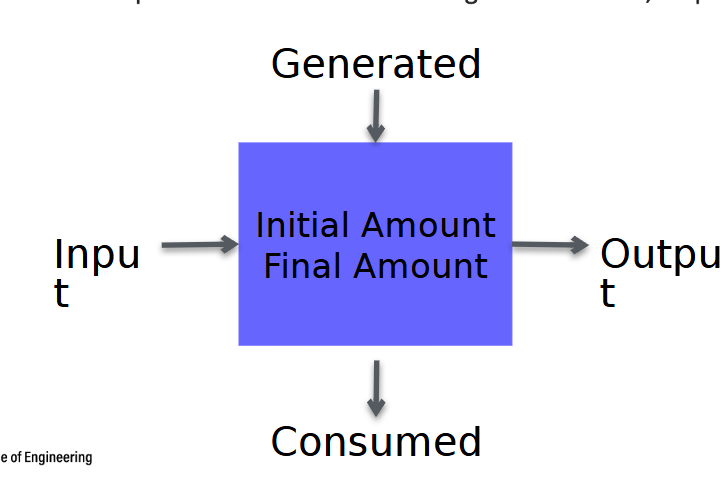
universal accounting equation system representation diagram
initial and final inside box, generated in from top, consumed out from bottom, input in from left, output out from left
work
applying a force to a particle in a way that causes the particle to move through some distance, only the portion of the force parallel to the motion can do work
energy
what a system has if it has the ability to do work on a particle
what is work done by a net force equal to
change in kinetic energy
work equation with constant force F causing displacement d (work energy theorem)
W = F ⋅ d = |F| * |d| * cosθ, d = Δr = rfinal - rinitial
work equation with nonconstant force F causing particle to move
W = (from rfinal to rinitial) ∫(F ⋅ d*r)
conservative force characteristics
path-independent state quantity, only the initial and final states matter (ex: gravity force, elastic/spring force, electric force)
conservative force equation
WC=PEinitial-PEfinal
non-conservative force characteristics
path quantity, distance travelled relates to the amount of work (ex: friction force, tension force, push/pull)
non-conservative force (general) equation
WNC=∑Efinal-∑Einitial
potential energy equation for gravity work
Wgrav=mgH
potential energy equation for spring work
Wspring=(1/2)kx2
kinetic energy equation for work
W = F ⋅ Δx = (1/2)m|v|2
what is the simplified equation for work done by friction force
−μmg(*1 or *cosθ or *sinθ)*Δx
if friction work is done on the system, is the force an input or output
input
if friction work is done by the system, is the force an input or output
output