Psych 240 Exam 1
 Call Kai
 Learn
 Practice Test
 Spaced Repetition
 Match
 Flashcards
 Knowt Play
1/147

There's no tags or description
Looks like no tags are added yet.
148 Terms
Common misconception about study strategies
better performance = more learning
maximizing learning
training methods that’re most effective for long-term learning tend to introduce difficulties that make short-term performance worse
Simon Bjork Experiment
Evaluating strategies: criteria
does the technique work in a variety of environments?
does the technique work for a variety of different students?
does the technique work for different types of material?
is the technique effective regardless of how learning is tested?
highlighting
may cause us to focus on osilated facts and ignore bigger connections
students may struggle to distinguish central ideas from peripheral information
fowler & baker: highlighting didn’t help → when all 3 groups were tested on material a week later, they all performed about the same
peterson: on questions that covered basic factual material, all 3 groups performed the same; on questions that required students to draw inferences, students who underlined did worse
rereading
doesn’t improve comprehension or performance on inference-based questions
rereading a 2nd or 3rd time doesn’t help
can give students the mistaken impression that they’ve mastered the material
rothkopf: more exposure to readings led to more correct responses for shorter worded passages and less correct responses for larger worded
geenrating explanations
coming up with explanations for why concepts are true, or how they relate to what you already know
Presley et al: the group who generated their own explanations performed about twice as well as the other groups
interleaved practice
mix up problems and jump back and forth from one topic to another
Rohrer & Taylor: blocked practice had better performance for practice but interleaved practice had better performance for test
distributed practice
spreading out your study over time with breaks
bahrick: 30 day between sessions group had best test results and then 1 day between sessions group and then 0 days between sessions
testing yourself
one of the single most effective ways to learn
butler: practice test group had better final test performance than restudy group
utility of study strategies
highlighing → low
rereading → low
generating questions → moderate
interleaving practice → moderate
distributed practice → high
testing → high
What is Cognitive Psychology?
scientific study of human mind
study of structures and processes of mind and brain that take in, transform, and use information
processes required
perceive letters
recognize words
comprehend english setence
access knowledge of objects
decide truth or falsify
remember true-left, false-right
decide which chand to raise
use movement processes to move hand
The problem
mind is unobservable
stimulus → “black box” → response
some solutions: inrtospectionism, behaviorism, cognitivism
introspectionism
just look inside and see what is going on…
Wundt
Titchener
problems with introspection
difficult to verify
private events, not public
end product, not the process itself
Behaviorism
psychology is science of behavior
emphasis on what can be directly observed: stimuli; responses; reinforcements/rewards; rats in mazes
stimulus → no black box → response
ignore the mind(unobservable)
pavlov
Watson
BF Skinner
Problems with behaviorism
can’t account for diversity of human behavior ex: language
limiting science to observable is a bad idea
cognitive approach
infer what’s going on inside the box
stimulus → brain in box → response
dependent variable
what you measure/analyze
reaction time
accuracy
barin activity
independent variable
what you manipulate
number of items to be memorized
amount of alcohol ingested
passage of time
Mental chronometry
invented by Donders
study of the time course of mental processes
Recognition test
higher study time had greater percentage of correct responses at 10mins, day 1 and day 10 compared to lower study time
reaction time methods
assume mind is info processing computer
lots going inside balck box
reaction time methods are a powerful approach
nformation processing stages
stimulus → processing → still more processing → response
each stage
receives information from the previous stage
transforms information
sends information to the next stage
detection task
press button when you see red or green light
s → detection → r
choice task
press left button for red light; right button for green light
s → detection → decision → r
subtractive method
s → detection → decision → choice RT. 285 ms
s → detection → detection RT 197 ms
duration of decision stage = 88 ms
subtractive method: problems
assume of pure insertion: all stages remain the same when the new one is added
problem: adding decision stage may influence another stage (like detection)
assumption of additivity: duration of all stages add together to yield the reaction time
problem: stages might operate in parallel
assumes you already know what the stages are
you probably don’t
why is donders 1868 work important today?
similar assumptions in modern research
similar criticisms can apply
donders’ contributions
the idea that you can measure mental processes
the choice reaction time procedurem
modern cognitive psychology
confirming evidence is weak
key methodological technique: eliminating alternative explanations
Hubbert and piercy experiments
Perception
means by which info acquired from environment via sense organs is transformed into experiences of objects, events, sounds, tastes
stages in perception
distal stimulus → proximal stimulus → perception
lack of correspondence
when perception does not correspond to distal stimulus
ex: perceptual (optical) illusions
paradoxical correspondence
when proximal stimulus does not correspond to distal stimulus but perception does
ex: moving objects, moving eyes
perceptual constancy
our perception of an object’s features remains constant even when viewpoint (and proximal stimulus) changes
perception of size doesn’t change with distance
perception of color doesn’t change with light
perception of shape doesn’t change with angle
theorretical approaches
direct perception (stimulus theory)
constructivist theory
direct perception
enviornment provides all necessary cues
our brains are pre-wired to pick up cues
stimulus information is almost always unambiguous
biological motion
there’s a lot of information in the stimulus itself
constructivism
perception uses data from world and our prior knowledge and expectations
sensory information is often ambiguous
must rely on knowledge/expectations
bottom-up vs top-down
bottom up processing: processing that’s driven by external stimulus, rather than internal knowledge
direct perception claims perception is purely bottom-up
top-down processing: processing that is driven by knowledge and expectations
constructivism: bottom-up and top down processes
depth perception
distal stimulus (the world) is 3D
proximal stimulus (on retina) is 2D
perceptual experience is 3D
example of paradoxical correspondence
how? → exploit environmental cues to recover depth
depth cues
linear perspective
shape
relative size
interposition
shadows
retinal disparity
accomodation
convergence
distal stimulus
light emitted from light source
some frequencies of light are absorbed by a distal stimulus
other frequencies of light are reflected
some of thsi light reaches your eyes
the eye
pupil: black dot
iris: colored part
sclera: white of eye


rods and cones
photo receptors
photo-chemical reaction takes place inside these cells when exposed to light
rods detect brightness
conesa re concentrated in fovea
most people have 3 types of cones: blue, green, red

potential
difference in charge inside vs. outside axon

threshold
potential must get above a threshold level for neuron to fire
firing = generating an action potential
all or none
action potential always has same strength; either you get all of it (if above threshold) or none of it
propagation
once past threshold, active process (ion pumping) propagates action potential down axonl
refractory period
short period after firing before neuron can fire again
neural transmission
Summation: if combined effects at all synapsesbtake potential across axon above threshold, then neuron will fire an action potential
when 1 neuron fires it can cause neighboring cells to fire (or it can prevent them from doing so)
so signal can move from one cell to another to another
communicate by sending chemical (neurotransmitters) across very small gaps between calls (synapses)
triggered by action potential when it reaches axon’s end
so neural transmission is electrochemical
involves an electrical action potential within cells
involves a chemical neurotransmitter between cells
when neurotransmitter is released into synapse, it binds to receptorson target neuron
causes chain of events that eventually change potential across axon of taregt cell
some neurotransmitters are excitatory
others are inhibitory
same thing is happening at thousands of other synapses on target cell
mapping receptive field
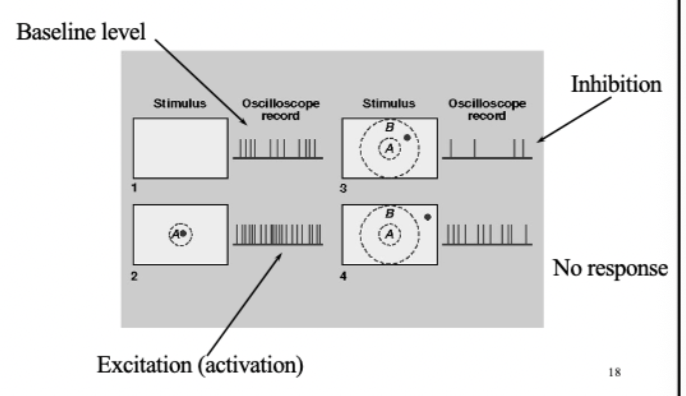
center-surround organization
on center/off surround
off center/on surround
Functions:
point detection
edge detection
light on dark or dark on light

Magno
transient response
large receptive field
movement/location
Parvo
sustained response
small receptive field
patterns/color/form
cerebral cortex

visual cortex
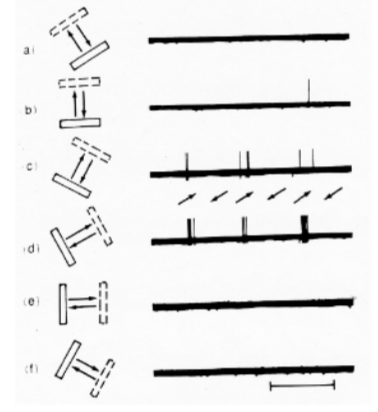
simple cortical cells
complex cortical cells
hypercomplex cells
very specific chapes
corners
gaps
simple cell
bar of light
specific orientation
specific retinal portion

complex cell
edges
movement
edge detection
edges in images correspond to edges of real-life objects
offer depth cues
allow parts of 3D objects to be identified

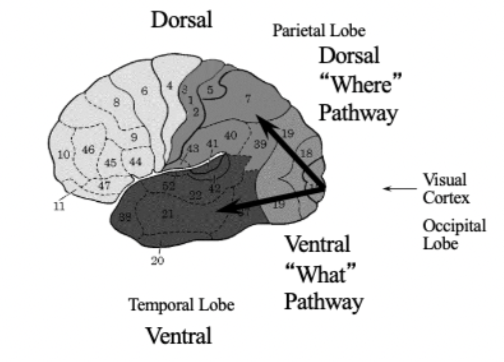
two visual pathways
dorsal “where” pathway
ventral “what” pathway
Positron emission tomography
mental activity → neural activity → blood flow → more radioactive tracer → more positron emitted
PET Study: spatial vs. object processing
spatial (where) task should activate occipital and parietal regions
object (what) task should activate occipital and temporal regions
PET results: kohler et al. study

population coding
need pattern of activation across a population of cells to recognize objects
pattern recognition theories
template theories
feauture theories
structural description theories
template theory
cubes
problem: transformations, obstructed objects
visual system feature decomposition
Visual system decomposes scenes into primitive features
cells in temporal lobe aren’t “tuned” to specific stimuli (no grandmother cell)
feature theory
perceptual representation: 3 horizontal lines, 1 vertical line, 4 right angles
memory representation: 3 horizontal lines, 1 vertical line, 4 right angles OR 2 horizontal lines, 1 vertical line, 3 right angles
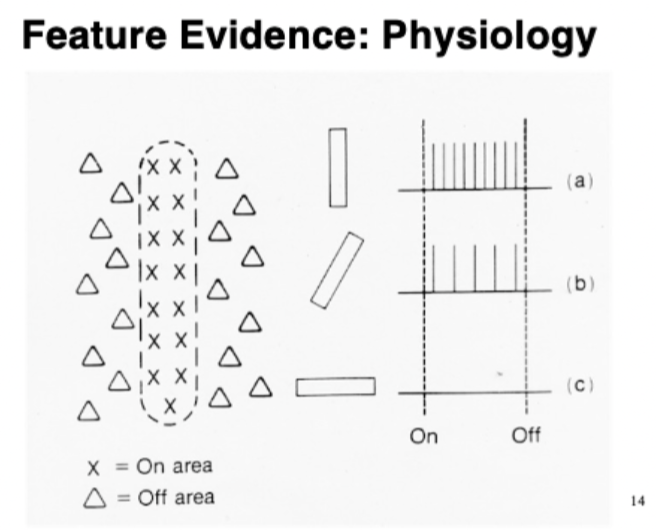
evidence for feautures
physiology (recordings from neurons)
stabilized retinal images
visual search
pandemonium model

feature theory: problems
realtionship between features → 1 line 1 half cirlce = P d b
different arrangemnts of same features produce different objects
recognition by components
36 geons (geometric ions)

non-accidental properties

RBC: matching process
detect elementary features, edges
find non-accidental properties
determine component geons
match to memory
RBC: evidence
partial or degraded objects
object complexity
unusual orientations
deleting accidental vs non accidental

RBC: problems
similar objects
brain evidence?
context effects
but RBC is good at:
transformations
relationships between features
explaining how we make sense of nonsense objects
Top Down vs Bottom Up Processing
top = refers to areas of brain responsible for higher-level cognition. ex: gaol setting; decision-making
bottom = refers to lower-level areas of brain that receive input from sensation. ex: vision, audition
top-down processing: processing that originates in higher cognition and proceeds downwards towards sensation
bottom-up processing: processing that originates in sensory areas and proceeds upwards towards areas responsible for higher cognition
top dwon processing: 3 types
expectation/bias
context
higher levels of analysis that affect lower ones
expectation/bias
your own expectation or biases can affect the way you perceive something
signal detection
frequently encountered task
in general:detecting some “signal” in prescene of noise/distractions
signal detection theory (SDT)
addreses how we make these detection decisions
demonstrates how expectations/biases (top-down influences) effect perception
signal
something in the environemnt you are trying to detect
noise
things in environemnt other than he signal
sensitivity
how easy/difficult it is to discriminate signal from noise
depends on how separable are signal and noise
depends on how good your detetor is (vision, hearing, sense of touch)
bias
bias/tendency to say yes vs no (no vs yes). detrmined by expectations or payoffs
it moves your responses between the yes and no rows of matrix
accuracy
% hits + % Correct rejections
Depends on:
proportion of trials with signal present/not present
bias
sensitivity
signal detection matrix
hit: there’s a signal and you correctly detect it (yes and present)
miss: there’s a signal but you fail to detect it (no and present)
correct rejection: there’s no signal and you correctly say there was no signal (no and not present)
false alarm: there’s no signal but you say that there was a signal (yes and not present)
signal detection
example of how biases/expectations affect perception
context effects
when perception of an object is affected by its context/environment
examples
subjective contours
letter recognition
Subjective contours
we perceive triangles even though they’re nopt there
ambigupous letters
what you percieve depnds on context (B vs 13)