BB Exam 4
 Call Kai
 Learn
 Practice Test
 Spaced Repetition
 Match
 Flashcards
 Knowt Play
1/81

There's no tags or description
Looks like no tags are added yet.
82 Terms
Prenatal testing
ABO and RH
Antibody screening
Parental positive antibody screen
Perform antibody ID
Titer it, see how much
Parental antibody titer
Significant if >16 tubes
Anti-K is significant if >8 tubes
Titering is repeated every 4 weeks
Rhogam dosing
DOSE at 28 weeks
DOSE if abortion, miscarriage, trauma
DOSE within 72 hours of delivery if baby is D pos, weak D or UNK
Rhogam administration
1 dose address 30ml of whole blood bleed
DO NOT give more than 5 doses per 72 hours
Clears within 6 months
Indistinguishable between endogenous and exogenous
Monitoring of fetus - Ultra sound
Ultra sound - low risk
Checking for hydrops
Monitoring of fetus - Amniocentesis
Amniocentesis - invasive, risk of miscarriage
Phenotype baby
Measuring amniotic fluid at 450nm
Monitoring of fetus - cordocentesis
Cordocentesis - invasive, risk of miscarriage
Measuring hemoglobin in cord blood
Intrauterine transfusion
transfusion reaction between baby and mom
Positive if
cordocentesis hemoglobin is >10g/dL
Hydrops noted
IUT transfusion product requirements
Leukoreduced
Fresh
O neg
Antigen compatible with parent
Hgb S negative
Washed
Post natal fetal testing (when do we test baby)
Parent is O
Parent is RH negative
Parent has history of antibodies is positive
Type and screen not done
Baby <1kg
* No reverse testing as baby has not antibodies until 4 months
Baby samples
Cord blood (can be contaminated with parent or Wharton’s jelly)
DAT on babies
IgG is the only concern
Done through elution to removal mother’s ABs on bay RBCs
Rosette testing
Detection of Rh positive baby cells in mothers Rh negative body
Will detect >10ml of fetal blood
Add chemically modified anti-D to create the rosette
Kleihauer Betke testing
Quantifies how much fetal blood has entered mother’s bloodstream
Wash and stain with acid
Baby cells will look pink
Not precise
Calculating RHOGAM dosage
(# fetal cells / # of parent cells) * 100 * 50= bleed volume
(bleed volume/30) + 1 = vials Rhogam
Baby conditions to look out for
Kenictidis (bilirubin in brain): >25mg/dL
Treat via bilirubin light
Only remove at 0.5-2mg/dL
Information needed for blood donation
Name, previous names
Govn. ID
Address
DOB
Way to contact
Pre-screening rationale screening
Make sure patient isn’t sick
Ensure patient understands they can opt out
Ensure they know no compensation
Ensure they may be susceptible to HIV, Hep C. or death
Donor evaluation requirements
Hemoglobin
Males 13g/dL
Females 12.5g/dL
Height
Weight
Temperature <37.5
Last time collected
8 weeks since whole blood donated
16 weeks since DOUBLE RBC
Blood pressure and pulse
Systolic 90-180mmHg, Diastolic 50-100mmHg
Pusle 50-100BPM
Donor site (vein)
No sign of IV drug use, lesion or infection
Age (over 18, over 16 if parents OK)
hemoglobin tests
Copper sulfate - Low cost, not sensitive (pass/fail)
Occlusion spectroscopy - less light absorbed = more hemoglobin)
Finger stick test
Universal donor history questionnaire MUST BE:
SIMPLE and specific
Universal donor history questionnaire DEFERRALS:
Aspirin? - RBCs but not PLTs
Tegison or etretinate? NO
Soriatane or acitretin? NO
HIV medication? NO
Measles, mumps, typhoid, yellow fever, hepititis B within 2 weeks? NO
MMR, Chicken pox, Shingles within 4 weeks? NO
Flu and COVID? no deferral
Confidential unit exclusion procedure
After donation, donors can say whether they have anything that would disqualify them from donation
Helps for pressured donations
Donation process
Assign DIN
Inspect site, clean with iodine and alcohol
Use large gauge needle (16-18) to ensure blood flows
Draw for 10 minutes
Gather 450-500mL
Discard if the system is leaking
Whole blood additives
CPD - 21 days
CP2D - 21 days
ACD - 21 das
CPDA-I - 35 days
RBC additives
AS-1
AS-3
AS-5
All 42 days
Apheresis donation
Used to collect RBC, plasma, platelets separately
Products separated can also be returned
Apheresis reactions
Citrate toxicity
Hypocalcemia
Paresthesia in lips
Arterial punctures
Missing a vein and going straight to an artery
Bright red blood
Pulsing needle
Bag fills fast
Discard
Autologous donations
Blood donated for the donator
For patients with rare blood type or antigen combinations
logistical challenge though
Directed donations
Donations intended for one person
Helpful in use cases like Bombay to Bombay or Mur to Mur
Logistical challenge

Donation label #1
Donor ID
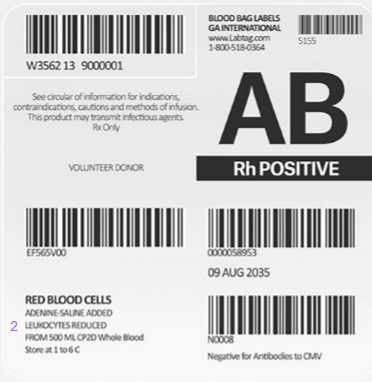
Donation label #2
Unit type
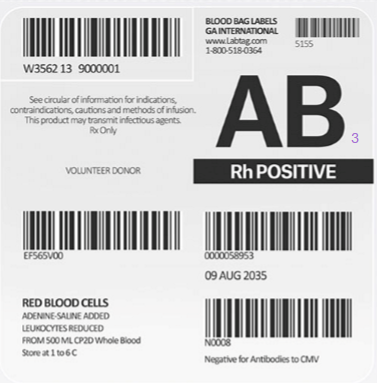
Donation label #3
ABO and Rh type

Donation label #4
Expiration date

Donation label #5
Other test results
After draw procedure
Instructions on how to contact if reaction OR if they require deferral
Monitor for 15 minutes, info kept at blood bank
First tests ran on donated blood
Patient history analysis
ABO typing
Antigen testing
Serological testing
Looking for antigens or antibodies
NAT testing
Looking for DNA and RNA
Uses mini pools of 6-16 donors for max efficiency
Syphilis
Looking for anti-T pallidum
Deferred for 3 months WITH proof of medication
Hepatitis B
Liver infection, typically cleared
Testing for Hep B antigens, HBV DNA, anti-HepB
Deferred if positive
Hepatitis C
Most infections are asymptomatic
Testing for Hep C antibodies, HCV RNA
Deferred if positive
HIV
Infection of T cells leading to aids
Testing for HIV RNA, anti-HIV, HIV antigens
Deferred if positive
HTLV
Infection of lymphocytes
Tests for anti-HTLV
Deferred if positive
Cytomegalovirus
Only a concern in immunocompromised patient
Tests for anti-CMV
Not deferred if positive
West nile virus
Mainly asymptomatic cases
Tests for WNV Rna
Deferred if positive
Zika
Most cases are asymptomatic, issue in pregnancy
Testing no longer required
Bacteria
Concern in platelets
Requires blood culture (slow)
Deferred if actively infected
Babesia
Tick bite parasite
14/50 states required to test
Deferred if positive for 2 years
Pathogen reduction
Removal of pathogens from blood products via chemicals and UV light
Sickle cell
Sickle cell disease cannot donate
Sickle cell trait can
Whole blood expiration
CPD, CP2D = 21 days
CPDA1 = 35 days
Additive preservatives = 42 days
Cryopreservation = 10 years
Volume reduction = 24 hours
Washing = 24 hours
Processing donation
Soft spin; separate plasma from RBC, remove RBC
Hard spin; separate plasma from PLTS, remove plasma
Let rest for 2 hours and re suspend with 40-50mls of plasma
Red cells storage
Stored at 1-6C
Transport temp is 1-10C
Platelets pooling
6 units from different donor becomes one dose
Apheresis has 1 unit = 1 dose
Plasma flash frozen
Frozen in 8 hours
Must be transfused within 24 hours
If not, it becomes thawed plasma
Higher factor 5 and 8
Plasma frozen within 24 hours
Plasma frozen within 24 hours
lower factor 5 and 8
Liquid plasma
Plasma never frozen, only refrigerated
Goes bad when whole blood goes bad + 5 days
Cryoprecipitated plasma
Used in traumatic labor and hemophiliacs
Frozen at -18
Cold insoluble proteins are collected, makes it high in clotting factors
Good for 6 hours after thawing
Cryopoor plasma
Plasma left over after cyroprecipitation
Same storage and expiry as plasma
Granulocytes
Retrieved through apheresis and hydroxy starch
Helps fight severe bacterial infections
Donor prepped with GCSF
Product must be ABO typed and recipient must be cross matched
PRBC expiration
Additive preservatives = 42 days
PLTs expiration
Whole blood = 5 days
Washed = 4 hours
Volume reduced = 4 hours
PLT frozen and thawed
Fresh froze - 8 hours
Thawed - 5 days
Frozen and thawed
Cryoprecipitate - 6 hours
Granulocytes
Granulocytes - 24 hours
Leukoreduction process
Pulls out >99% white cells from product
Reduces chance of fever and spread of mono
Does not impact expiry date
Irradiation
Destroys nucleus to prevent graft Vs. host disease
Exposure to radioactive material or X rays
Reduces expiry date to 28 days (or original date if its sooner)
Volume reduction
Excess plasma and additives removed
Used to manage TACO risk
RBCs reduced to 24 hour expiry, PLTs reduced to 4 hours expiry
Red cell platelet washing
Removing cellular elements to reduce allergic reaction
Washed RBCs good for 24 hours
Washed PLTs good for 4 hour
Cryopreservation and thawing
RBCs frozen with glycerol at -65C
Can be stored for 10 years
Thawing requires step removal via washing
RBCs regulatory requirements if LEUKOREDUCED
95% of units must have <5x10^6 leukocytes
RBCs regulatory requirements if APHERESIS-ed
mean collection of >60g of Hgb per unit
PLT regulatory requirements if WHOLE BLOOD
>90% units sampled must have >5.5*10^10 platelets and >6.2 pH
PLT regulatory requirments if POOLED
<5.0*10^6 leukocytes
PLT regulatory requirments if LEUKOREDUCED
<5.0*10^6 leukocytes
PLT regulatory requirements if CYROPRECIPITATE
>150mg fibrinogen and minimum of 80IU of factor 8 per unit
Plasma storage
Frozen at -18
PLTs storage
Cooled at 1-6