4.2 ENERGY, POWER AND RESISTANCE - Chapter 9 (Physics OCR A-Level)
 Call Kai
 Learn
 Practice Test
 Spaced Repetition
 Match
 Flashcards
 Knowt Play
1/56

There's no tags or description
Looks like no tags are added yet.
57 Terms
Circuit symbol for cell
.

Circuit symbol for battery
reminder: a battery is 2+ cells connected together

Circuit symbol for diode
.

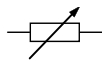
Circuit symbol for a variable resistor
.
Circuit symbol for a fuse
.

Circuit symbol for a thermistor
.

Circuit symbol for an LDR
.

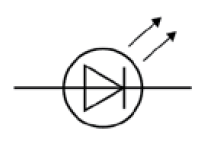
Circuit symbol for an LED
.
Circuit symbol for a capacitor
.

What is the definition equation for p.d.?
V = W/Q
pd = energy transferred / charge
How can you work out the amount of energy gained by the electron?
rearrange V = W/Q to W= Q x V
where Q (charge) of an electron is always 1.6 x 10⁻¹⁹J
What is the definition of one volt?
one volt is the p.d. across a component when 1J of energy is transferred per unit charge (C) passing through a component
(1V = 1JC⁻¹, because units are V = J/C)
How to ensure no current is flowing into the parallel part of a circuit?
make resistance of voltmeter extremely large
What would an IDEAL voltmeter be like?
INFINITE resistance to ensure NO current passes through
- because voltmeters are connected in parallel + you want to ensure no current is flowing into the parallel part
What is electromotive force (emf)?
- in volts (V)
- happens when energy is supplied by cell
- charge carriers GAIN this energy (work is done on the charge carriers)
How energy transfer works for emf + example
- energy transferred FROM other forms TO electrical PER UNIT CHARGE
e.g. emf found across cell as chemical energy is transferred to electrical energy
How does potential difference differ from emf?
- pd is when the charge carriers LOSES the energy
How energy transfer works for pd + example
- energy transferred FROM electrical TO other forms PER UNIT CHARGE
e.g. pd found across resistor as electrical energy is transferred to heat energy
How does the amount of pd relate to the amount of emf?
the MAXIMUM value for emf = the amount of pd
EQUATION FOR PD (linking potential difference, energy transferred and charge)
V = W/Q
potential difference (V) = energy transferred (J) / charge (C)
rearranged...
for energy: W = V x Q
for charge: Q = W/V
How can we find the base unit for the volt?
1. take V = W/Q and replace Q with Q = It (V = W/Ixt)
2. (remember E is the same as W) take E = 1/2mv² and replace with units: 1/2 x kg x (ms⁻¹)² which equals kgm²s⁻²
3. substitute units into V = W/Ixt which we made earlier:
V = kgm²s⁻²/As which equals kgA⁻¹m²s⁻³ (final base unit for the volt)
EQUATION FOR EMF (linking emf, energy transferred and charge)
E = W/Q
emf (V) = energy transferred (J) / charge (C)
rearranged...
for energy: W = E x Q
for charge: Q = W/E

What is the electron gun? (1)
What is it used as + 3 examples
What triggers the release of the electrons? (1)
- a device used to produce a narrow beam of electrons with precise kinetic energies
- used as scientific instruments e.g. electron microscopes, spectrometers, oscilloscopes
- filament heated, releases electrons through
How does the electron gun work? (4 steps)
1. heat filament
2. releases electrons through thermionic emission
3. a potential difference is used to accelerate the electrons
4. the greater the pd, the greater the KE of the electrons
W = eV (electronvolt)
- the electrons are gaining energy from the pd
- they have a charge of e (W = eV)
- this energy is transferred into a kinetic store (W = 1/2mv²)
rearranged for speed:
v² = W / 1/2m
v = √2W/m
v = √2eV/m
What is an electronvolt (eV)?
- amount of (kinetic) energy gained by AN ELECTRON accelerating from rest through a potential difference of 1 volt
it is e x V (1.6 x 10⁻¹⁹ x V)
- 1 eV = 1.6 x 10⁻¹⁹J
- eV = 1/2mv² AS KE = 1/2mv²
Electron rest mass
9.11 x 10⁻³¹ kg (FOUND IN FORMULA BOOK)
(Practice question) An electron is accelerated by a p.d. of 5000V. Calculate the speed of this particle.
1. eV = 1/2mv² (remember m is mass, and the mass of an electron is found in the formula book)
2. W = KE is an electrical to kinetic energy transfer
3. rearrange to v = √2eV/m to find speed
4. substitute values into this equation:
v = √2 x (1.6x10⁻¹⁹) x 5000 / 9.11 x 10⁻³¹
v = 4.2 x 10⁷ (don't forget the unit ms⁻¹)
OHM'S LAW
(in an ohmic conductor) at a CONSTANT TEMPERATURE, the current is PROPORTIONAL to the p.d. (V=IR)
What does constant temperature imply?
constant temperature implies constant resistance
Conduction meaning, and its connection to current (2)
- conduction is the transfer of (heat) energy OR an electric charge through a material
- current is the rate of flow of charge (so when we say conduction starts = current starts to increase)
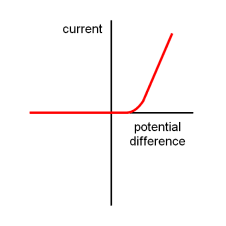
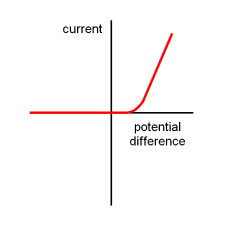
I/V Measurements of a (SEMICONDUCTING) DIODE (4)
- diodes are NOT ohmic conductors, they are SEMICONDUCTORS
- p.d. is NOT proportional to current
- does NOT obey Ohm's Law (V=IR)
- diode's behaviour depends on its polarity (i.e. not conducting with reverse p.d. / no current when p.d. reversed / negative)
Conventional current vs electron flow
conventional is + to -
electron flow is - to +
What is a diode and what does it do? (4)
- made of semiconductor material
- regulates direction of current in a circuit
- diode's behaviour depends on its polarity (positive or negative polarity)
- the p.d. across it is NOT (directly) proportional to the current through it
What is a diode and what does it do?
What makes an ohmic conductor? (2)
- when an I/V component obeys Ohm's Law (V=IR)
- graph goes through origin and is a straight line
Describe 3 different points on an I/V graph for a (SEMICONDUCTING) DIODE
1. at point A, resistance is HIGH (infinite); NO current here
2. at point B (where p.d. starts increasing), it starts conducting / current starts to increase; resistance decreases as the current rises at a faster rate than p.d.
3. at point C, the diode has a small resistance

What is a resistor?
a component that has resistance and is used to control the flow of electric current, limits the amount of current flow
Low resistance and high resistance on a graph
- on an I/V graph, the gradient = 1/R
- the SMALLER the resistance, the HIGHER the gradient
(resistance increase = lower gradient, vice versa)

Why does the current rise at a faster rate than the p.d.? (2)
- due to R=V/I where increase in I means decrease in R
- this is a reason why diodes are much more efficient than filament lamps
I/V Measurements of a RESISTOR
- current is DIRECTLY PROPORTIONAL to p.d.
- obeys Ohm's Law (V=IR) so it is an OHMIC CONDUCTOR
- resistance is CONSTANT
- resistance is the same regardless of polarity (meaning graph still goes through origin when voltage and current negative)

I/V Measurements of a FILAMENT LAMP (5)
- current NOT proportional to p.d.
- NOT an ohmic conductor as it doesn't obey Ohm's Law (V=IR)
- p.d. increases at a faster rate than the current, meaning resistance is increasing (confirmed by calculating R=V/I at different points on graph)
- resistance increase = temp increase = more collisions between electrons and ions
- less efficient than diodes (most energy released as heat, not visible light)

relationship between resistance current and temperature
increase in temp is often caused by increase in current
1. in a thermistor, increased current = increased temp = decreased R (since current increases at higher rate than V)
2. in a filament lamp, increased current = decreased temp = decreased R (since V increases at higher rate than current)
I/V Measurements of a THERMISTOR
- current NOT proportional to p.d.
- NOT an ohmic conductor as it doesn't obey Ohm's Law (V=IR)
- current increases at a faster rate than the p.d. (OPPOSITE TO FILAMENT LAMP), therefore resistance decreases as p.d. increases
- resistance decreases because as current and temp increase, no density increases, because more conducting electrons freed
- confirmed by calculating R=V/I at different points on the graph

I/V Measurements of an LED
- identical to diode (since LED is a type of diode)
Resistance and energy in electrical components
- each electrical component has resistance
- it requires energy to move a charge carrier through a component
- so the HIGHER the resistance, the MORE energy required
- resistance produced when electrons collide with ions in lattice of metal wire
SO increased temp = increased vibrations = increased collisions between electrons and ions = increased resistance
Define 1 Ohm (Ω)
one Ohm (Ω) is defined as the resistance of component when a 1V p.d. is produced per ampere of current (1Ω = 1VA⁻¹) (R=V/I)
Relationship between current and resistance
resistance and current are inversely proportional
resistivity (ρ)
- a measure of how strongly / the ability of the material of the conductor opposes current flow
- unit of ρ is Ωm
- resistivity is a property of the material itself, does not depend on quantity of material
- each material has a different resistivity

relationships in restivity equation
rearranged to make R subject
- resistivity is always the constant (when temp constant)
- resistance doubles if length doubles
- resistance halves if radius of wire doubles
- resistance halves if cross-sectional area doubles

5 factors that affect resistance
- number density, n
- cross-sectional area of material/wire, A
- length of wire, L
- temperature (increased temp = increased resistivity)
- material of wire
2 factors that affect resistivity
1. material of conductior
2. temperature of material
resistivity practical (RP8)
... we can change length of wire to see resistance changing
calculating the cost of energy (equation)
price(pence) = power x time(hour) x unit cost(equation)
price = [electrical energy (E=pt)] x unit cost
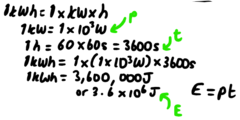
what is a kilowatt hour
a unit of energy (kWh)
the amount of energy used by a 1kW device in one hour
deriving kWh from W = p x t
W = p x t
J W h
becomes:
W = p x t
kWh kW h
how can we convert 1kWh to Joules?
.