BIOL 413 Lab Practical 2
 Call Kai
 Learn
 Practice Test
 Spaced Repetition
 Match
 Flashcards
 Knowt Play
1/40

There's no tags or description
Looks like no tags are added yet.
41 Terms

Label osculum and ostia
Leucosolenia

Label osculum and ostia
Grantia (Scypha)

Label ostia, incurrent canal, radial canal, spongocoel, and choanocytes
Grantia (Scypha) Cross section and tangential longitudinal section

Label ostia, osculum, and epidermis
Show water flow in and out
Whole sponge

Living Spongilla

Label comb rows and explain their function
Ctenophore

Label tentacles, stalk, mouth, basal disc (foot), oral end, and aboral end
Hydra

Label buds
Budding hydra undergoing asexual reproduction

Label sperm and egg producing regions
Hermaphrodite hydra

Label the locations of sperm and egg
Cross sections of hydra

Label the oral end, aboral end, feeding poly (Gastrozooid), reproductive polyp (Gonozooid), and medusa buds
Obelia

Label the bell, tentacles, manubrium (mouth), radial canal, oral end, and aboral end
Medusa stage of Obelia
Compare reproductive strategies between Hydra and Obelia
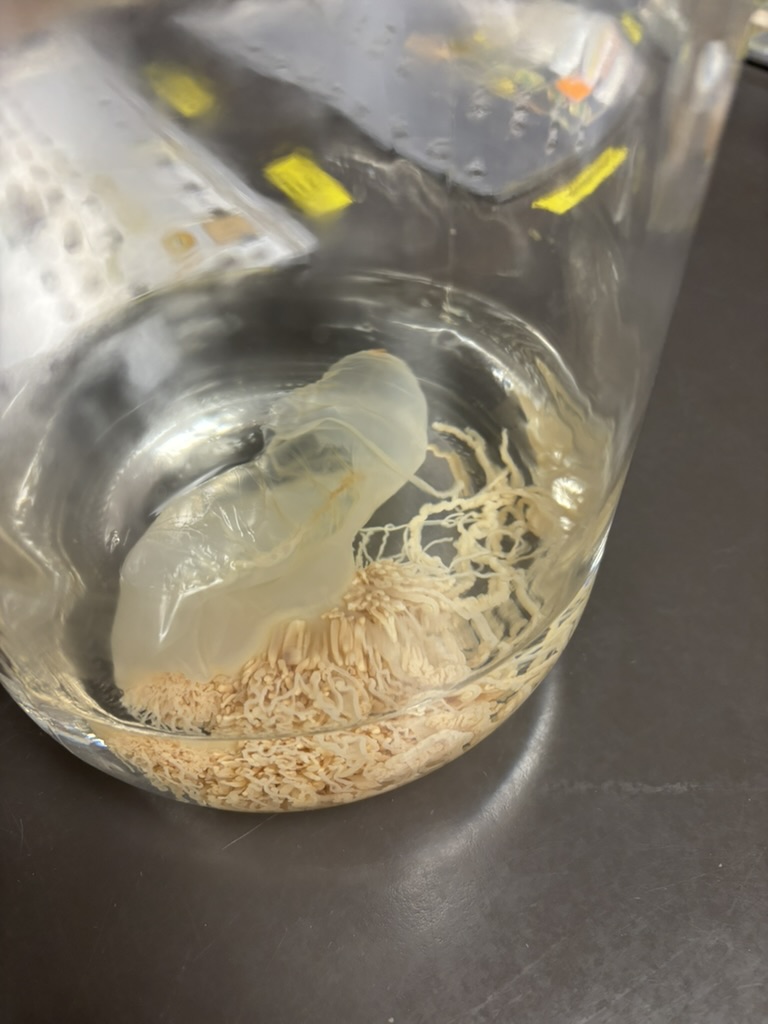
Label gas bladder and several individual zooids
Physalis
Label gastrovascular cavity, pharynx, septum, and epidermis
Metridium (a sea anemone)
Compare a sea fan coral specimen with a dried sponge
Sea fan: 2D branching, thicker, polyps on surface, covered in hollow holes, bumpy
Dried sponge: 3D branching, composed of ostia and osculum, stringy forms

Label where the corallite is located
Different hard coral growth forms (one colonial and one solitary)

Label gonads
Aurelia

Label the eyespot, pharynx, gastrovascular cavity, auricle, pharyngeal cavity, and mouth
Describe movement, response to touch, response to light, and interaction with others
Planaria

Label gut cavity, pharynx, epidermis pharyngeal cavity, and gastrointestinal trat
Cross section of planaria
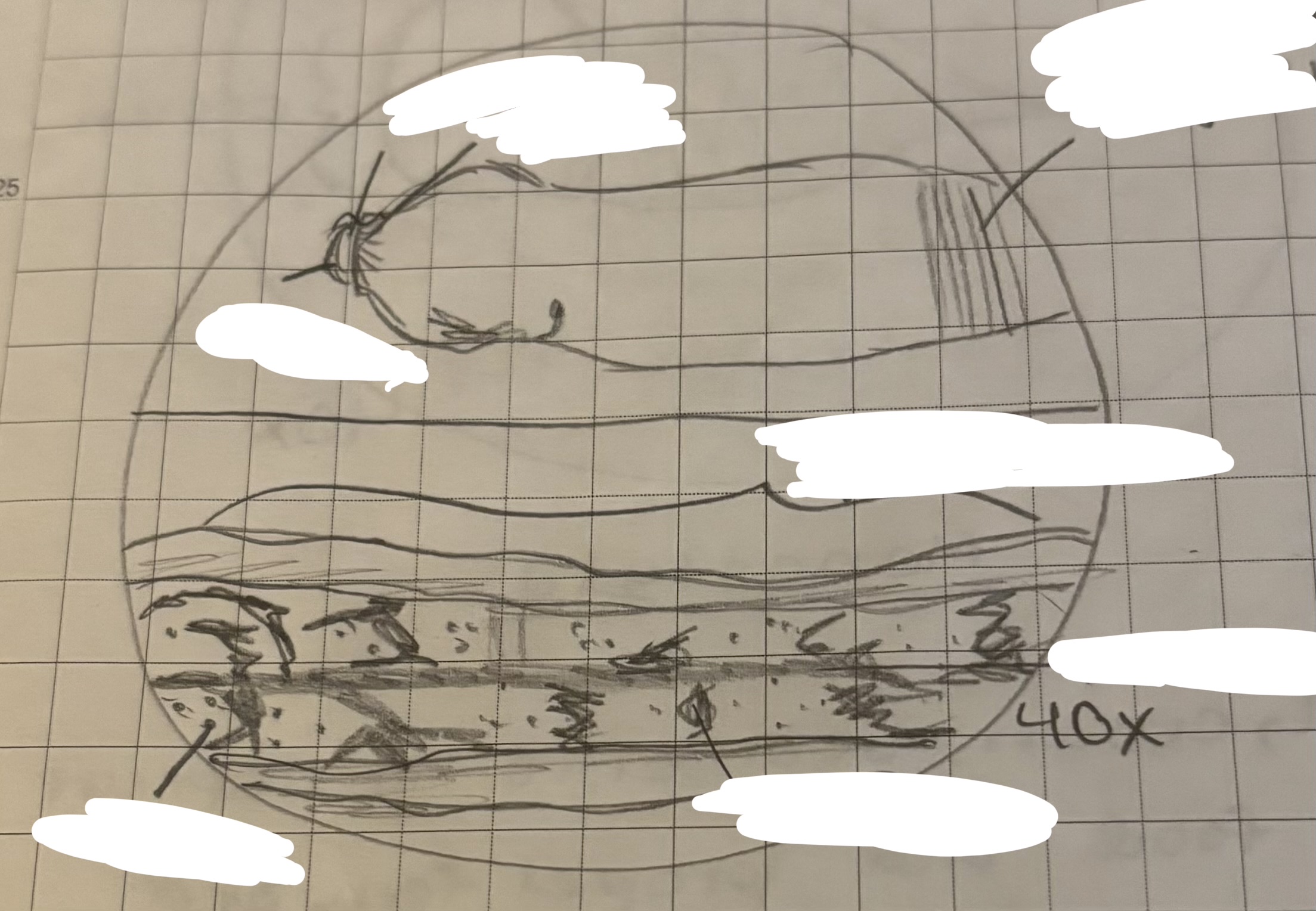
Label scolex, hooks, suckers, immature ploglottid, testis, ovary, and uterus
Cestode tapeworm Taenia pisiformis

Label oral sucker, pharynx, intestine, ventral sucker, testis, uterus, excretory pore, ovary
Trematode fluke Eurytrema pancreaticum
Compare Planaria, Taenia, and Eurytrema in body shape, presence of digestive system, presence of visual structures, presence and location of hooks and suckers, and natural history

Describe movement and label the crown and mastax. Decsribe how they move
Live specimens of Philodina

Label crown and mastax. Functions?
Monostyla
Compare the locomotion between Philodina and Monostyla. One of these has a hard protective covering called the lorica. Which one? How can you tell? How might the lorica influence their movement?


Label the valves and pedicle, and describe the function of each partLabel lophophores on shells. Function? Difference in symmetry between brachiopod and bivalve shells
Lingula (Brachiopod)
Label the zooecium. Single or colonial? What characteristics of bryozoans allow them to fossilize so well?
Fossil bryozoan

Label the shell plates and girdle. Describe how two shared molluscan features have contributed to its success living in rocky intertidal zones.
Dorsal view of a chiton (Polyplacophora)
The foot allows chitons to stay in place when water goes over them in tidal pools
The radula allows them to eat food off rock surface
Describe the movement of live mystery snails and pond snails
The radula presses against the glass. The radula has a rhythmic, scraping motion. The snails themselves move with visible muscular contractions and glide, slowly

Label the umbo and shell. Label the adductor muscles, gills, foot, mantle, and shell
Quahog (Bivalvia)

Label the umbo, shell, and incurrent excurrent siphons
Long-neck clam (Bivalvia)

How do its arms differ from those of a squid? Do octopuses and squid have the same number of appendages?
Octopus (Cephalopoda)

Label the mantle, fins, funnel (siphon), eyes, arms, and tentacles
Squid (Cephalopoda)

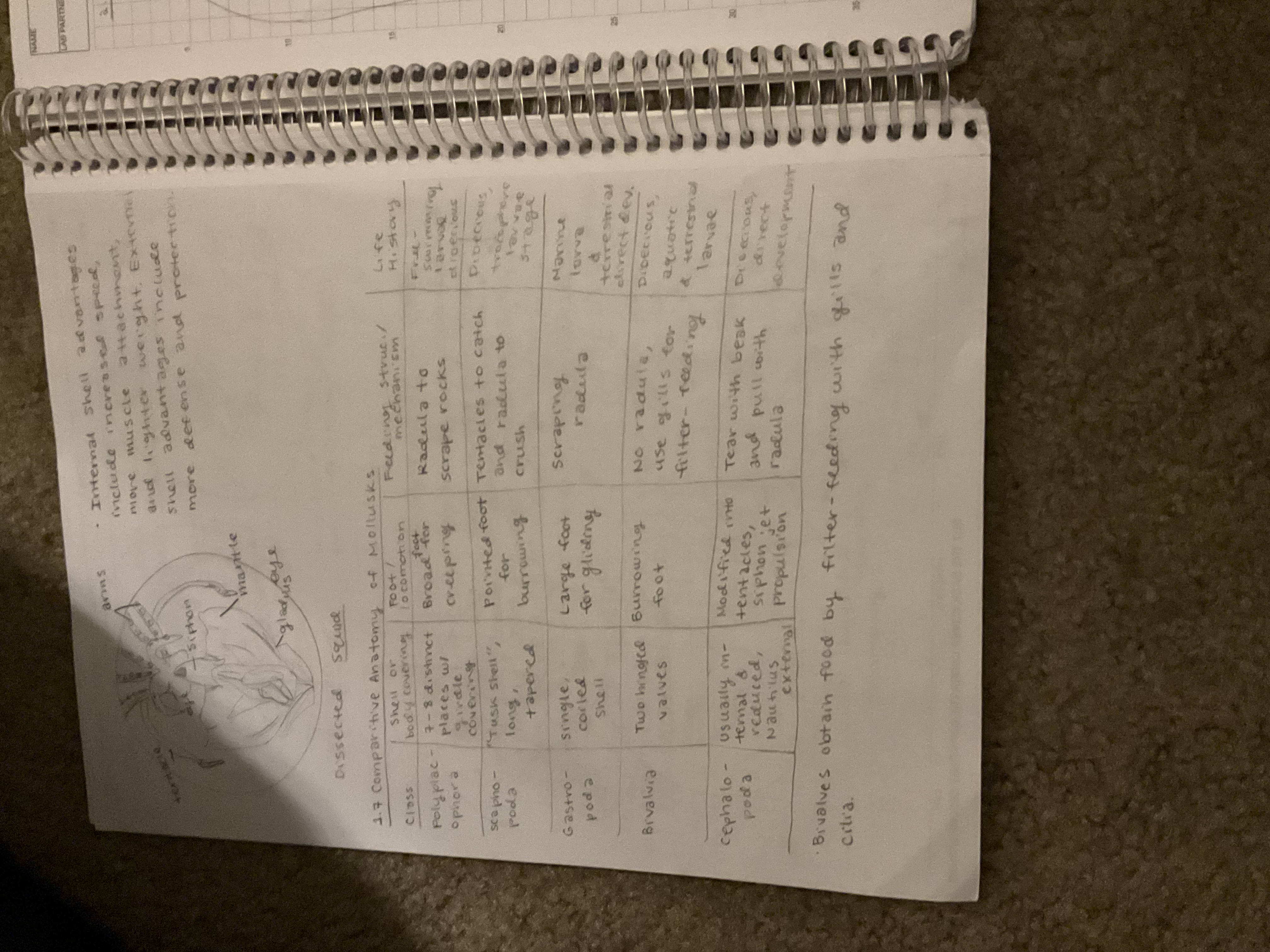
Label the mantle, siphon, gladius, beak, eye, tentacles, and arms. The gladius of a squid is located inside the mantle. What are some advantages of having an internal versus an external shell (as in Nautilus)?
Dissected squid (Cephalopoda)
Comparative anatomy of mollusks
Class Shell or body covering Foot / locomotion Feeding structure /mechanism Life History
Polyplacophora
Scaphopoda
Gastropoda
Bivalvia
Cephalopoda
Most mollusks possess a radula, but bivalves do not. How do bivalves obtain food without a radula?
Bivalves obtain food by filter-feeding with gills and cilia.

Label the circular muscles, longitudinal muscles, coelom, intestine, dorsal blood vessel, ventral blood vessel, and ventral nerve cord.
Identify two anatomical features visible in the cross-section that distinguish earthworms from members of Platyhelminthes. How does the position of the nerve cord in earthworms differ from that in humans? How does the earthworm’s complete digestive tract differ from the digestive systems of cnidarians and most flatworms?
Earthworms use their circular and longitudinal muscles to move. Predict how contracting each muscle layer changes the length and diameter of a body segment.
Label the pharynx, esophagus, crop, gizzard, intestine, aortic arches (“hearts”), and dorsal blood vessel. Identify the septa separating adjacent segments in your drawing. How does the internal segmentation correspond to the external rings? Beginning with segment 1, immediately posterior to the prostomium, determine which segments contain the pharynx, aortic arches, esophagus, crop, and gizzard. Record your observations.
Cross-section of earthworm
Label the prostomium, segments (annuli), clitellum, and pygidium
Compare the number, arrangement, and appearance of chaetae across several segments. Are they similar or different among segments?
Count the number of segments between the anterior end and the clitellum. How does the clitellum differ in appearance from the surrounding segments?
External anatomy of earthworm
Label the cuticle, longitudinal muscles, nerve cords, pseudocoelom, intestine, and female reproductive structures (uterus with eggs, ovaries, if visible).
Cross-section of female Ascaris (Nematoda)
Cross-section of male Ascarsis (Nematoda)