Epidemiological concepts of disease causation
 Call Kai
 Learn
 Practice Test
 Spaced Repetition
 Match
 Flashcards
 Knowt Play
1/24

There's no tags or description
Looks like no tags are added yet.
25 Terms

Given what you know about the aetiology of the human diseases below, which conform to Koch’s postulates?
• SARS-CoV-2
• Rabies
• Heart disease
• COPD
• Stroke
• H5N1 avian influenza (zoonotic)
• Diabetes
• AIDS
• Suicide
• Chronic liver disease
• Unintentional injury
A: All of them
Some are non-communicable diseases; the agents of disease are not infectious
injury, stroke
Some may be multi-factorial; although infectious agents are implicated, there may be more than one factor responsible for the occurrence of disease
COPD
Isolation of the causal agent may not be feasible
rabies
Individuals vary in their susceptibility to infection and to progression to clinical disease
Influenza H5N1 infection
Individuals may be infected by the causal agent but not show clinical signs e.g. subclinical infections, carriers (as Koch himself later acknowledged)
SARS-CoV-2
COVID-19 AND SARS-COV-2 VIRUS
Bao et al. demonstrate that the SARS-CoV-2 virus fulfils Koch's postulates with regards to the disease, COVID-19
1. The microorganism must be found in abundance in all organisms, suffering from the disease, but should not be found in healthy organisms.
2. The microorganism must be isolated from a diseased organism and grown in pure culture.
3. The cultured microorganism should cause disease when introduced into a healthy organism.
4. The microorganism must be re-isolated from the inoculated, diseased experimental host and identified as being identical to the original specific causative agent.
Do you agree that this study reflects reality?
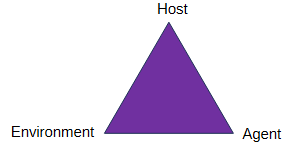
the epidemiological triad
U S E F U L F O R T H I N K I N G A B O U T M U L T I P L E C A U S E S A N D E F F E C T
• Disease occurs when a susceptible host encounters an agent of
disease within a defined environment
• Emphasizes that there are multiple considerations and
interactions when thinking about how disease occur
agent factors: infectious disease
• Virulence: the severity of disease caused, shown by the case fatality rate Pathogenicity; the ability of the agent to cause disease in a particular host (these can vary by pathogen species/strain)
• Infectious dose: the number of organisms required to predictably initiate disease
• Transmission rate; the average number of new cases attributable to one
case during the infectious period
• Life cycle, including reservoir and vectors
• Route of transmission/infection: Direct, Indirect, droplet; airborne; vector- borne, fomites (= opportunities / access)
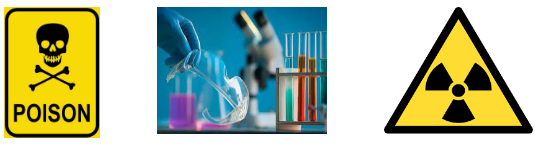
agent factors: chemical, physical, radiological
• Dose : deficiency / excess
• Toxicity
• Duration of exposure
• Rates : accumulation/ degradation
• Absorption
• Route of exposure
host factors
• Species
• Age
• Breed
• Sex (+/- neutered)
• Stage of reproductive cycle/ lactation
• Immunocompetence
• Plurality of host genetic factors
• Other diseases/conditions
• Job (how do they spend their day

environmental/contextual factors
• Geographic: e.g. altitude, climate, soil type, vegetation, season,
interaction with wildlife or vectors
• Physical: e.g. managed environment: fences, shelter, floors, ventilation,
light, equipment & maintenance, transport etc
• Husbandry : e.g. diet, stocking density, routine prophylaxis, biosecurity,
handling, stockmanship, productivity,
• Economic : e.g. value of a dairy bull calf, feed costs, access to capital for
farm improvements, access to veterinary care
• Contact network/ movement
• Proximity to other holdings

sufficient cause model
According to this model
• There are one or more causes of disease (any event, condition,
context, or characteristic) that are required for disease to occur in
a given individual in a given situation
• These are called the causes or component causes of disease
Necessary Cause: A specific component cause that always must
be present in every instance of the disease (in any individual in any
situation)
• For example, in every case of every dog with parvovirus infection,
parvovirus is a necessary cause
• HOWEVER, presence of the parvovirus pathogen alone does not
invariably result in disease
Sufficient Cause: A minimum set of component causes that if
present in a given individual, will lead to the disease
• Sufficient cause depends on the individual and the situation
• Sets of components may vary and be different in each
individual with the disease
• any one component cause may or may not be present
Each unique set of components = sufficient cause for disease to occur
• Can be visualized as a ‘pie’ where the component causes are analogous
to ingredients in a pie
• All the ingredients must be there for there to be a pie
Removal of ANY one component cause from a sufficient cause will prevent
disease
Other factors may be present but if they are not part of the sufficient
cause they can be removed without impacting the disease occurrence
sufficient cause model example
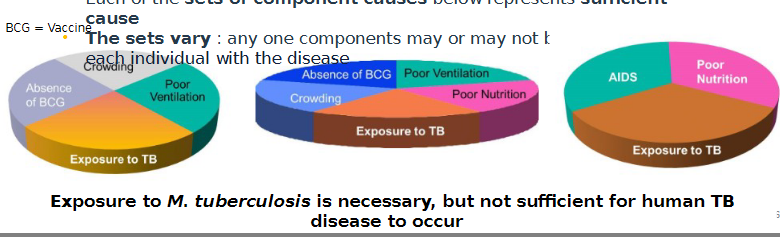
Here, exposure to Mycobacterium tuberculosis is necessary for human TB
to occur in an individual
• Without the M. tuberculosis bacillus, there cannot be tuberculosis
disease
• BUT presence of the pathogen alone does not invariably result in
disease
• Each of the sets of component causes below represents sufficient
cause
• The sets vary : any one components may or may not be present in
each individual with the diseas
sufficient cause model numeric example….hein
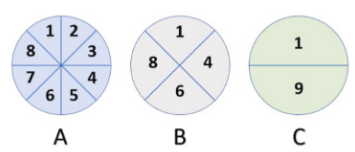
• Here, component causes of a condition called retinopathy of
prematurity are designated by numbers
• The pies below, A, B, and C, represent different sufficient cause for
the condition to occur
• Which number represents the necessary cause?
it would be 1 cause its present in all charts
shes just repeated the same concept like 7 times… last time:
• Sufficient Cause: any minimum set or array of components that if
present in a given individual in a given situation, will lead to the
disease
• Necessary Cause: A specific component that always must be
present for disease to occur
Why does this matter?
Thinking about disease causation using this model :
• Underscores the complexity of disease pathogenesis
• Presents/allows multiple opportunities to prevent disease
• According to the model, removing any one of the sufficient cause
components prevents the occurrence of disease
causation vs influence
Consider what is causing the disease compared to what is influencing the
outcome
According to the model, the entire set of sufficient causes must be present
for disease to occur
• This is difficult to know/test/prove – unlikely that the complete set of
components in any given sufficient cause can be known
Another way to think about disease causation is to consider risk factors
(rather than sufficient causes) – e.g. age, nutritional status, underlying
diseases
• Risk factors have different levels of influence, which can be studied
• Necessary causes, e.g. pathogens for infectious diseases, are still relevant
Consider what is your outcome of interest
• Infection?
• Clinical disease?
T H E U S C D C L I S T O F R I S K FA C T O R S
F O R S E V E R E C O V I D - 1 9 C L I N I C A L
D I S E A S E
• Age
• Race/ethnicity
• Gender
• Some medical conditions
• Use of certain medications
• Poverty and crowding
• Certain occupations
• Pregnancy
3 essential attributes of a cause
• Association: variation in a causal factor must result in a change in probability of the outcome; if X changes, Y changes
• Time order: a cause must precede the effect; can be either proximate (e.g.; food poisoning) or distant (e.g.; carcinogen)
• Direction: the exposure results in the outcome, not vice versa.
Bradford-Hill’s criteria for causation
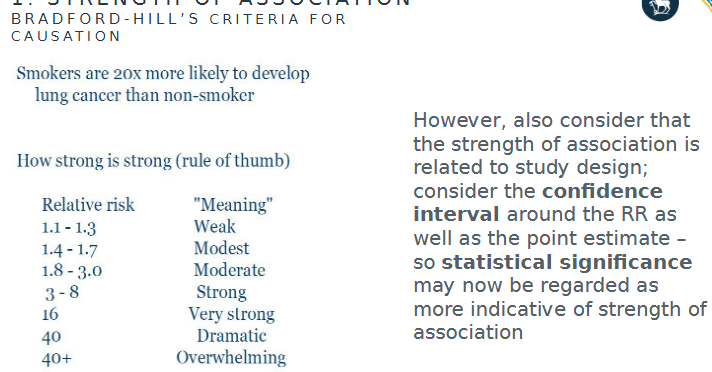
1. Strength of association
2. Consistency
3. Specificity
4. Temporality
5. Biological gradient
6. Plausibility
7. Coherence
8. Experiment
9. Analogy
1 Strength of association
2 Consistency

3 Specificity
• An association between an exposure and a disease is more likely
to be causal if it is only linked with one disease.
• Similar to Koch – the “uniqueness” of a necessary cause.
• However, we are now much more comfortable with two
concepts – that one exposure may be linked to more than one
disease outcome and also that some diseases have a
multifactorial aetiology
4 Temporality

5 Biological gradient

6 Plausibility

7 Coherence
Related to plausibility and consistency:
• The putative cause should be in line with accepted knowledge
• Publications/evidence
• Knowledge of underlying biological mechanisms
• Epidemiological findings should be in line with laboratory findings
As the biological mechanisms that underlie disease are elucidated,
these can provide the evidence that supports – or refutes –
epidemiological association and possible causatio
8 Experiment

9 Analogy
An analogy is a comparison between two things, typically one of which
is familiar and the other of which is unfamiliar. We are more likely to
accept a new concept if it can be suggested that it is similar to
something that we already know.
For example, if we accept that smoking causes lung cancer then by analogy, we may also accept that passive smoking can cause lung cancer, too
On the other hand, use of an inappropriate analogy may be unhelpful
summary
• Establishing causality of a disease is difficult; most diseases are multifactorial with many components and influences contributing, some of which will not be known
• Koch’s postulates, though not universally applicable, can help to establish disease causation, as they provide evidence for an infectious agent as a contributory and often necessary cause of an infectious disease (especially in the lab)
• Consideration of the epidemiological triad is useful in hypothesising causes and influences (risk factors) for a disease
• Component causes / sets of component causes may be necessary and/or sufficient to cause infection or disease
• Rothman’s sufficient cause model proposes that more than one component can be required fora disease to occur, and that a single cause may be necessary but alone may not be sufficient
• Application of Bradford-Hills criteria guides evaluation of the strength of evidence for causality but does not prove causality
• Association ≠ causation
• Terminology: Risk factor / component cause / cause / variable may be used
• Use of ‘risk factor’ terminology may be useful in researching and assessing factors influencing the occurrence of infection and/or disease and disease sever
