Whole of Immunity
 Call Kai
 Learn
 Practice Test
 Spaced Repetition
 Match
 Flashcards
 Knowt Play
1/23

There's no tags or description
Looks like no tags are added yet.
24 Terms
What is an antigen?
A foreign protein on the cell surface that stimulates an immune response
What is an antibody?
a protein produced by B plasma cells which binds to a specific complementary antigen
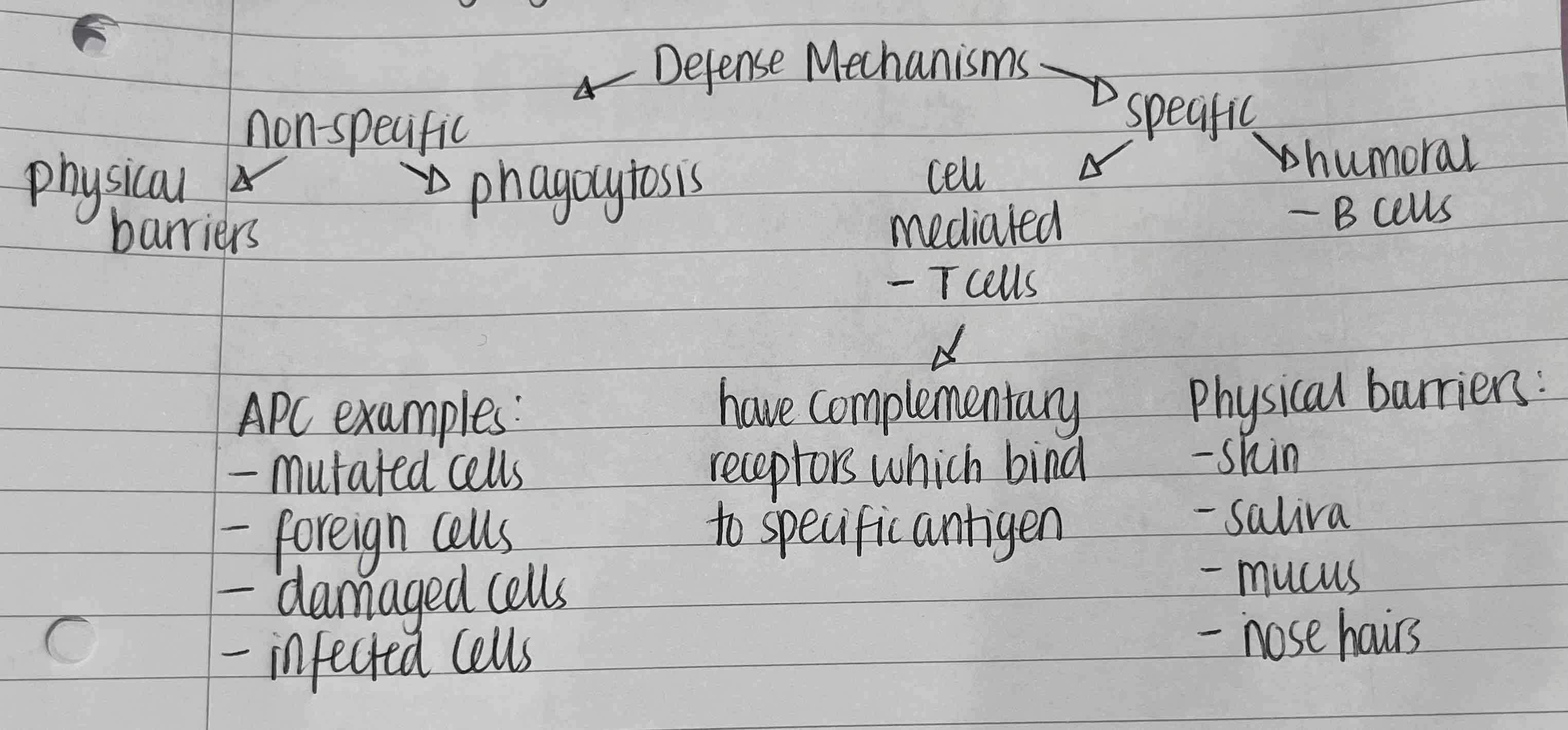
Defense mechanisms
non-specific (phagocytosis and physical and chemical barriers) and specific (cell mediated response and humoral response)
Describe the meaning of phagocytosis.
Phagocytosis involves the recognition of foreign particles by phagocytes, followed by engulfment through membrane extension, and subsequent digestion of the ingested material by lysosomal enzymes.
Describe the process of phagocytosis.
Pathogen releases chemoattractants which attract the phagocyte
The phagocyte binds to the pathogen and engulfs it, placing it in a vesicle called a phagosome
The lysosome (inside phagocyte) fuses its membrane with the phagosome and releases its hydrolytic enzymes into the phagosome to hydrolyse the molecules the pathogen is made of
The soluble products are digested into the cytoplasm of the phagosome
The phagosome gains antigens from the pathogen and they are presented on the phagosomes’ cell surface membrane, it turns into an APC (antigen presenting cell)
Describe the process of the cell mediated response.
Phagocytes engulf pathogens & display their antigens on their cell- surface membrane —> now APCs
Specific T helper cells with complementary protein receptors bind to these antigens- T helper cells do not recognise antigens unless they are on APCs- T helper cells are now activated
Activated T helper cells divide by mitosis to form generically identical clones (clonal selection)
They secrete chemicals- cytokines- which’s activate other T cells and B cells with the same receptors:
Stimulate activation of B cells (involved in humoral response)
Stimulate phagocytosis by stimulating phagocytosis release
Stimulate release of cytotoxic T cells- produce chemicals to make the APC membrane permeable, kills cells- holes are made to allow toxins to get in, this kills the APC
Forms T memory cells- THESE ALSO FORM W/O CYTOKINES- have the same complementary receptor as T helper cell, circulate in body to form long-term immunity to a certain virus
Describe the process of the humoral response.
First, specific B cell encounters APC or pathogen that has antigens on its surface
B cell have specific protein receptors on its cell surface membrane that are complementary to the presented antigens
B cells engulfs APC/pathogen and presents antigens on its own surface- is now an APC
Receptor of specific activated T-helper cell binds to antigen presented on the surface of the B cell and releases cytokines
The cytokines activate the B cell, which divides by mitosis to produce clones, these cells differentiate to form
B plasma cells- produce monoclonal antibodies which are specific to the antigens, they bind to the pathogen —> ultimately killing pathogens (eg by being engulfed by pahagocyte)
B memory cells- remain in blood so if pathogen re-invades, these cells divide by mitosis to make B-plasm a cells which make more antibodies more quickly
What are the 2 regions of an antibody?
Constant region - This is the same for all antibodies and binds to receptors on cells such as B cells.
Variable region - This is different for each antibody as its shape is complementary to a specific antigen. This is the part of the antibody that binds to antigens
What are the functions of antibodies?
Agglutination of pathogens - This involves clumping pathogens together to enable easier phagocytosis.
Neutralisation of toxins - This is when antibodies bind to toxins to inactivate them.
Preventing pathogens from binding - This is when antibodies bind to pathogens to stop them from infecting body cells.
What does each antibody have?
Each antibody has a unique binding site (in the variable region) that fits onto a specific antigen. When an antibody binds to an antigen, they form an antigen-antibody complex.
What is the agglutination of pathogens?
antibodies act as agglutinins, causing pathogens (or APCs) to clump together, easier for phagocytes to locate pathogens and allows them to engulf a number of pathogens at once
What is the neutralisation of toxins?
Antibodies can act as antitoxins when they bind to toxin produced by pathogens this binding neutralises (inactivates) the toxins to prevent them from damaging body cells.
How do antibodies prevent pathogens from binding to cells?
When antibodies bind to a pathogen’s antigens, they block cell surface receptors needed to bind to other cells. This means the pathogen cannot bind or invade host cells.
Define monoclonal antibodies?
antibodies produced from a single of clone plasma cells
What are the uses of monoclonal antibodies? (4)
diagnosis of disease- monoclonal antibodies find two specific cell types to identify infected cells
treatment of disease- monoclonal antibodies find two specific cells bringing therapeutic drugs with them
Pregnancy testing- Monoclonal antibodies bind to a pregnancy hormone in home pregnancy testing kits
Detecting cancer- for example, monoclonal antibodies can bind to prostate specific antigens (PSA) to identify prostate cancer in men
How many types of ELISA test are there and what do they entail?
2 types:
direct test- uses only 1 antibody
indirect test- uses 2 antibodies
How do you carry out an ELISA test?
Add the sample (containing the target protein) to a well plate where the target protein can attach to the well.
Add the antibody that is specific to the target protein. These antibodies will bind to the target proteins attached to the well.
Wash the well to remove any unbound antibodies.
Add a second antibody that will bind to the first antibody. These secondary antibodies are attached to an enzyme.
Wash the well again to remove any unbound secondary antibody.
Add a solution containing substrate to the well. The enzyme attached to the second antibody will act on the substrate to cause a colour change. The intensity of the colour indicates the quantity of protein present.
Active immunity?
This type of immunity develops when the immune system makes its own antibodies after exposure to a pathogen's antigens.
It takes a while to become immune to the disease, but it is long-term protection because memory cells are produced.
Passive immunity?
This type of immunity develops when an individual is given antibodies made by a different organism (the individual's immune system does not make these antibodies).
This method provides immediate immunity to the disease, but it is short-term protection because the antibodies are broken down and memory cells are not produced.
natural active immunity and artificial active immunity?
Natural active - antibodies made after an infection
Artificial active - antibodies made after a vaccination
natural passive immunity and artificial passive immunity?
Natural passive - antibodies transferred from mother to baby
Artificial passive - antibodies transfused or injected into individual
What are vaccines?
A vaccine contains an antigen, or antigens from a pathogen that stimulate an immune response, resulting in the formation of memory cells.
Describe and explain how vaccinations can lead to protection of people against bacterial caused diseases.
A vaccine is made from dead or weakened pathogen or antigens from them.
B cells with complementary receptors bind to the antigen
Specific activated T helper cells, activate these B cells.
B cells divide by mitosis to produce B-plasma cells.
The B plasma cells release antibodies, which are complementary to the antigen
Some B plasma cells become B memory cells
If the person is exposed again to the antigen or pathogen, the B memory cells become active and divide by mitosis to produce B plasma cells, which produce more antibodies more quickly.
These antibodies lead to the destruction of the pathogen before symptoms appear
Vaccinating a large proportion of the population results in the herd effect (which means that there are fewer people to pass on the disease, so unvaccinated people are protected)
Describe the process of HIV.
HIV is Non living and therefore cannot undergo cell division.
The virus's attachment proteins binds to the CD4 receptor proteins on the surface of the Th cell.
The virus's lipid envelope fuses with the cell membrane of the Th cell.
The protein capsid breaks down
RNA and enzymes (e.g. reverse transcriptase) of the virus are now released into the cytoplasm of the host cell.
Reverse transcriptase enables the viral RNA to act as a template to form DNA.
The viral DNA is inserted into the cell's DNA.
The viral DNA can now be transcribed into mRNA
Viral mRNA passes through the nuclear pore and attaches to a ribosome
Viral mRNA is translated into viral proteins that can be assembled into new HIV particles.
HIV particles bud off the Th cell (so that the Th cell's membrane forms the lipid envelope of the virus).