Lecture 12 - Generation of T Cells

0.0(0)
Studied by 0 people
call kaiCall Kai
learnLearn
examPractice Test
spaced repetitionSpaced Repetition
heart puzzleMatch
flashcardsFlashcards
GameKnowt Play
Card Sorting

1/15

encourage image

There's no tags or description

Looks like no tags are added yet.

16 Terms
1
New cards
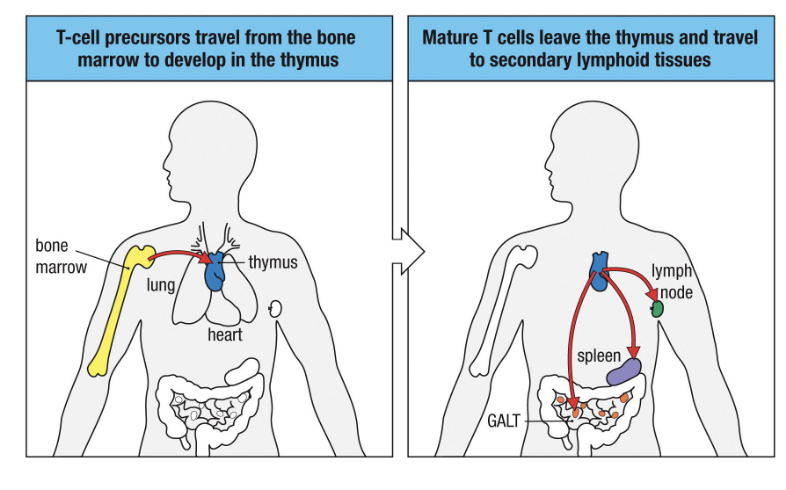
T Cell Origin and Migration
Hematopoietic stem cell progenitors form precursors in bone marrow, travel to the thymus for maturation, and migrate as naïve T cells to secondary lymphoid tissues like lymph nodes, spleen, and GALT
2
New cards
Evidence for Thymus Function
  • DiGeorge syndrome lacks a thymus and mature T cells

  • nude mice have a FOXN1 mutation causing a lack of a thymus and T cells, neonatal thymectomy eliminates T cells

  • thymus transplantation restores T cells as demonstrated by Jacques Miller


<ul><li><p>DiGeorge syndrome lacks a thymus and mature T cells</p></li><li><p>nude mice have a FOXN1 mutation causing a lack of a thymus and T cells, neonatal thymectomy eliminates T cells</p></li><li><p>thymus transplantation restores T cells as demonstrated by Jacques Miller</p></li></ul><p></p>
3
New cards
Thymic Involution
The thymus naturally shrinks and fills with fat over time, leading to a progressive age-related decline in the production of new T cells
4
New cards
Thymocyte Developmental Stages
  • Defined by surface markers CD3, CD4, and CD8

  • passing through double-negative (CD4- CD8-),

  • double-positive (CD4+ CD8+),

  • single-positive (CD4+ or CD8+) stages


5
New cards
Alpha-Beta vs Gamma-Delta T Cells
  • Approximately 95 percent of T cells carry alpha-beta receptors

  • gamma-delta T cells are primarily found in mucosal tissues like intestines, remain double-negative, show limited diversity, and act like innate cells


6
New cards
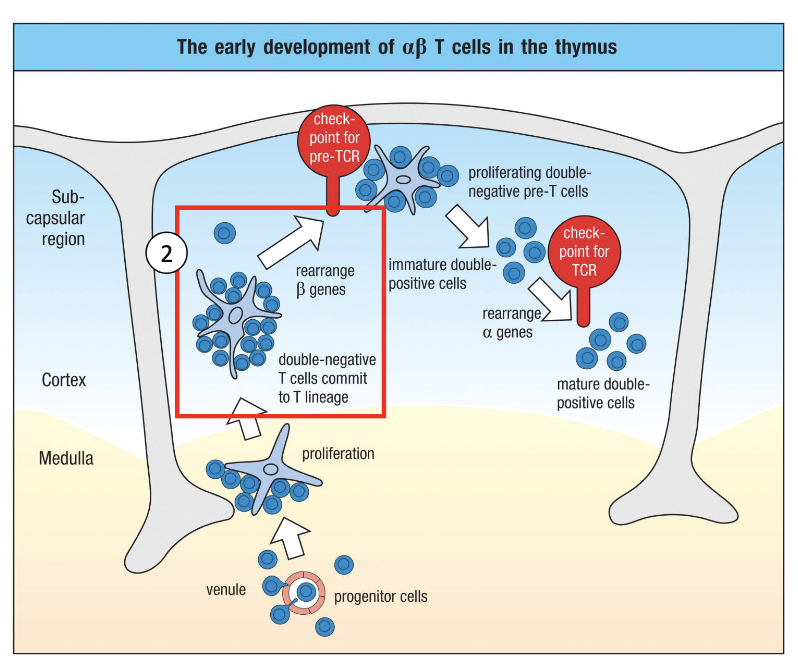
First Checkpoint Pre-TCR Test
  • Successful rearrangement of the beta chain allows it to pair with a surrogate alpha chain (pT-alpha) forming a pre-TCR, which signals survival

  • halts further beta rearrangement, and triggers cellular proliferation and CD4/CD8 co-receptor expression

<ul><li><p>Successful rearrangement of the beta chain allows it to pair with a surrogate alpha chain (pT-alpha) forming a pre-TCR, which signals survival</p></li><li><p>halts further beta rearrangement, and triggers cellular proliferation and CD4/CD8 co-receptor expression</p></li></ul><p></p>
7
New cards
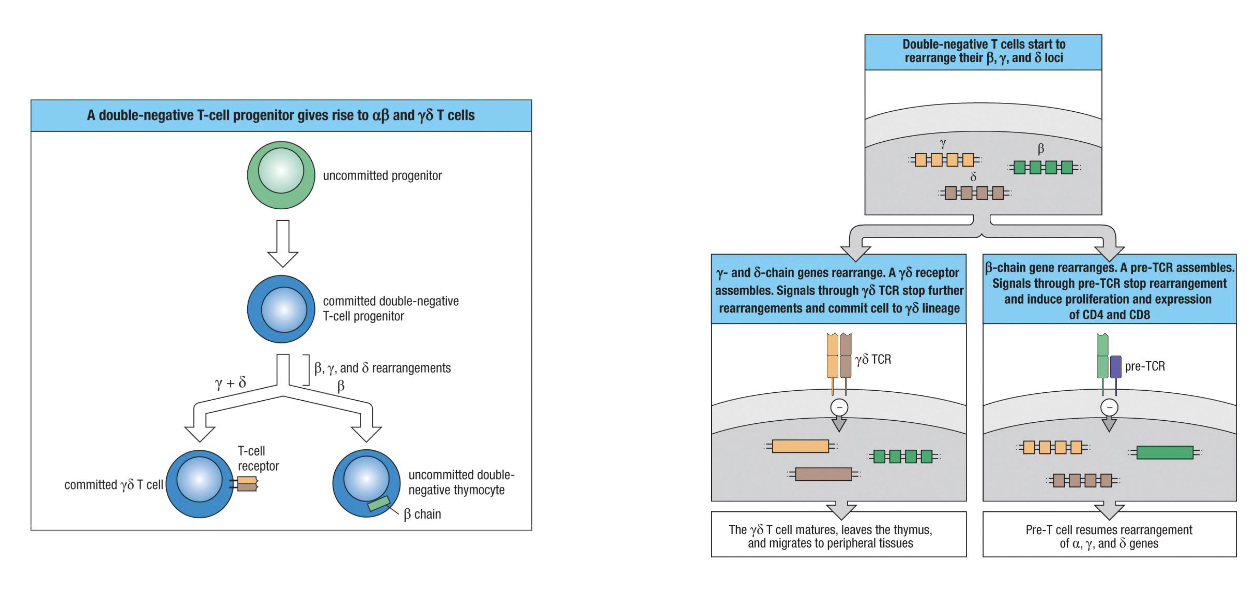
Beta Chain Rearrangement Rescue
  • Cells can make two rearrangement attempts per homologous chromosome utilizing downstream C1 and C2 regions

  • 66 percent of attempts fail primarily due to frameshift mutations creating premature stop codons

<ul><li><p>Cells can make two rearrangement attempts per homologous chromosome utilizing downstream C1 and C2 regions</p></li><li><p>66 percent of attempts fail primarily due to frameshift mutations creating premature stop codons</p></li></ul><p></p>
8
New cards
Death by Neglect
Thymocytes that fail to produce a functional receptor or signal properly receive no survival signals and undergo programmed cell death in the thymus
9
New cards
Second Checkpoint Alpha Chain Test
Following proliferation, thymocytes rearrange alpha chain V and J segments, express a complete alpha-beta TCR using a new alpha chain, and turn on both CD4 and CD8 to become double-positive cells
10
New cards
Positive Selection Overview
Occurs in the thymic cortex where cortical epithelial cells present self-peptide:MHC complexes to test if the TCR can bind MHC molecules
11
New cards
Positive Selection Outcome
  • Moderate or strong binding to MHC class I or II provides a survival signal and dictates lineage commitment

  • causing cells to retain either CD8 or CD4 while weak binding results in death by neglect


12
New cards

How do we know positive selection is done by stromal cells?

  • In these bone marrow chimeras:

    • Stromal cells express EITHER MHCa (yellow mouse) or MHCb (blue mouse).

    • The immune cells express both MHCa and MHCb.


13
New cards
Negative Selection Overview
Occurs predominantly at mice cortico-medullary junctions as thymocytes travel toward the medulla, eliminating self-reactive cells to prevent autoimmune disease
14
New cards
Negative Selection Mechanism

Mediated primarily by bone marrow-derived immune cells like dendritic cells and macrophages that induce apoptosis in thymocytes binding self-peptide:MHC complexes too tightly


15
New cards
AIRE Transcription Factor
Autoimmune regulator expressed by thymic medullary epithelial cells allowing them to transcribe every protein in the body so developing T cells can be tested against diverse self-antigens
16
New cards
Thymic Selection Statistics
About 98 percent of thymocytes die in the thymus through selection processes, with approximately 10 to the 8th power thymocytes generated daily and only a small fraction entering circulation as mature T cell



