NMR Spec
 Call Kai
 Learn
 Practice Test
 Spaced Repetition
 Match
 Flashcards
 Knowt Play
1/17

There's no tags or description
Looks like no tags are added yet.
18 Terms
NMR Spec
Stands for Nuclear Magnetic Resonance
Nuclei contain charge and can spin, and spinning creates a magnetic dipole.
Magnetic Dipole
Represented by quantam number “I” and can can exist in three phases:
I = 0, has an even number of protons and an even number neutrons, meaning there is 0 spin, like C12 or O16
I = 1/2, has odd mass number, like Carbon13 or H1
I = 1, has even mass number but either has odd protons or neutrons, like H2 or N14
Nuclear Magnetic Resonance
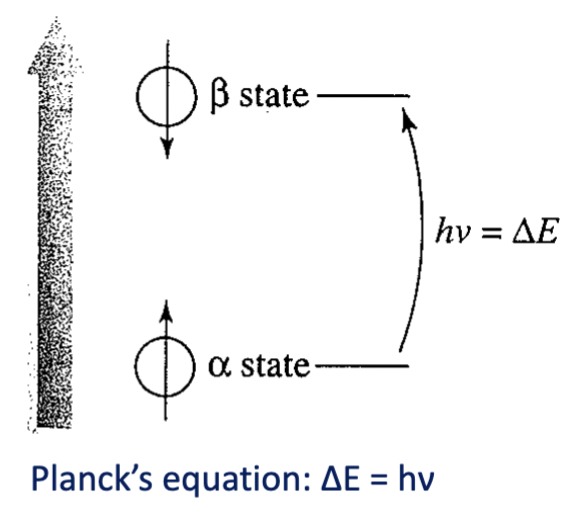
More nuclei are aligned with the externally applied magnetic field or the lower energy α-spin state.
∆E = Energy difference between α and β-spin states
Increasing the applied magnetic field = Increasing ∆E between spin states
Nuclei can absorb energy and flip from the α-spin state to the β-spin state. When this happens, the nucleus is said to be in RESONANCE with the applied magnetic field
The difference in energy ΔE between the two spin states corresponds to a frequency in the Radiofrequency region of the EM spectrum.
Plancks Equation
Energy difference of a and b states is equal to h (plancks constant) x frequency, so basically energy is directly proportional to frequency.
Conditions for resonance (NMR)
hν = γ Boh/ 2π
ν = γ Bo/ 2π
γ = gyromagnetic ratio; a constant
that depends on the magnetic
moment of the nucleus
Shielding and deshielding nuclei
Electronegative electron withdrawing groups deshield nuclei by taking away electron density from C and H atoms, meaning they come into resonance at a higher frequency and are more left than shielded nuclei and are “downfield”

NMR Schematic

NMR Spectrum
A plot of the intensity of an observed NMR signal Vs the frequency, measured relative to a reference compound which is typically, Tetramethylsilane (TMS).
TMS
Si surrounded by four CH3, used as baseline for three advantages:
TMS HAS 12 equiv. H’s, very well shielded
NMR Signal due to protons in TMS appears as a singlet at 0 ppm (way upfield from other signals), so sets 0 baseline
3. It is low-boiling and inert
NMR Solvents
CdCl3 for non-polar compounds
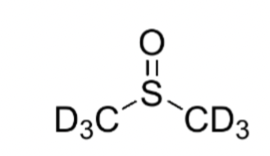
DMSO-d6 for polar compounds
Typical H1 NMR prep
10-20 mg compound + 0.5-0.6 mL CDCl3
NMR Spec Chemical shift
Chemical Shift = Frequency difference between the resonance observed for the nucleus and the resonance observed for the reference compound (usually TMS).
Formula: V sample - v reference/TMS / v spectrometer frequency

Features of NMR Spec that tell you about structure
Integration (size or area of the peak) = the relative number of identical protons in that environment.
Number of signals = corresponds to different groups of non-equivalent protons.
Chemical shift δ (position) = the kind of proton responsible.
Spin–spin splitting = the number of neighboring protons, from the (n+1) rule.
Number of signals
Chemically equivalent protons: protons in the same chemical environment – Produce a single 1H NMR signal. Only equivalent if identical
Equivalent protons do not split each other’s signals
Integration
Area under an NMR signal is proportional to the number of protons contributing to that signal.
Height of integration step is proportional to the area under the peak which in turn is proportional to the protons responsible for that signal.
EXAMPLE: CH3 vs (CH3)3, CH3 is 1/3 the size

Spin-spin splitting
Spin-spin splitting usually occurs between non-equivalent protons on adjacent carbon atoms.
A set of “n” non-equivalent protons splits the signal of a neighboring proton into (n+1) peaks.
Splitting by “n” nuclei of spin quantum number “I” gives (2nI + 1) lines.
For protons where I= ½, this equation results in (n + 1) lines
Splitting not generally observed for protons separated by more than 3 sigma bonds.
Example
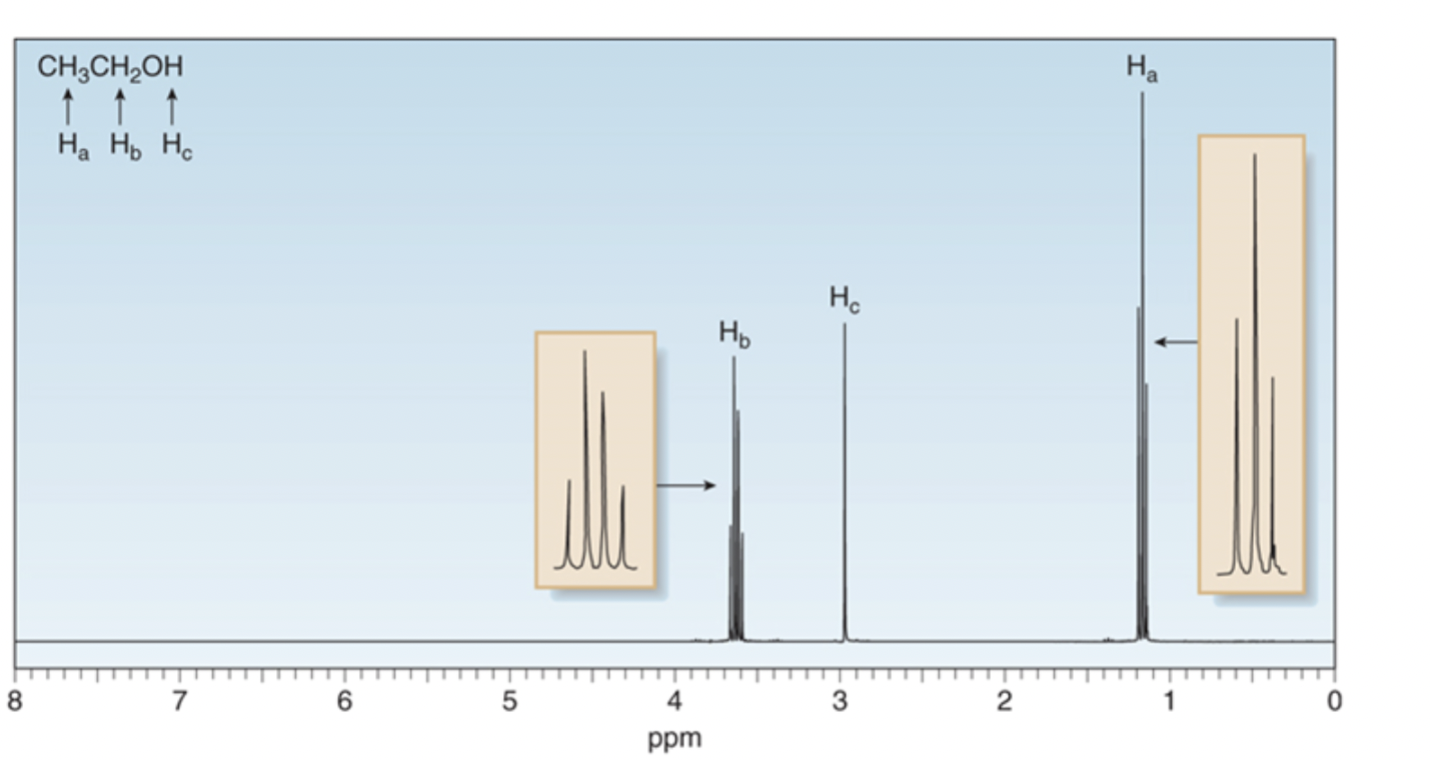
Peak names and intensities
