Thermodynamics
0.0(0)
Studied by 0 people Call Kai
 Learn
 Practice Test
 Spaced Repetition
 Match
 Flashcards
 Knowt Play
Card Sorting
1/88

There's no tags or description
Looks like no tags are added yet.
89 Terms
1
New cards
What is the definition of enthalpy change (ΔH)?
Heat energy transferred during a reaction at constant pressure.
2
New cards
What is the standard enthalpy of formation (ΔfH°)?
Enthalpy change when 1 mol of a compound forms from its elements in their standard states under standard conditions.
3
New cards
What are standard conditions for AQA enthalpy changes?
298 K and 100 kPa, with substances in their standard states.
4
New cards
What does the standard state of a substance mean?
Its physical state and form under standard conditions, at a pressure of 100 kPa.
5
New cards
What is enthalpy of atomisation (ΔatH°)?
Enthalpy change when 1 mol of gaseous atoms forms from an element in its standard state.
6
New cards
Give the equation for atomisation of chlorine.
½Cl₂(g) → Cl(g).
7
New cards
What is bond dissociation enthalpy?
Enthalpy change when 1 mol of a specified covalent bond is broken in gaseous molecules.
8
New cards
What is the first ionisation energy (IE₁)?
Enthalpy change when 1 mol of gaseous atoms forms 1 mol of gaseous 1+ ions.
9
New cards
What is the second ionisation energy (IE₂)?
Enthalpy change when 1 mol of gaseous 1+ ions forms 1 mol of gaseous 2+ ions.
10
New cards
What is the first electron affinity (EA₁)?
Enthalpy change when 1 mol of gaseous atoms gains 1 mol of electrons to form 1− ions.
11
New cards
What is the second electron affinity (EA₂)?
Enthalpy change when 1 mol of gaseous 1− ions gains 1 mol of electrons to form 2− ions.
12
New cards
Why is the second electron affinity endothermic?
Energy is needed to overcome repulsion between the negative ion and the incoming electron.
13
New cards
What is lattice enthalpy of formation?
Enthalpy change when 1 mol of solid ionic compound forms from its gaseous ions.
14
New cards
What is lattice enthalpy of dissociation?
Enthalpy change when 1 mol of solid ionic lattice separates into its gaseous ions.
15
New cards
How do lattice enthalpies of formation and dissociation relate?
They have equal magnitudes but opposite signs.
16
New cards
What is a Born–Haber cycle used for?
To calculate lattice enthalpies indirectly using Hess's law, and to calculate other enthalpy changes in the cycle.
17
New cards
What does Hess's law state?
The enthalpy change is independent of the route taken between the same initial and final states.
18
New cards
Which enthalpy changes can appear in Born–Haber cycles?
Formation, atomisation, bond enthalpy, ionisation energy, electron affinity and lattice enthalpy.
19
New cards
What is the Born–Haber equation for NaCl using lattice formation enthalpy?
ΔfH° = ΔatH°(Na) + ½D(Cl₂) + IE₁(Na) + EA₁(Cl) + ΔlattH°(formation).
20
New cards
What must you remember when constructing a Born–Haber cycle?
Use correct ion charges, state symbols, stoichiometric multiples, arrow directions and signs.
21
New cards
Why is chlorine atomisation sometimes multiplied by 2 in a Born–Haber cycle?
The number of gaseous chlorine atoms must match the formula unit being formed.
22
New cards
How do you calculate an unknown enthalpy in a Born–Haber cycle?
Apply Hess's law: the total enthalpy change along each route between the same states must be equal.
23
New cards
What is the lattice formation enthalpy of LiCl in the class example?
−846 kJ mol⁻¹, calculated using the supplied formation and other enthalpy values.
24
New cards
What is the perfect ionic model?
A model assuming ions are spherical, with evenly distributed charges and purely ionic bonding.
25
New cards
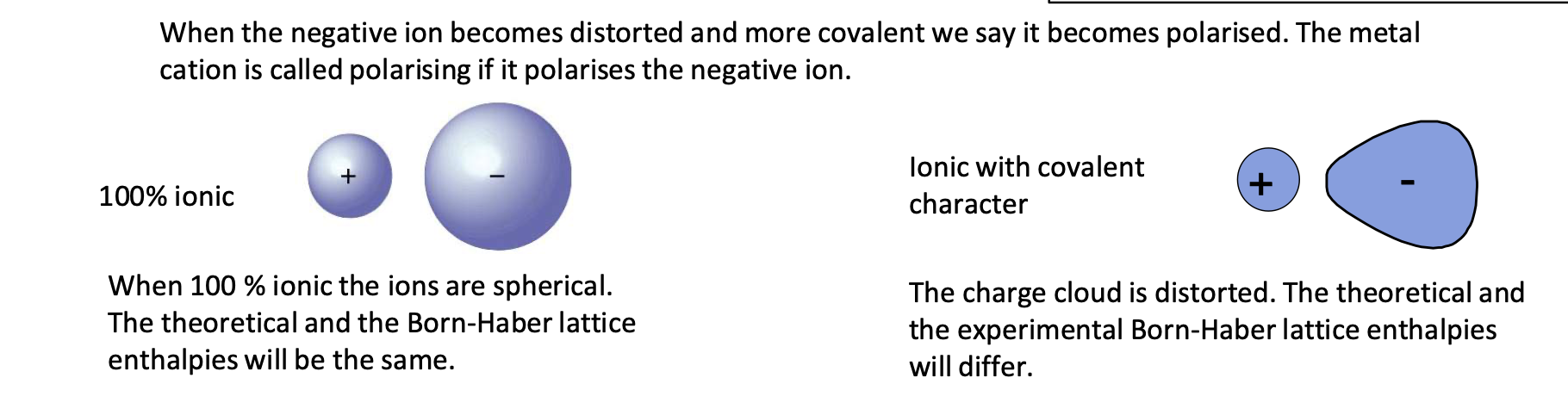
Why can theoretical and experimental lattice enthalpies differ?
Real ionic compounds can have covalent character, unlike the perfect ionic model.
26
New cards
What causes covalent character in an ionic compound?
A positive ion polarises and distorts the electron cloud of a negative ion.
27
New cards
What is the enthalpy of hydration (ΔhydH°)?
Enthalpy change when 1 mol of gaseous ions forms aqueous ions in an infinitely dilute solution.
28
New cards
Why is hydration enthalpy exothermic?
Attractive interactions form between gaseous ions and polar water molecules, releasing energy.
29
New cards
What is enthalpy of solution (ΔsolH°)?
Enthalpy change when 1 mol of ionic solid dissolves in water to form an infinitely dilute solution.
30
New cards
What is lattice enthalpy of dissociation in an enthalpy of solution cycle?
Energy absorbed when 1 mol of solid ionic lattice forms gaseous ions.
31
New cards
How do you calculate enthalpy of solution using a Hess cycle?
ΔHsol = ΔHlattice(dissociation) + ΣΔHhyd for all the ions.
32
New cards
Why must hydration enthalpies be included for every ion?
Each mole of gaseous ions produced from the lattice must become aqueous ions.
33
New cards
What determines whether dissolving an ionic solid is exothermic or endothermic?
The balance between energy absorbed breaking the lattice and energy released hydrating the ions.
34
New cards
What was the NaCl enthalpy of solution in the class calculation?
+17 kJ mol⁻¹, using +787, −406 and −364 kJ mol⁻¹.
35
New cards
What is the equation for enthalpy of solution using lattice formation enthalpy?
ΔHsol = ΣΔHhyd − ΔHlattice(formation).
36
New cards
What is entropy (S)?
A measure of energy dispersal and the number of possible arrangements of particles and energy.
37
New cards
What does an increase in entropy mean?
Energy is more dispersed and there are more possible arrangements of particles and energy.
38
New cards
What are the usual units for entropy and entropy change?
J K⁻¹ mol⁻¹.
39
New cards
What is the standard entropy of a substance (S°)?
Its absolute entropy under standard conditions, usually expressed in J K⁻¹ mol⁻¹.
40
New cards
Are standard entropy values of elements zero?
No. Absolute standard entropy values are generally positive, including those of elements.
41
New cards
How does entropy change when a solid melts?
Entropy increases because particles become less ordered and have more freedom of movement.
42
New cards
How does entropy change when a liquid boils?
Entropy increases significantly because gas particles have much greater freedom of movement.
43
New cards
How does entropy change when a gas condenses?
Entropy decreases because particles become less free to move.
44
New cards
How does entropy change when a gas dissolves in a liquid?
Entropy generally decreases because gas particles become less dispersed and more constrained.
45
New cards
How does increasing the number of gas molecules affect entropy?
It generally increases entropy because more arrangements are possible.
46
New cards
How does a change from solid to aqueous ions usually affect entropy?
Entropy generally increases as an ordered solid forms mobile, dispersed aqueous ions.
47
New cards
What is the equation for standard entropy change of reaction?
ΔS°reaction = ΣS°(products) − ΣS°(reactants).
48
New cards
How do you calculate ΔS°reaction from a data table?
Multiply each S° by its balanced-equation coefficient, add products, then subtract the reactants.
49
New cards
Why must coefficients be included when calculating ΔS°reaction?
They represent the number of moles of each substance involved in the reaction.
50
New cards
What does a positive ΔS°reaction indicate?
The products have greater total entropy than the reactants.
51
New cards
What does a negative ΔS°reaction indicate?
The products have lower total entropy than the reactants.
52
New cards
Why is ΔH alone insufficient to predict whether a reaction is feasible?
Feasibility depends on both enthalpy change and entropy change.
53
New cards
What is Gibbs free energy change (ΔG)?
A quantity combining enthalpy and entropy changes to determine whether a process is feasible at a given temperature.
54
New cards
What is the Gibbs free energy equation?
ΔG = ΔH − TΔS.
55
New cards
What do the symbols in ΔG = ΔH − TΔS represent?
ΔG = Gibbs free energy; ΔH = enthalpy; T = temperature in kelvin; ΔS = entropy.
56
New cards
What is the feasibility criterion using Gibbs free energy?
A reaction is feasible when ΔG is zero or negative (ΔG ≤ 0).
57
New cards
What does a positive ΔG mean?
The forward reaction is not feasible under the stated conditions.
58
New cards
What does a negative ΔG mean?
The forward reaction is feasible under the stated conditions.
59
New cards
What does ΔG = 0 indicate?
The reaction is at the boundary of feasibility.
60
New cards
Why must temperature be in kelvin in the Gibbs equation?
The equation uses absolute temperature, so temperature must be expressed in kelvin.
61
New cards
What unit conversion is needed when using ΔG = ΔH − TΔS?
Make ΔH and TΔS use consistent energy units, such as converting kJ to J or J to kJ.
62
New cards
What happens to ΔG as temperature increases when ΔS is positive?
ΔG decreases because the −TΔS term becomes more negative.
63
New cards
What happens to ΔG as temperature increases when ΔS is negative?
ΔG increases because the −TΔS term becomes more positive.
64
New cards
When ΔH is negative and ΔS is positive, when is a reaction feasible?
At all temperatures, because both terms favour a negative ΔG.
65
New cards
When ΔH is positive and ΔS is negative, when is a reaction feasible?
At no temperature, because both terms make ΔG positive.
66
New cards
When ΔH is positive and ΔS is positive, when is a reaction feasible?
At sufficiently high temperatures, when the TΔS term outweighs ΔH.
67
New cards
When ΔH is negative and ΔS is negative, when is a reaction feasible?
At sufficiently low temperatures, before the negative entropy term makes ΔG positive.
68
New cards
How do you calculate the temperature at which a reaction becomes feasible?
Set ΔG = 0, then rearrange ΔG = ΔH − TΔS to give T = ΔH/ΔS.
69
New cards
What must you check before calculating T = ΔH/ΔS?
Use consistent units for ΔH and ΔS, and express temperature in kelvin.
70
New cards
Calculate the threshold temperature when ΔH = +60 kJ mol⁻¹ and ΔS = +150 J K⁻¹ mol⁻¹.
T = 60000 ÷ 150 = 400 K. The reaction is feasible above 400 K.
71
New cards
What is the gradient of a ΔG against temperature graph?
−ΔS, when ΔG is plotted on the y-axis and temperature T on the x-axis.
72
New cards
What is the y-intercept of a ΔG against temperature graph?
ΔH, when ΔG is plotted on the y-axis and temperature T on the x-axis.
73
New cards
How can you calculate ΔS from a ΔG against temperature graph?
Find the gradient and use gradient = −ΔS; remember to use consistent units.
74
New cards
How can you calculate ΔH from a ΔG against temperature graph?
Read the y-intercept, which is ΔH.
75
New cards
How do you find the temperature at which a reaction becomes feasible from a ΔG graph?
Find where the line crosses ΔG = 0; the x-coordinate is the threshold temperature.
76
New cards
What does the point where a ΔG line crosses the temperature axis represent?
The temperature at which ΔG = 0 and the reaction is at the feasibility boundary.
77
New cards
Does a feasible reaction necessarily happen quickly?
No. Feasibility is thermodynamic; reaction rate depends on kinetics and activation energy.
78
New cards
What is the relationship between ΔG, ΔH and ΔS at a fixed temperature?
ΔG is determined by the balance between ΔH and the temperature-weighted entropy term TΔS.
79
New cards
How is a bond enthalpy value used in a Born–Haber cycle?
Breaking a covalent bond is endothermic, so the bond enthalpy is added as a positive value.
80
New cards
How is the sign of lattice enthalpy different for formation and dissociation?
Formation is exothermic and negative; dissociation is endothermic and positive.
81
New cards
How do you identify the correct stoichiometric amount in a Born–Haber cycle?
Match the amounts of gaseous atoms and ions to the balanced formula unit of the ionic solid.
82
New cards
What is the effect of stronger ion–dipole attractions on hydration enthalpy?
Stronger attractions release more energy, giving a more negative hydration enthalpy.
83
New cards
Why is the entropy change of a reaction calculated using products minus reactants?
It gives the net change in entropy as reactants are converted into products.
84
New cards
Born-Haber cycle: sodium chloride

85
New cards
Born-Haber cycle: magnesium chloride
Note in this example the first and
second ionisation energies of
magnesium are needed as Mg is
a +2 ion.

86
New cards
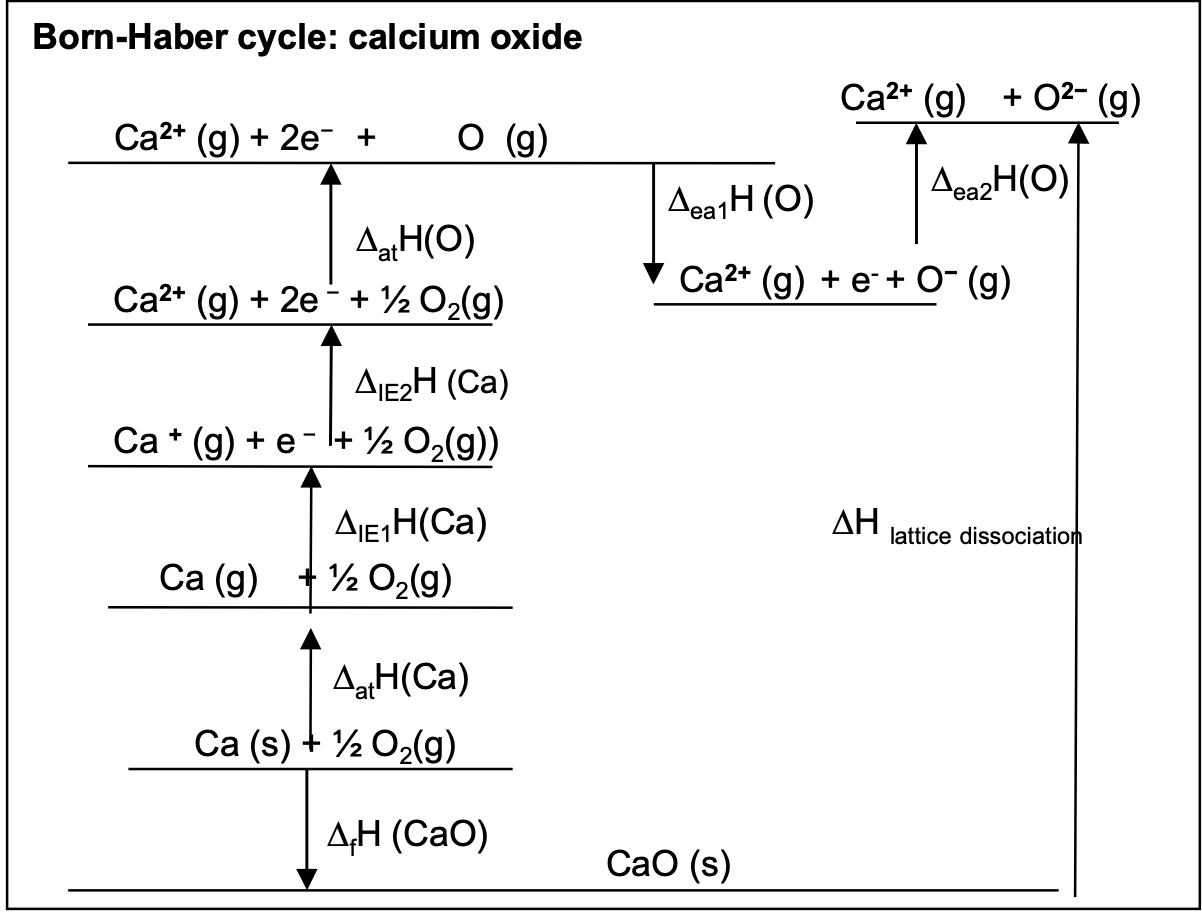
Born-Haber cycle: calcium oxide
87
New cards
polarisation diagram
88
New cards
entropy vs temp graph

89
New cards
look at chemrevise for diagrams etc.