Responses in Flowering Plants (chpt 36)
 Call Kai
 Learn
 Practice Test
 Spaced Repetition
 Match
 Flashcards
 Knowt Play
1/14

There's no tags or description
Looks like no tags are added yet.
15 Terms
External factors of growth
Temperature
When air temp is below 5°C, enzyme activity is low, slowing rate of chemical reactions
Temp enzymes work best at → optimum temp (25°C in plants, 40°C in animals)
Some plants respond to intense heat by releasing heat shock proteins which protect other vital proteins from denaturing
Day Length
As days get longer, plants know it is spring, get ready to grow/reproduce, and vice versa when getting colder; lose leaves, fruit ripen, seeds drop
Not as useful to plants in equatorial regions, not much variation
Light Intensity
More light → grow better as increases rate of photosynthesis until limiting factor (eg. CO₂ concentration/temp)
CO₂ Concentration
Affects rate of photosynthesis → increased artificially in greenhouses to increase photosynthesis rate
Water
If not enough water, wilts and stomata close to conserve water (grass roll up into tubes to shelter stomata from wind)
Plants communicate to neighbouring plants if short of water, causing others to close stomata
Gravity
Ensure growing up/down of shoots/roots, detected by dense components of cytoplasm → statoliths (settle to bottom of cells)
Statoliths promote redistribution of auxin in root to grow down and cause opposite reaction in stems
Internal factors of growth
Growth regulators
aka plant hormones. Compounds eg. auxins, gibberellins, cytokinins, ethylene, etc.
Injury and disease
Cause changes in plant and cause chemical attack using group of chemicals → phytoalexins
Tropism
A growth response of a plant to a stimulus
Types of tropisms
Phototropism
Growth response to light (increases photosynthesis)
Stems grow towards light (positive phototropism), roots away from light (negative phototropism)
Main regulator → auxin called indole acetic acid (IAA)
Geotropism
Growth response to gravity (grow in direction of light and water)
Stems grow away from gravity (negatively geotropic) and roots grow towards gravity (positively geotropic)
Thigmotropism
Growth response to touch
Modified end of pea leaves → tendrils. Grow around anything they touch, giving support to weak stems (allows them to grow bigger)
Cells that touch support grow less causing it to wrap
All plants respond like this → grow better the less they are touched
Hydrotropism
Growth response to water
Roots grow towards (positively hydrotropic), therefore can obtain more water and minerals
Chemotropism
Growth response to varying concentration of chemicals in environment
Eg. growth of pollen tube. Finds way to ovary by chemotropism. Specific pollen respond correctly to chemical(s)
Growth Regulator
Substance that controls growth of a plant
Promoters
Growth regulators that increase growth, eg. auxins like IAA (also can be inhibitor)
Inhibitors
Growth regulators that inhibit growth, eg. abscisic acid
How are growth regulators similar to hormones
Chemical in nature
Transported through vascular system ie blood in animals and phloem/xylem in plants
Slow-acting and tend to have long-lasting effect
Produced in one place and have effect in another place
Auxins
Can be both synthetic and natural. Most common natural is indole acetic acid (IAA) produced in apical meristems in young tissue and diffuses down stem
Elongates stems, grows roots and shoots, develops fruit
Travels away from shoot tip → polar
Cell elongation occurs when auxins cause hydrogen bonds between cellulose fibres to loosen and cause cells to absorb more water, causing cell to swell and loosen bonds
Auxins in phototropism
Darwin found phototropism is controlled by coleoptile (shoot), and that curving happens further down stem
Peter Boysen-Jensen placed layer of gelatine between cut tip and coleoptile, stopping cells being in contact but allowed chemicals to diffuse → signal passed as normal. Layer of impervious substance (mica) didn’t allow signal past → no bending
When plant exposed to unilateral light (one side) causes more auxin to diffuse down shaded side
Due to exposure of higher concentration of auxin, cells on shaded side elongate more, resulting in tip growing towards light (not bending)
Apical dominance of auxins
Auxin produced by meristem at tip of stem and transported down stem, decreasing in concentration as it moves
High auxin concentration near growing tip inhibits growth of lateral buds, keeping them dormant
As auxin concentration continues to drop as goes down stem, reaches concentration where no longer inhibits lateral buds, begin to develop into side shoots
If apical bud removed, IAA production stops, and all lateral buds develop making plant bushy
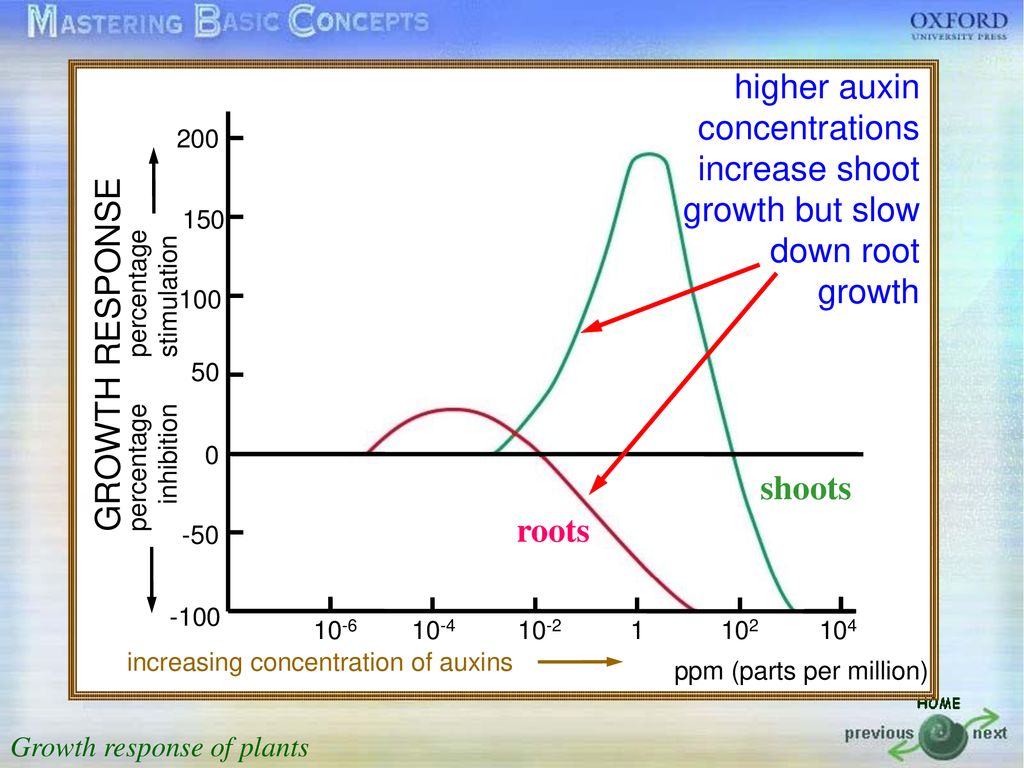
Effect of concentration of auxins
Auxin concentration that promotes growth in one part can inhibit growth in another part
Roots are more sensitive than shoots, shown in graph
Use of Plant Growth Regulators
Auxins
Used in rooting powders, especially synthetic eg. IBA. Cut end dipped in powder before insertion into growing medium; promotes growth of adventitious roots
Synthetic auxins used as selective herbicides also to remove dicots, eg. daisies, dandelions, trees. Monocots are resistant (ie grasses)
Cytokinins
Used in micropropogation to promote cell differentiation, eg. xylem and phloem, works together w IAA and gibberellins
Prolongs shelf life of cut flowers and vegetables
Used to break dormancy in buds and seeds, triggering leaf and growth in spring
Ethylene
Ethene (C₂H₄), used to ripen fruit. Produced by burning paraffin
As fruit rots, also releases ethylene, encouraging other fruit nearby to ripen
Triggers trees to drop leaves
Gibberellins
Cause stem lengthening. Mobilise stored food in germinating seeds and trigger digestion and absorption of food by embryo
Used to break dormancy in buds and seeds dormancy in spring
Abscisic Acid
Triggers bud and seed dormancy in autumn
Inhibits cell growth and premature seed germination in late winter/early spring
Sprayed on nursery plants before transportation, as when plants dormant are more resistant to damage
Adaptations that protect plants
Hawthorn: sharp throns discourage animals from eating it
Chillies: oils cause burning sensation in the mouth of deter browsers. Tend to become less hot when ripe and red
Nettles: stings containing formic acid (methanoic acid) discourages animals from eating or touching them. When touching, brittle pointed sting ppierces skin and injects acid resulting in welts
Gorse: hard stiff pointed leaves which discourage animals from eating it. When leaves die and dry out, become like tinder → spread fire and produce intense heat
Investigate effect of IAA on plant tissue
Serial Dilution
Make stock solution of 1ppm auxin
Put 10cm³ of this solution into test tube and 9cm³ distilled water into 5 other test tubes
Remove 1cm³ from stock solution (1ppm) and add to first test tube containing only water. Stopper and mix well
Remove 1cm³ from tube and add to next test tube of distilled water, stopper and mix well
Repeat until all test tubes used
Experiment Steps
7 sterile petri dishes and place 10 cress seeds on acetate grid in each petri dish
Place filter paper and enough cotton wool on top of seeds to hold them in position
Pour different concentration of IAA solution into each dish, ie 10⁻¹, 10⁻², 10⁻³, etc. Add water as control
Label each dish, then cover and seal
Stand dishes on edge so roots grow down and shoots up
Incubate at room temp for 3 days
Measure length of all roots and shoots in each dish and calculate average length of each
Results
Control had little growth
Low concentrations of IAA have longer roots than shoots
High concentrations of IAA have longer shoots than roots
Conclusions
Low concentrations of IAA promote root growth
high concentrations of IAA promote shoot growth