L26 - High Yield
 Call Kai
 Learn
 Practice Test
 Spaced Repetition
 Match
 Flashcards
 Knowt Play
1/111

There's no tags or description
Looks like no tags are added yet.
112 Terms
______: Thin, hollow, helical rods used for motility; governed by chemotactic responses
Flagella
3 components of the flagella?
Basal body, hook, and filament
________ - Small central rod spanning entire cell wall; spins (motor) flagellum
Basal Body
______ connects the rotary motor (basal body) to the whip-like propeller (filament
Hook
_____ Protein filaments; extend like long tails from cell membranes
Filament
Species of bacteria can be identified by use of specific antibodies against ______ proteins
flagellar
Virulence Factor = ?
Motility of bacteria allows for spread of infection
________: Single flagellum
Monotrichous
________: Two flagellum
Amphitrichous
_________: Two or more flagella at one or both ends
Lophotrichous
_________: Flagella all over the surface
Peritrichous
What type of flagella is this?
Monotrichous
What type of flagella is this?
Amphitrichous and Lophotrichus
What type of flagella is this?

Amphitrichous and Lophotrichus
What type of flagella is this?

Peritrichous
how does flagella impact virulence factor?
Motility of bacteria allows for spread of infection
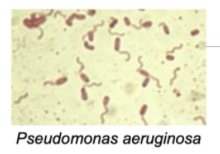
Pseudomonas aeruginosa would be an example of what type of flagella?
Monotrichous
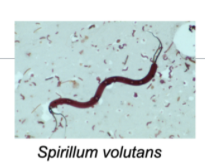
Spirillum voltans would be an example of what type of flagella
Amphi and Lophtrichus
Proteus vulgaris would be an example of what flagella type?
Peritrichous flagella
_____: Short, filamentous non-motile protein
Pili
types of pili?
Attachment Pili: Adheres to surfaces
Conjugation (Sex) Pili
how does pili act as a virulence factor
Serves as an adherence factor (adhesins)
Neisseria gonorrhoeae (bind to cervical & buccal cells), E. coli and Campylobacter jejuni (bind to intestinal epithelium)
This would be an example of?
Pili
_______: Polysaccharides; form loosely assoc. outer layer attached to cell wall
Capsule
_______: Formed due to depletion of essential nutrients, can lie dormant for years
Endospores
how do endospores serve as a virulence factor?
Activated then exposed to favorable nutrient environment
Bacillus would be an example of? (bacterial structure/adaptation)
Is it aerobic or anaerobic?
Endospore - Aerobic
Clostridium would be an example of?
Is it aerobic or anaerobic?
endospore - Anaerobic
__________: Organisms that survive in immune cells unharmed
Facultative Intracellular Organisms
what is the virulence factor of Facultative Intracellular Organisms?
inhibits phagosome-lysosome fusion
escapes deadly H2O2 and superoxide radicals
pathway of endospore formation (6 steps)
Spore septum forms, isolating replicated DNA and some cytoplasm.
Plasma membrane surrounds the isolated DNA and cytoplasm.
Spore septum encloses the isolated portion, forming a forespore.
Peptidoglycan layer forms between the two membranes.
Spore coat forms.
Endospore is released from the cell.
________: Proteins that are released by both gram positive and gram negative bacteria.
Released by all major gram _____ bacteria
Some gram _____ bacteria (e.g. Vibrio cholerae, E. coli) can secrete exotoxins
Exotoxins
positive
negative
______: Act on nerves or motor end plates to cause paralysis
Neurotoxins
______: Act on GI tract to cause diarrhea
Enterotoxins
________: Stimulates release of cytokines causing rash, fever, and toxic shock syndrome
Pyrogenic Exotoxins
_________: Bacteria destroys and tunnels through tissues
Tissue Invasive Exotoxins
_________: Disease unique to individual bacteria
Miscellaneous Exotoxins
Botulism would be an example of what type of exotoxin?
Neurotoxin
Tetanus would be an example of what type of toxin?
Neurotoxin
Symptoms and cuases of botulism?
Sym: lethal, rapidly fatal food poisoning
Cause: Spores in canned food not cooked through then placed in anaerobic conditions
mechanism of botulism?
Spores germate → bacteria release exotoxin that block Ach in nerve → flacid muscle paralysis
Sym and cause of tetanus?
Sym: lockjaw
Cause: Spores in soil enter skin through trauma
Mechanism of tetanus?
Toxin causes sustained contraction of skeletal muscle
Cholera would be an example of? (what type of toxin)
what does it cause?
Enterotoxins - causes infection Diarrhea
Bacillus cerus would be an example of? (what type of toxin is it?)
Enterotoxins
Staph. aureus would be an example of? (what type of toxin is it?)
Enterotoxins
what do Bascillus cerus and staph. aureus cause?
food poisening
What is a type I toxin?
Toxin binds to receptors on target host cells, but is not internalized within the cell
TSST-1 of Staph. Aureus would be an example of?
Type I toxin
How do superantigen exotoxins (Like Type 1 toxin - TSST-1 of Staph. Aureus) cause toxic shock? pathway
Bind to the high affinity T cell receptor–MHC Class II antigen complex.
Stimulate an enhanced T lymphocyte response.
Activate T cells, causing massive cytokine release (via IL-2, TNF, and IFN).
Excess cytokines can lead to toxic shock.
What is a type II toxin?
Toxins that mechanically destabilizes the integrity of host cell plasma membranes.
Phospholipases would be an example of what type of toxin?
type 2
How do Type II toxins damage host cells? pathway
Phospholipases or pore-forming cytotoxins disrupt host cell membranes.
Damaged host cells release damage-associated molecular patterns (DAMPs).
DAMPs bind to pattern-recognition receptors (PRRs), triggering inflammatory cytokine release.
Inflammatory cytokines can cause further tissue damage.
(disruption → dAMP released → PRR binding → inflammatory cytokines released)
What are type III toxins?
Toxins that binds to the surface of target host cells and a portion becomes internalized within the cell.
Cholera toxin would be an example of?
Type 3 (A-B) toxins
Q: How does cholera toxin cause active secretion of ions and water as a type III (A-B) toxin?
Cholera toxin binds to the GM1 ganglioside receptor on membrane.
A subunit enters the cell and activates the Gs protein, which activates adenylate cyclase.
Adenylate cyclase increases cAMP production.
Elevated cAMP causes active secretion of ions and water.
(binding to GM1 + integration → Gs activation → aden cyclase activation → cAMP production → releases ions + water)
___________ (endotoxin) is a very toxic toxin released when bacteria undergoes lysis.
it is usually only present in gram (negative or positive) bacteria
Lipid A endotoxin - gram negative
Lipid A can be ____ from living bacteria in steady amounts
How is this endotoxin different than exotoxins?
shed
its not a protein that is excreted from cells
_________: Deadly response to both gram positive and gram negative bacteria
Septic Shock
WHat is the localized site of infection in septic shock called?
Bacteremia
Q: What is the mechanism of septic shock?
Organisms release toxins into the bloodstream, stimulating immune cells.
TNF triggers IL-1 release, leading to cytokine and prostaglandin production.
The immune system, initially defending against microbes, begins damaging the body's organs.
Organ damage contributes to septic shock.
how to treat septic shock?
Broad spectrum antibiotics
Fluids, drugs, and oxygenation to support B/P
Recombinant activated Protein C - modest reduction in multi-organ failure and mortality
Hydrocortisone - increases blood pressure & increases survival
Polyclonal IVIG - reduced mortality among adults with sepsis
would monoclonal Ab, TNF, IL-1, or anti-inflammatory agents be successeful at blocking the inflammatory cascade in septic shock?
no
Antibodies bound to bacterial capsule (______) enable macrophages or neutrophils to bind to the FC portion of the antibody and phagocytize the bacteria.
opsonization
______ bound to bacterial capsule (opsonization) enable _______ or ______ to bind to the FC portion of the antibody and phagocytize the bacteria.
Antibodies; macrophages or neutrophils
Antibodies bound to bacterial capsule (opsonization) enable macrophages or neutrophils to bind to the ______ of the antibody and _______ the bacteria.
FC portion; phagocytize
______ – structural component (LPS) of gram-negative bacteria.
Endotoxins
Endotoxins are not actively secreted by ______.
Endotoxins are lipopolysaccharides (LPS) and cause ______ sepsis.
bacteria (they are located on the outer membrane of gram negative LPS and “shed”)
Gram- negative
Endotoxins are are seen in gram ___
negative
septic shock is a Deadly response to both _____ and ______
bacteria.
gram +ive; gram –ive
in septic shock, organisms release toxins (_______) that circulate in the bloodstream and stimulate _______ via ____ from TNF
endo/exotoxins; immune cells via IL-1
Endogenous mediators of sepsis?
TNF
what does TNF do in septic shock?
triggers the release of IL-1 from macrophages and
endothelial cells triggering the release of other cytokines
and prostaglandins.
Monotrichous, amphitrichous, lophitrichous, or peritrichous?
Pseudomonas
monotrichous - single flagellum
Monotrichous, amphitrichous, lophitrichous, or peritrichous?
Spirillum
amphitrichous - two flagella and lophotrichous - two or more flagella
Monotrichous, amphitrichous, lophitrichous, or peritrichous?
Salmonella
peritrichous - flagella all over the surface
Monotrichous, amphitrichous, lophitrichous, or peritrichous?
Proteus
peritrichous - flagella all over the surface
A gram-negative bacteria is able to mechanistically destabilize the integrity of a host cell membrane. What type of toxin is this?
Type II toxins
Can both Gram + and - do septic shock
yes
which bacteria (aerobic) gram pos can form endospores?
bacillus
which anaerobic bacteria (gram pos) can form endospores?
Clostridium
what is able to bind to prosthetic devices like IV catheters and form a mechanincal scaffold?
Which bacteria would you expect to do this in the hospital?
biofilms
Staphylococcus epidermidis.
which bacteria would you expect to Inhibit phagosome-lysosome fusion and escape host’s deadly H2O2 and superoxide radicals (facultative)
Listeria and Salmonella
which bacteria would you expect to secrete exotoxins
cholerae and e.coli
_____ are not actively secreted by bacteria
these are structural components in?
Endotoxins
LPS
disease manifestation of V. Cholerae?
infection diarrhea
disease manifestation of Bacillus cereus?
Food Poisoning
disease manifestation of staphylococcus aureus.?
Food Poisoning
TSST-1 of Staphylococcus aureus is associated with that type of toxins?
Type I
phospholipases are associated with what type of toxins?
type II
cholera is associated with what type of toxins?
Type 3 (A - B)
Example of a bacteria that uses pili that binds to cervical/buccal cells?
Gonorrhoeae
example of bacteria that uses pili that cause diarrheas using its adhesions to bind to intestinal epi? (theres 2)
E coili and Campy
Examples of capsules that use rough and smooth colonies?
Streptococcus pneumoniae
Examples of Facultaticve intracellular organisms? (theres 2)
Listeria and salmonella
What cell structures make the bacteria unable to be phagocytosed from macrophages and neutrophils
capsules
What type of toxins release for exotoxins?
Type 1 - 3 Toxins
mechanism of release for exotoxins
shed from living bacteria in steady amounts. Only seen in endo