L2: Hereditary and Prenatal Development
 Call Kai
 Learn
Learn Practice Test
 Spaced Repetition
 Match
Match Flashcards
 Knowt Play
1/48

There's no tags or description
Looks like no tags are added yet.
Name | Mastery | Learn | Test | Matching | Spaced | Call with Kai | Chat |
|---|
No analytics yet
Send a link to your students to track their progress
49 Terms
Intro
hereditary influences on development
influences of genes on probability/sensitivity on neurodevelopment
genes interact with environment + experience + timing (when genetic changes happen)
case paper - to avoid genetic determinism
Introduction to Genetics (Zygote)
father’s sperm + mother’s ovum = zygote
46 chromosomes total
23 from each parent
Every cell in your body traces back to this single cell.
The Role of Genes
Each chromosome contains genes.
Made up of DNA
The chemical code that supports development
Shaped like a double helix
Has the ability to replicate + respond to signals, of which give rise to development for a child to be flexible rather than fixed (for recovery, dev, etc.)
genes from the basis of hereditary
Hereditary Transmission - Mitosis
Mitosis begins after fertilization. (allows single cell → complex organism of many cells; although cells have same genetic material, they do not become same cell type → same genes therefore does not lead to same developmental outcome)
cells divide to support growth + repair
Hereditary Transmission - Meiosis
Meiosis- produces reproductive cell (sperm, egg), exchanges genetic material thru crossing over, creating new combo of genes - a major reason why siblings differ in temperament, cognition, etc. even from same parent
Genetic diversity - diff starting points - interact differently w env over time
Crossing over: Genes from a maternal chromosome “cross over” to the paternal chromosome and vice versa. Note that the 23rd pair of chromosomes for the male consists of one elongated X chromosome and a Y chromosome that is noticeably smaller, whereas the 23rd pair for the female consists of two X chromosomes
Multiple Births: Identical vs. Fraternal Twins
Multiple births: twins
Monozygotic (identical): a zygote that divides to form two genetically identical individuals (share all genes)
Dizygotic (fraternal): occurs when two ova are released simultaneously and each is fertilized by a different sperm (share half of genes)
Identical, or monozygotic, twins (left) develop from a single zygote. Because they have inherited identical sets of genes, they look alike, are the same sex, and share all other inherited characteristics → if identical twins are the same = genetic influence; but their differences highlight important of env influences
Twins provide a natural experiment for studying heredity and environment → helps separate genetics + env influences
Determining Biological Sex: The Role of Chromosomes
Male or female?
The 23rd pair of chromosomes:
Males have X and Y chromosomes
Females have X and X chromosomes
Sex of child determined by father’s sperm
Functions of Genes in Development
Genes direct production of amino acids necessary for forming new cells
Guide cells to develop different parts of body (differentiation)
Regulate pace and timing of development
May “turn on” or “turn off” other genes
Impacted by environmental factors
Gene Expression and Inheritance Patterns
Gene expression - whether a gene is active at a certain time (simplest model)
Alleles influence many characteristics
One pair of genes
One member from mother, one from father
Simple dominant–recessive inheritance (e.g., eye colour)
Some alleles are stronger than others.
Dominant alleles will always express themselves if they are present.
Recessive alleles will only express themselves if both alleles in the pair are recessive.
Allele Combinations: Homozygous, Heterozygous, and Codominant
If two alleles are homozygous
they are both dominant or both recessive.
If two alleles are heterozygous
one is dominant and one is recessive
If two alleles are codominant
both alleles are expressed simultaneously.
e.g., AB bloodtype
Examples of Dominant and Recessive Traits
Most psychological traits are polygenic and not determined by single genes

Sex-Linked and Polygenic Inheritance
Sex-linked inheritance
Characteristics associated with genes on sex chromosomes
Most on X chromosome
Making males more susceptible to recessive X-linked traits (no second X chromosome to buffer/compensate) → hence some conditions more likely for males
Polygenetic inheritance
Characteristics influenced by many pairs of alleles
many psych characteristics fall under this category
shows that many outcomes are probabilistic rather than predetermined
Epigenetics: Modifying Gene Expression
Epigenetics: a modification of gene expression that has no effect on the DNA (influences activation of genes)
Can affect subsequent generations under specific circumstances
gene expression responsive to experience (env, diet, exposure to toxins, caregiving envs, etc.)
Example: environmental factors like stress, diet, or exposure to toxins can lead to epigenetic changes that might affect offspring (can transfer b/w generations)
Hereditary and Congenital Disorders
Babies may have problems at birth due to hereditary (genetic) or prenatal environmental influences
Hereditary disorders are passed from parents to offspring
Congenital problems are present at birth but not always apparent at birth (e.g., autism, seizures)
Present at birth ≠ detected at birth
Causes of Chromosomal Abnormalities
How do chromosomal abnormalities occur?
During cell division in meiosis (production of eggs + sperms), distribution of chromosomes may be uneven (nondisjunction)
separation may not be even → gametes
May also occur through mutation (changes in genetic material caused by error in replication process or thru exposure to env hazards)
Most abnormalities are lethal.
Some are not, and some babies are born with +1 or −1 chromosome. (leads to recognizable dev pattern/visible in child at birth)
Hereditary Disorders
Sex chromosomes
Female abnormalities
Turner syndrome: XO
Poly-X syndrome: XXX, XXXX, or XXXXX
Male abnormalities
Klinefelter syndrome: XXY or XXXY
Supermale syndrome: XYY, XYYY, or XYYYY
those w developmental disorder may have healthy lives but need support etc.
Autosomal Abnormalities: Down Syndrome
Autosomes
First 22 pairs of chromosomes (not involved in sex determination)
Autosomal abnormalities
Down syndrome (trisomy 21) most common
Extra 21st chromosome
Intellectual disability - reach key dev milestones but at a slower pace
Distinctive physical features
Risk increases with age of mother - genetic influences on meiosis process rather than env influences?
Genetic Abnormalities: Recessive and Dominant Alleles
Genetic abnormalities often associated with recessive alleles
Recessive disorder = child inherits affected allele from both parents who are healthy carriers
Cystic fibrosis
Diabetes
Hemophilia
Parents often healthy; both must be carriers
all more common in males due to x-linked inheritance
Some genetic abnormalities associated with dominant alleles
Huntington’s disease
Parent contributing allele has the disorder
Genetic Counselling and Detection of Hereditary Disorders
Genetic counselling: professional service that helps prospective parents estimate the likelihood of hereditary or chromosomal disorders
Especially relevant for:
Older parents
Families with a history of genetic disorders
Couples who have previously had an affected child
Key tools used
Pedigree analysis: family history across generations
Blood and DNA tests: identify carrier status ▪ Screening tests: assess risk, not certainty
Prenatal Detection Techniques
Amniocentesis (15–22 weeks)
Analyzes fetal cells in amniotic fluid
Detects chromosomal and genetic disorders
Small miscarriage risk (Approx. 1 in 400)
Chorionic villus sampling (CVS) (10–14 weeks)
Earlier detection than amniocentesis
Slightly higher miscarriage risk (1–2%)
Non-invasive prenatal testing (NIPT)
Blood test using placental DNA
Very high accuracy for trisomy 21 (down syndrome)
Screening Test (not diagnostic)
No risk to fetus
Positive NIPT results require confirmation with diagnostic testing
Ultrasound
Detects physical abnormalities
Does not test chromosomes directly
Treating Hereditary Disorders (review)
Treatment approaches
Dietary interventions
Phenylketonuria (PKU) managed through early and sustained dietary control - genetic disorder that cannot break down phenylalanine
Example of how early intervention alters developmental trajectories
Fetal surgery (rare, final option)
Corrects life-threatening abnormalities before birth
Still experimental; ethical risks involved
Genetic engineering (replacing affected genes w healthy ones to correct error)
Somatic gene therapy: affects the individual only
Germline gene therapy: affects future generations (highly controversial)
Hereditary Influences on Behaviour - review
Behavioral genetics examines how genes and experience jointly shape behavior
biological predispositions + environmental experiences
Which behaviors show genetic influence? •How do environments amplify, suppress, or redirect genetic tendencies?
Genotype and Phenotype: Hereditary Influences on Behaviour
genotype (inherited genetic potential) is expressed thru phenotype (observable traits & behaviours)
Hereditary Influences on Behaviour (review)
Heritability: Refers to population-level variability, not individuals
A high heritability does not mean a trait is fixed or unaffected by environmental influence
Methods to determine heritability
Selective breeding experiments (animals): shows genetic contribution
Tryon’s “maze bright” and “maze dull” rats (rats bred for ability to navigate maze; bright rats improved over generations → shows genetic basis for maze running ability)
Family studies - compare resemblance among relatives (trait comparison among family members shows similarities)
Family Study Methods in Behavioral Genetics
Twin design
Researchers compare maternal + fraternal twins - if identical twins are more similar, genetics play roles in trait
?
Are identical twins raised up together more similar than fraternal twins raised up together?
Adoption design
Are adopted children similar to biological parents or adopted parents?
If child is more similar to parents, there is genetic influence
Adopted children similar to adoptive parents, suggests an env influence
Concordance rates are calculated
Percentage of pairs of people in which both members display a trait (identical twins often discordant for many traits…)
Environmental Influences on Behavior
Two influences examined
Non-shared environmental influences: Experiences unique to individual, not shared by other members of family in same environment
Shared environmental influences: Experiences common to all family members in same environment (e.g., family socioeconomic status, parenting styles, diets)
Heritability and Inheritance - review
Heritable does not equal inherited.
heritability - how much variation in a specific trait in the pop can be contributed to by genetics
does not mean it can be inherited by individual (cognitive abilities, illnesses, etc.) but genetic factors can influence greatly
ADHD is heritable, but does not mean a child would inherit ADHD from their parents, as research shows that parenting style, education, and stress plays a role in whether or how ADHD manifests
Gene-Environment Interactions: Canalization Principle
Canalization principle: Genes restrict development to a small range of outcomes. Meaning that some traits are highly regulated by genes and are less influenced by the environment.
basic motor skills, language development, occurs
e.g., babbling + walking in infants (walking around the same age regardless of environmental factors (cultures, areas, etc.))
Range-of-Reaction Principle
Genes set boundaries for a range of phenotypes (possible outcomes) based on environment, and the environment determines where within that range an individual will fall (enriched environment (within highest range) vs. impoverished environment (within lowest range))
Child’s height has a genetic range, but factors like nutrition or health can influence whether they reach the upper or lower end of that genetic potential
Genotype and Environment Correlations
Genotype and environment may be correlated.
Passive genotype/environment correlations: when parents provide both genes and environments to their children (parents who are musicians, likely that child inherits their musical talent, and they may grow in a much more musical environment)
Evocative genotype/environment correlations: when a child's genotype is prompted the environment. (review)
Active genotype/environment correlations: when a child actively selects environments that match genetic tendencies.(seek envs that enriches + supports their talents (e.g., sports))
Contributions and Criticisms of the Behavioural Genetics Approach
Contributions
Many traits are influenced, at least in part, by genes
Epigenetic re-modelling plays role in phenotype plasticity (env can impact plasticity) - review plasiticity
Criticisms
Behavioral genetics often describes how much genes and environment matter, but less clearly explains how they interact across development.
Many behavioural genetic findings come from population averages and may not apply directly to individuals. (overgeneralization)
Prenatal Development Stages
Germinal period or the period of the zygote
Period of the embryo
Period of the fetus
Germinal Period
Germinal period or the period of the zygote
From conception to implantation in uterine wall
Zygote travels down the fallopian tube
Cell division occurs in preparation for implantation
Most fertilized eggs never implant successfully
Period of the Embryo (Embryonic)
Period of the embryo (From week 3 to week 8)
Formation of major body structures
Development of three cell layers:
Ectoderm: Nervous system and skin
Mesoderm: Muscles, bones, circulatory system
Endoderm: Digestive system and lungs
Development of placenta and umbilical cord - very vulnerable stage of development
Period of the Fetus
Period of the fetus (From week 9 to birth)
Rapid growth and organ development
By third month: Movement, digestion, urination, and sex organ formation
Second trimester: Refined movements (kicking, thumb sucking)
Third trimester: Organ system maturation and weight gain
Age of viability: Weeks 22–28 (survival outside the womb)
Birth typically between weeks 38 and 41
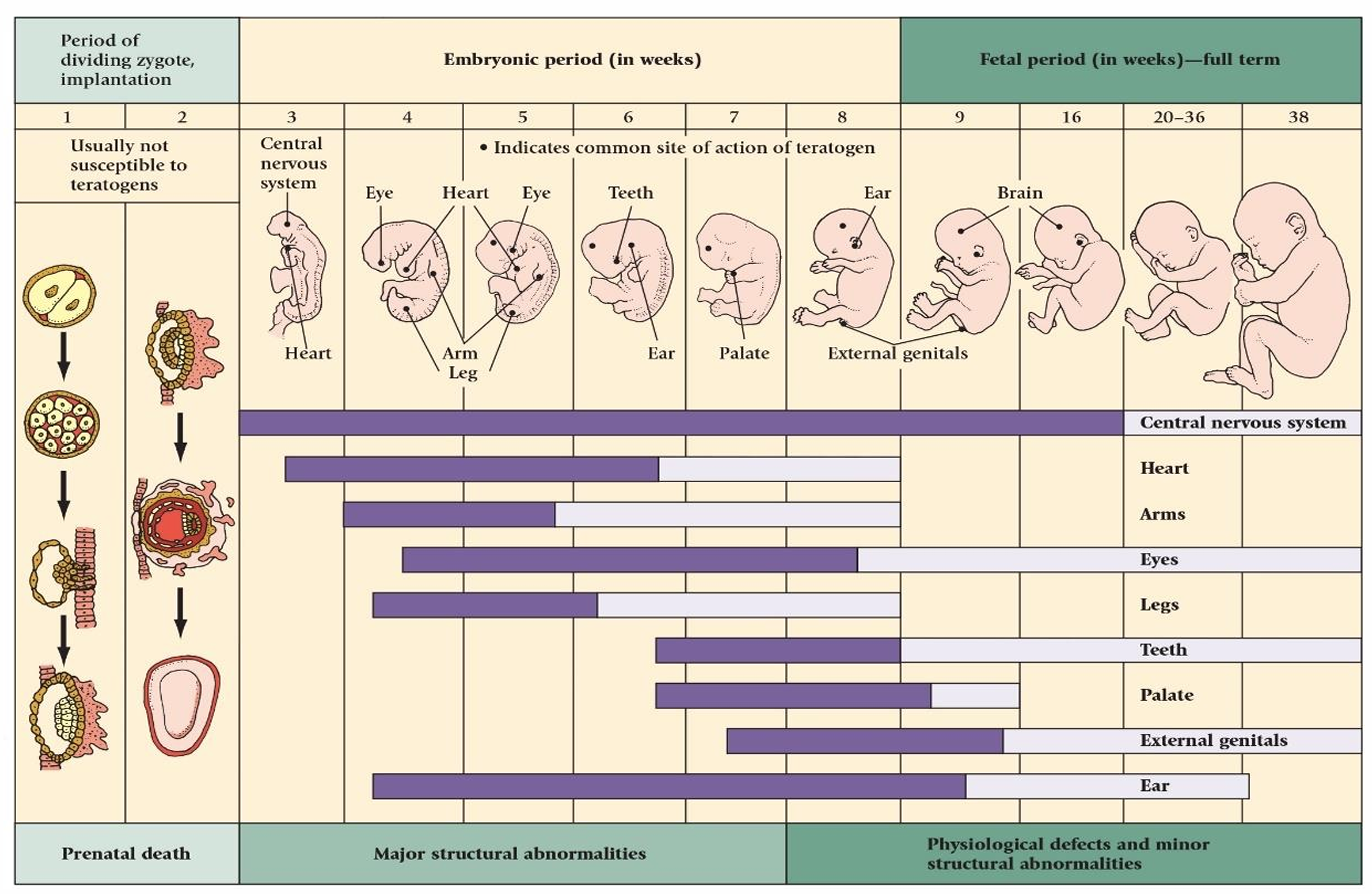
Environmental Influences on Prenatal Development
Environmental factors affect prenatal development.
Teratogens (viruses, drugs, chemicals, radiation) - embryonic period most sensitive to
Environmental hazards (air pollution; water contamination)
Maternal characteristics (Nutrition, emotional well-being, age)
diagram - dark purple most sensitive periods, light purple less sensitive to teratogens
Sensitive Periods in Prenatal Development
Each developing structure has a sensitive period.
A time when it is particularly susceptible to be damaged from teratogens + alcohol, etc.
Recall rapid development during embryonic period
Once fully formed, body parts are less susceptible to damage. (higher risk for behavioural/functional abnormalities rather than physical abnormalities that are more likely to occur early on)
Maternal Diseases
Rubella Disease (German weasels)
Most dangerous in first trimester
Effects include blindness, deafness, cardiac abnormalities, intellectual disability
Toxoplasmosis Infection
Caused by a parasite acquired from undercooked meat or handling feces from cats
Effects include brain damage, vision loss in first trimester; miscarriage thereafter
Sexually Transmitted Diseases/Infections
Syphilis: not dangerous until 18th prenatal week
Effects include eye, ear, bone, heart defects or brain damage, or miscarriage
can be cured through antibiotics for mother (but may lead to still birth)
Genital herpes: most infectious at birth (thru birth canal via natural birth)
Effects include death, blindness, brain damage, neurological disorders
HIV/AIDS: screening and antiretroviral treatment have reduced prenatal transmission to 2% (in NA and Europe).
Effects of exposure to HIV in developing countries include low birth weight, impaired early growth, impaired psychomotor and cognitive development, and immune issues.
Thalidomide and Diethylstilbestrol (DES): Historical Lessons on Teratogens
2 historical drugs that were first believed to be safe but are actually harmful
Thalidomide (unpredictable risks)
Originally marketed to relieve morning sickness among pregnant women
Lab tests with rats showed no effect on fetus
Harmful when taken early in human pregnancy
Many babies born with severely deformed eyes, ears, noses, hearts, and phocomelia (underdeveloped limbs)
Yet, many showed no effect at all → risk is unpredictable
Diethylstilbestrol (DES) - used for pregnancy support and cancer treatment
Effects not apparent until early adulthood (reproductive system cancers or fertility issues for children)
Alcohol and Fetal Development: FASD and Its Impact
Fetal alcohol spectrum disorder (FASD) - umbrella term for prenatal alcohol exposure, increases risk for the following:
Fetal alcohol syndrome (FAS)
Caused by heavy drinking
Effects include microencephaly (baby head’s smaller than expected bc brain did not develop properly/stopped developing), facial malformation, hyperactivity, seizures, intellectual and learning difficulties
Fetal alcohol effects (FAE)
Caused by moderate, social drinking
Effects include poor motor skills, attention problems, below-average intelligence
The Impact of Cigarette Smoking on Prenatal Development
Cigarette smoking, introduces nicotine + CO2 into bloodstream for mother + child, affecting oxygen levels + nutrients?
Slows growth of fetus
Associated with low birth weight and increased risk of cleft lip with or without cleft palate
↑ risk of miscarriage or of SIDS (sudden infant death syndrome)
Long-term effects less clear
Some studies report cognitive deficiencies, however,
strongly shaped by postnatal environment and caregiving.
The Impact of Illicit Drugs on Prenatal Development
Cocaine → Premature births mean smaller babies, lower IQs
Opioids (ex.Heroin, prescription Narcotics) → Increased neonatal death, born addicted, may recover
Marijuana → prenatal exposure has been associated with emotional, behavioural, and academic problems
Radiation and Environmental Hazards in Prenatal Development
Radiation: high exposure can result in serious physical deformities, intellectual disabilities, death (timing + dose important)
Chemicals and pollutants: can cause physical deformities and intellectual disabilities
these risks are probabilistic rather than deterministic
Maternal Diet and Its Impact on Fetal Development
Diet - Weight gain of 11 to 14 kg recommended
Malnutrition results in small babies.
May disrupt spinal cord development in first trimester
Leads to low birth weight in third trimester
Adequate protein-calorie intake crucial to brain development
Folic acid (folate) is crucial for neural tube development.
Spina bifida is a defect occurring during neural tube development.
Emotional Well-Being and Age Factors in Pregnancy
The mother’s emotional well-being
↑ chronic/severe stress (e.g., workplace stress, loss of a loved one) → ↓ birth weight → ↑birth complications
moderate stress may not be harmful + may support fetal development
The mother’s age
Risks associated with teen mothers (premature birth, low birth weight associated w little prenatal care)
Risks associated with older mothers (above mid-30s) - increased risk of chromosomal abnormalities, etc.
Protective factors such as social support can reduce prenatal stress effects.
Genetic Abnormalities and Healthy Birth Outcomes
Most genetically abnormal embryos do not develop to term.
Ninety-five percent of newborns are healthy.
Many of the remaining 5% have minor congenital problems (minor, temporary, or treatable).
Prospective parents can lower the odds of an abnormal birth by following practical suggestions (healthy lifestyle, stress management, avoiding harmful substances, prenatal care.
Reading - why read it? Central Developmental Claim + Evidence
Why Are We Reading This Paper?
discussed 2 topics: Do prenatal experiences shape mental health? What does “risk” mean in developmental psychology?
Central Developmental Claim
Prenatal conditions are associated with later mental health risk
Effects are probabilistic, not deterministic
What Evidence Is Used?
Correlational evidence b/w birth weight + later psychopathology and chronic illnesses
Longitudinal human studies
Epidemiological data
Animal models
Neurobiological research
What the Paper Does Not Claim?
that prenatal stress causes mental illness (rather that it changes the risk trajectories)
that effects are permanent or irreversible
that there is only one single biological pathway
Common Misinterpretations!
“Prenatal stress permanently damages children.”
“Mothers cause children’s mental health problems.”
“Prenatal experiences determine children's futures.”
Best Developmental Lens + Why this matters?
Transactional / developmental systems perspective
development is plastic
transactional = relational, interactional
Biology × environment × time
timing is important
Increased sensitivity, not fixed outcomes