Art history 280 iowa state exam 2
 Call Kai
 Learn
Learn Practice Test
 Spaced Repetition
 Match
Match Flashcards
 Knowt Play
1/126

There's no tags or description
Looks like no tags are added yet.
Name | Mastery | Learn | Test | Matching | Spaced | Call with Kai | Chat |
|---|
No analytics yet
Send a link to your students to track their progress
127 Terms
Geometric Period (Ancient Greece)
(c. 900-700 BCE)
Orientalizing Period (Ancient Greece)
(c. 700-600 BCE)
Archaic Period (Ancient Greece)
(c. 600-480 BCE)
Early Classical Period (Ancient Greece)
(480-450 BCE)
High Classical Period (Ancient Greece)
(c. 450-400 BCE)
Late Classical Period (Ancient Greece)
(400-323 BCE)
The Hellenistic Period (Ancient Greece)
(323-31/30 BCE)
THE ETRUSCANS
(c. 500 BCE)
Roman Republic
(c. 50 BCE)
Julio Claudians (The Roman Empire)
(c. 0)
Flavians (The Roman Empire)
(c. 79 AD)
Good Emperors (The Roman Empire)
(c. 117)
Severans (The Roman Empire)
(c. 200)
Soldier Emperors (The Roman Empire)
(c. 250)
Late Empire (The Roman Empire)
(c. 300-476 AD)
Created individual busts
Romans
known for archs
Romans
Archaic smile
Greeks
only have paintings from this group
Romans
1st greek olympics
776 BCE
kouros
archaic-period greek statue of a standing nude youth

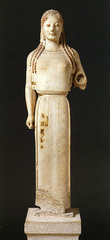
kore
archaic-period greek statue of a draped maiden
cella / naos
a rectangular hall in ancient temple architecture, housing an altar or cult image.
peripteral temple
one with free standing columns in the front (colonnaded portico) whereas the columns along the sides are engaged in the peripheral walls of the naos or cella.

colonnade
a row of columns supporting a roof, an entablature, or arcade.

Doric
an architectural style characterized by columns that have a simple cushionlike abacus and the absence of a base.

ionic
an architectural style characterized by columns that have a base and a capital with two volutes.
corinthian orders
is the most ornate of the orders, characterized by slender fluted columns and elaborate capitals decorated with acanthus leaves and scrolls.

volute
a spiral scroll characteristic of Ionic capitals and also used in Corinthian and composite capitals.

acanthus leaves
an ornament may be carved into stone or wood to resemble leaves from the Mediterranean species of the Acanthus genus of plants,

fluted shaft
in architecture is the shallow grooves running vertically along a surface. The term typically refers to the grooves running on a column shaft or a pilaster, but need not necessarily be restricted to those two applications.

entablature
in classical order the entire structure above the columns this usually includes the architrave, frieze, and cornice.

pediment
a low gable typically triangular framed by a horizontal cornice below and two raking cornices above.

triglyph
a tablet in a Doric frieze with three vertical grooves. Triglyphs alternate with metopes.

metope
In classical architecture, is a rectangular architectural element that fills the space between two triglyphs in a Doric frieze

frieze
a continuous band of painted or sculptured decoration.

red-figure / black-figure vessels
a type of greek vase painting in which the design is outlined in black and the background painted in black. leaving the figures and the reddish color of the baked clay after firing.

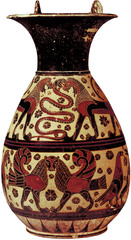
amphora
a tall ancient Greek or Roman jar with two handles and a narrow neck.

bilingual amphora
vase painting is a special form of ancient Greek vase painting. The term, derived from linguistics, is essentially a metaphorical one; it describes vases that are painted both in the black-figure and in the red-figure techniques.

krater
a large vase in Ancient Greece, particularly used for watering down wine

lost-wax bronze casting
is the process by which a duplicate metal sculpture (often silver, gold, brass or bronze) is cast from an original sculpture. Dependent on the sculptor's skills, intricate works can be achieved by this method.

Polykleitos, The Canon
The renowned Greek sculptor Polykleitos designed a sculptural work as a demonstration of his written treatise, entitled the "Kanon" (or Canon, translated as "measure" or "rule"), exemplifying what he considered to be the perfectly harmonious and balanced proportions of the human body in the sculpted form.

contrapposto
italian for set against. the disposition of the parts of the body so that the weight-bearing or engaged leg is distinguished from the raised or free leg, resulting in a shift in the axis between the hips and shoulders.

Perikles
Pericles was a prominent and influential Greek statesman, orator and general of Athens during the Golden Age—specifically the time between the Persian and Peloponnesian wars.

Athens
Athens is the capital of Greece. It was also at the heart of Ancient Greece, a powerful civilization and empire.
Delian League
founded in 478 BC, was an association of Greek city-states, members numbering between 150, 173, to 330 under the leadership of Athens, whose purpose was to continue fighting the Persian Empire after the Greek victory in the Battle of Plataea at the end of the Second Persian invasion of Greece.
entasis
a slight convex curve in the shaft of a column, introduced to correct the visual illusion of concavity produced by a straight shaft.

Elgin Marbles
a collection of Classical Greek marble sculptures made under the supervision of the architect and sculptor Phidias and his assistants.

caryatid
is a sculpted female figure serving as an architectural support taking the place of a column or a pillar supporting an entablature on her head.

The Agora
was a central public space in ancient Greek city-states. The literal meaning of the word is "gathering place" or "assembly". the center of the athletic, artistic, spiritual and political life of the city.

white-ground vessels
White-ground painting is less durable than black- or red-figure, which is why such vases were primarily used as votives and grave vessels.
Sparta
Sparta was a prominent city-state in ancient Greece. In antiquity the city-state was known as Lacedaemon, while the name Sparta referred to its main settlement on the banks of the Eurotas River in Laconia, in south-eastern Peloponnese.
Alexander the Great
was a king of the Ancient Greek kingdom of Macedon and a member of the Argead dynasty.

753 BCE
According to legend, Ancient Rome was founded by the two brothers, and demi-gods, Romulus and Remus on this date
Tiber River
Romulus & Remus
twin brothers, whose story tells the events that led to the founding of the city of Rome and the Roman Kingdom

verism
the artistic preference of contemporary everyday subject matter instead of the heroic or legendary in art and literature; it is a form of realism.

composite order
is a mixed order, combining the volutes of the Ionic order capital with the acanthus leaves of the Corinthian order.

tuscan order
is in effect a simplified Doric order, with un-fluted columns and a simpler entablature with no triglyphs or guttae.
appendage aesthetic
engaged column
is a column embedded in a wall and partly projecting from the surface of the wall, sometimes defined as semi or three-quarter detached.

pilaster
a rectangular column, especially one projecting from a wall.

keystone
is the topmost stone in the arch.
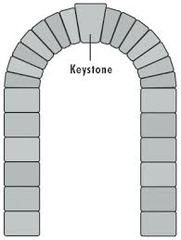
voussoirs
a wedge-shaped or tapered stone used to construct an arch.

barrel vault
a vault forming a half cylinder.

Mt. Vesuvius
ount Vesuvius is a somma-stratovolcano located on the Gulf of Naples in Campania, Italy, about 9 km east of Naples and a short distance from the shore. It is one of several volcanoes which form the Campanian volcanic arc.

79 AD
Mount Vesuvius, a volcano near the Bay of Naples in Italy, is hundreds of thousands of years old and has erupted more than 50 times. Its most famous eruption took place in this year.
Herculaneum & Pompeii
atrium
a large open air or skylight covered space surrounded by a building.

mosaic
is a piece of art or image made from the assemblage of small pieces of colored glass, stone, or other materials

tesserae
a small block of stone, tile, glass, or other material used in the construction of a mosaic.
(in ancient Greece and Rome) a small tablet of wood or bone used as a token.

roundels
a small disk, especially a decorative medallion.

oculus
s a circular opening in the centre of a dome or in a wall. Originating in antiquity, it is a feature of Byzantine and Neoclassical architecture. It is also known as an œil de boeuf from the French, or simply a "bull's-eye".

coffers
a strongbox or small chest for holding valuables.

basilica
a large meeting hall its exact form varying according to its specific use as an official public building.

Diocletian
was a Roman emperor from 284 to 305. Born to a family of low status in Dalmatia, Diocletian rose through the ranks of the military to become roman cavalry commander to the Emperor Carus

tetrarchy
describes any form of government where power is divided among four individuals
Battle of Milvian Bridge
The Battle of the Milvian Bridge took place between the Roman Emperors Constantine I and Maxentius on October 28, 312
Edict of Milan
a letter signed by the Roman emperors Constantine and Licinius, that proclaimed religious toleration in the Roman Empire.
313 AD
when edict of milan was signed
Funerary Vase (Amphora), Geometric Period, c. 900-700 BCE

Centaur, Geometric Period, c. late 10th century BCE

Mantiklos Apollo, Geometric Period, c. 750 BCE

Pitcher (Olpe), Orientalizing Period, c.600 BCE
Kouros, Archaic Period, c. 540 BCE

Anavysos Kouros, Archaic Period, c.450 BCE

Peplos Kore, Archaic Period, c. 530 BCE

Dying Warrior, Archaic Period, c. 480 BCE

Exekias, Achilles and Ajax Playing a Game, Archaic Period, c. 540 BCE

Death of Sarpedon, by: Ephronios (painter)Archaic Period, c. 515 BCE

Kritios Boy, Early Classical Period, 480 BCE

Riace Warrior A, Early Classical Period, 450 BCE found in the sea

Polykleitos, Doryphoros (spear bearer), High Classical Period, c. 450-400 BCE

Acropolis, High Classical Period, c. 450-400 BCE

Iktinos, Parthenon, High Classical Period, c. 450-400 BCE

Pheidias, Athena Parthenos, recreation of a High Classical Period sculpture

Erechtheion, High Classical Period, c. 450-400 BCE

Nike Untying Her Sandal, High Classical Period, c. 450-400 BCE

Woman and Maid, High Classical Period, c. 450-400 BCE

Praxiteles, Aphrodite of Knidos, Late Classical Period, c. 400-323 BCE
