Human anatomy
 Call Kai
 Learn
 Practice Test
 Spaced Repetition
 Match
 Flashcards
 Knowt Play
1/49

There's no tags or description
Looks like no tags are added yet.
50 Terms
A person has a fever, sore throat, and an increased number of neutrophils in their blood. They most likely have:
a bacterial infection
This plasma protein functions to help provide immunity:
gamma globulins
Red blood cells do not have a nucleus
True
There are 5 million red blood cells in a single drop of blood.
True
Blood needs to have a specific water-to-salt ration to that it does not become too thick or too dilute. This is the basis of:
Osmotic pressure
What may a hematocrit of 30 % indicate?
low red blood cell numbers, anemia
When are red blood cells formed and where are they broken down?
formed in the red bone marrow, broken down in the spleen
This plasma protein contributes to the osmotic pressure of the blood, meaning it helps hold water in the blood.
albumin
What is the main component of the plasma?
water
Platelets aren’t really cells, they are cellular fragments of a larger cell called a megakaryocyte.
True
Portion of the cardiac conduction system found in the ventricles, which allows the ventricles to contract in a coordinated manner:
purkinje fibers
This arterial blood vessel carries oxygenated blood from the left ventricle of the heart, to supply the entire body:
aorta
Straining on the toilet can:
decrease blood returning to the heart from veins
lower stroke volume
decrease cardiac output
lower blood pressure
cause dizziness or feinting
The inner lining of the heart is known as the:
endocardium
Which portion of the ECG tracing is due to depolarization of the ventricles?
QRS complex
Carbon dioxide is the other respiratory gas (besides oxygen) carried in the blood. It is produced as a byproduct from the chemical reaction of cellular respiration. Based on this information, classify carbon dioxide:
waste
The sides of the heart contract:
simultaneously
This is a wonderful chapter filled with blood and bodily fluids, tubes, and the pump that drives them.
True
These thin fibrous cords anchor the AV valves to the papillary muscles in the ventricles:
Chordae tendinae
These blood vessels branch off of the aorta and supply the heart muscle with oxygenated blood:
coronary arteries
Blood is one of the most important tissues in the body and without it, we could not survive. Blood and other fluids carry oxygen, carbon dioxide, hormones, nutrients, wastes and pathogen fighting agents, all to maintain our lives.
True
As valves close, and blood hits those valves, heart sounds are created. We can hear those sounds when we listen with a stethoscope.
True
The pulmonary trunk and arteries carry blood to the lungs where it picks up ox
Left atrium
If we didn’t have the chordae tendinae and papillary muscle, the valve flaps would invert like a(n) _____ in a windstorm, and blood would flow backwards into the atria.
umbrella
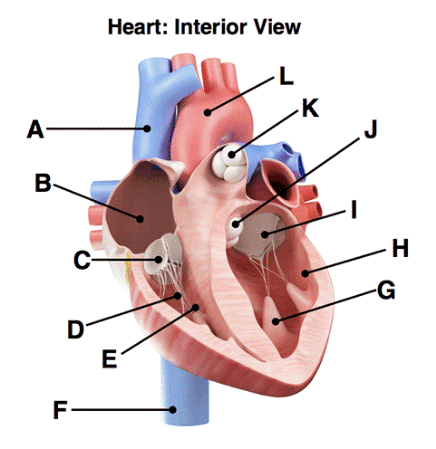
Identify the atrioventricular valve labeled I:
Bicuspid
A lubricating fluid is found between the layers of the serous pericardium, to reduce friction as the heart contracts.
True
This very short circuit supplies and drains the heart muscle:
coronary circuit
The slick, innermost layer of the blood vessel, consisting of simple squamous epithelium, is known as the:
Tunica intima
Once the subclavian artery travels into the armpit region, its name changes to:
Axillary artery
Unpaired blood vessels always reminded me of a _____ of a tree.
trunk
When we are dehydrated, we have less water in our blood. The blood is thicker or more “viscous”.
True
Deep veins located close to the muscles and a matching artery are usually have the same name (ex. femoral artery and vein).
true
Which vessels carry blood toward the heart?
veins
Which of the following is considered the high end of normal systolic pressure?
120 mmHg
The portion of the aorta found in the chest region is called the:
Thoracic artery
These veins drain deoxygenated blood from the kidneys:
renal veins
Which of the following arteries branching off the aorta is paired?
renal
The artery found in the anterior thigh which supplies oxygenated blood to the lower limb is the:
Femoral artery
This vein collects deoxygenated blood from the thoracic cavity and takes it to the superior vena cava:
Azygous vein
Which of the following supply the stomach, liver, pancreas, and spleen?
Celiac trunk
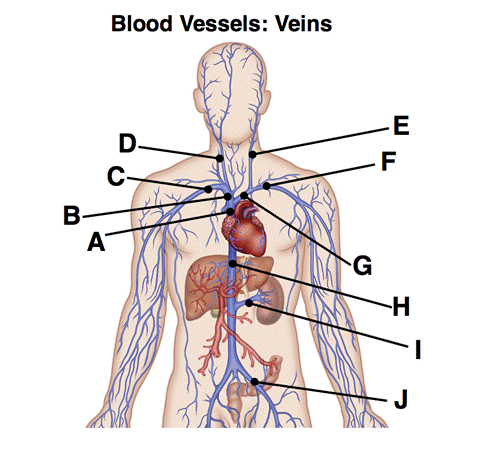
The veins labeled C and D are the right _____ and _____ veins. These are the 2 veins that merge to form the right brachiocephalic vein.
Subclavian, jugular
These blood vessels supply oxygenated blood to the heart muscle itself:
Coronary arteries
These vessels carry blood away from the heart, and most of them are carrying oxygenated blood:
arteries
Which layer of the blood vessel wall is comprised primarily of smooth muscle?
Tunica media
Lymphatic vessels are similar to veins in that they transport lymph towards the heart and also they have:
valves in their walls
Lymphatic capillaries are blind ended, meaning they have a beginning, and are therefore different than blood capillaries, which are a link between arteries and veins.
True
The thymus gland is a lymphatic organ.
True
This is a ring of lymphatic tissue in the pharynx, which functions to trap and remove pathogens coming in air or food:
Tonsils
The lymphatic system is like a _____ _____ picking up interstitial fluid.
garbage truck
Cancer often spreads along the lymphatic vessels. Therefore, when someone has breast cancer, the lymph nodes in the axillary region are checked for cancer cells.
true