NPB 101: Lecture 28 - Respiratory System 2: Compliance & Exchange
 Call Kai
 Learn
 Practice Test
 Spaced Repetition
 Match
 Flashcards
 Knowt Play
1/14

Earn XP
Description and Tags
Learning Objectives: Distinguish airway resistance from lung compliance and explain how asthma and pulmonary fibrosis affect breathing. Explain how surface tension and alveolar radius influence alveolar stability, including the role of surfactant. Identify the major lun volumes and capacities and calculate the minute and alveolar ventilation from tidal volume, respiratory rate, and dead space. Predict how changes in breathing depth, breathing frequency, and dead space affect effective alveolar ventilation. Relate gas composition and atmospheric pressure to partial pressure, and use partial-pressure gradients to explain oxygen and carbon dioxide exchange. Predict how changes in alveolar ventilation, the diffusion barrier, and pulmonary capillary transit time affect gas exchange.
15 Terms
Asthma
A common long-term (chronic) inflammatory disease of the airways that causes them to swell, narrow, and produce extra mucus.
Caused by intermittent episodes of airway smooth muscle excessive contraction
Generally associated with inflammation in airways
Leads to hyper-responsive airway smooth muscle contraction
What therapies would we use to treat Asthma?
Steroids
Epinephrine
relaxes smooth muscle and increases blood flow
Bronchodilators
reduces inflammation
e.g. inhalers

Lung Compliance
A measure of the lung’s ability to stretch, expand, and distend in response to pressure changes.
Compliance = Δ Lung volume / Δ(Palv - Pip) = ΔV/ ΔPtp
Inverse of stiffness
More stiff → less compliant
Depends on:
Connective tissues
Surface tension within alveoli
Excessive compliance reduces elastic recoil
Low compliance increases required work for breathing
What happens in pulmonary fibrosis?
Decreased compliance
presence of scar tissue = more work required to breathe

Surfactant
A mixture of lipids and proteins secreted by Type II alveolar cells.
Reduces cohesive forces between water molecules on the alveolar surface
Lowers surface tension
Increases lung compliance
Why do premature infants often need to be intubated?
Surfactant production occurs in late gestation so premature infant lungs have low compliance
Intubation is needed to add pressure

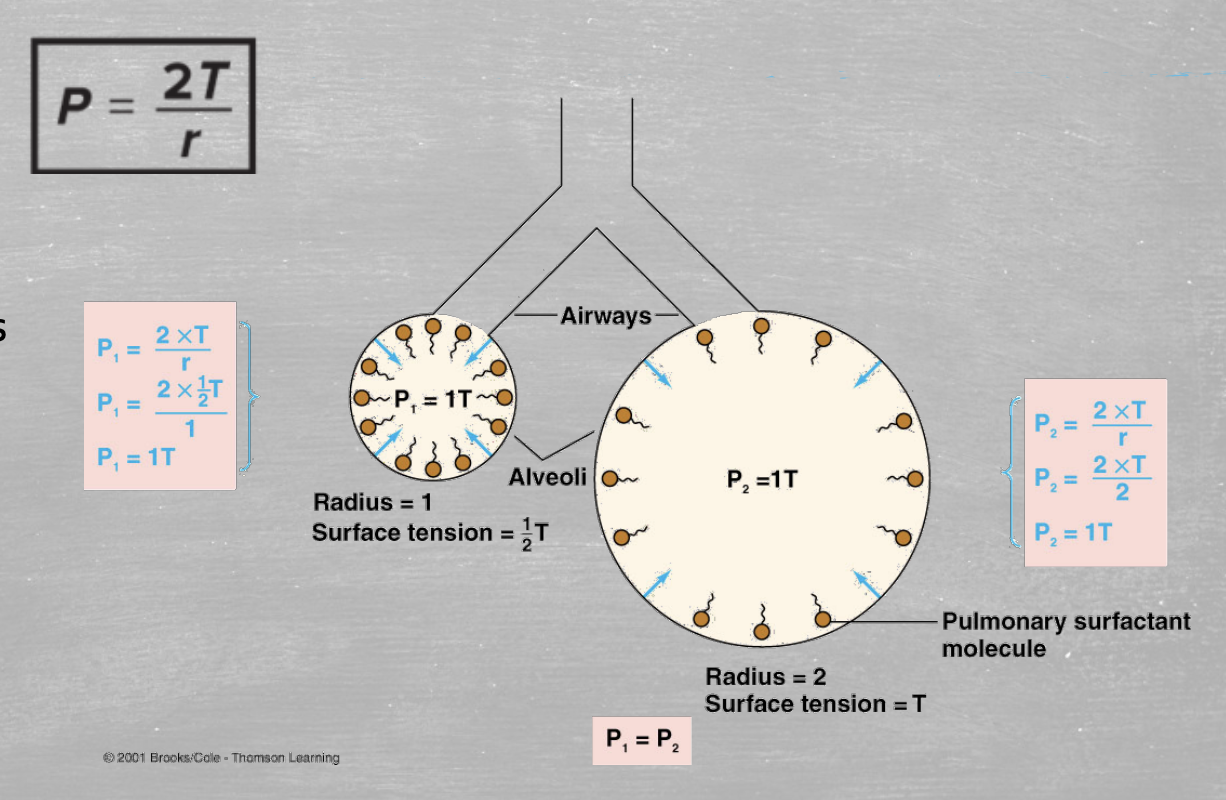
Law of Laplace
Describes the physical relationship between the internal pressure of a hollow vessel, the radius of the vessel, and the tension or stress within its wall.
P = 2T/r
P = pressure
T = surface tension
r = Radius
Smaller alveoli have increased pressure compared to large alveoli
To prevent smaller alveoli from collapsing into larger alveoli (positive feedback loop)…
The smaller the alveoli, the greater the surfactant concentration
↓ Surface Tension, ↑ Lung Compliance
Tidal volume
The amount of air that moves in or out of the lungs with each normal respiratory cycle.

Inspiratory reserve volume
The maximum extra volume of air that can be forcibly inhaled into the lungs after a normal, quiet tidal inhalation.
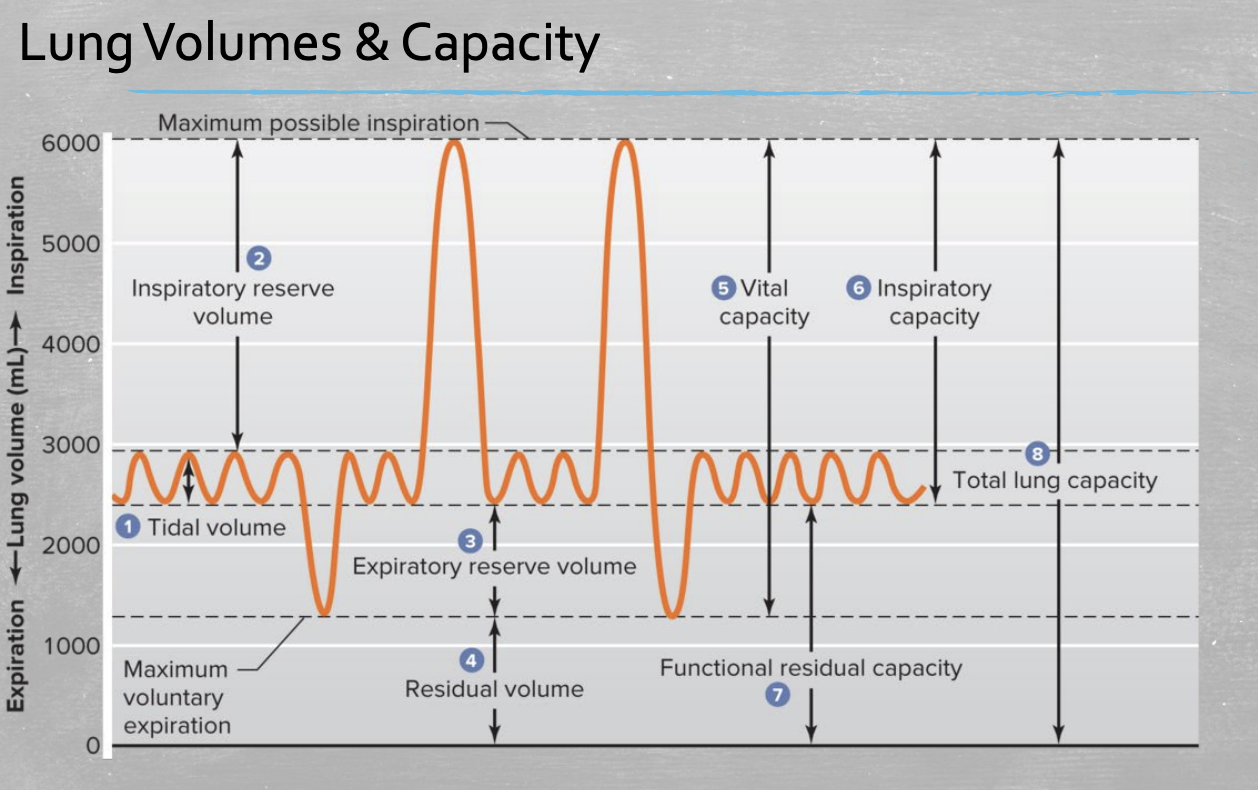
Expiratory reserve volume
The extra amount of air you can forcefully exhale past a normal, quiet breath out.

Residual volume
The amount of air that stays in the lungs even after you breathe out as hard as you can.
Lungs never fully collapse
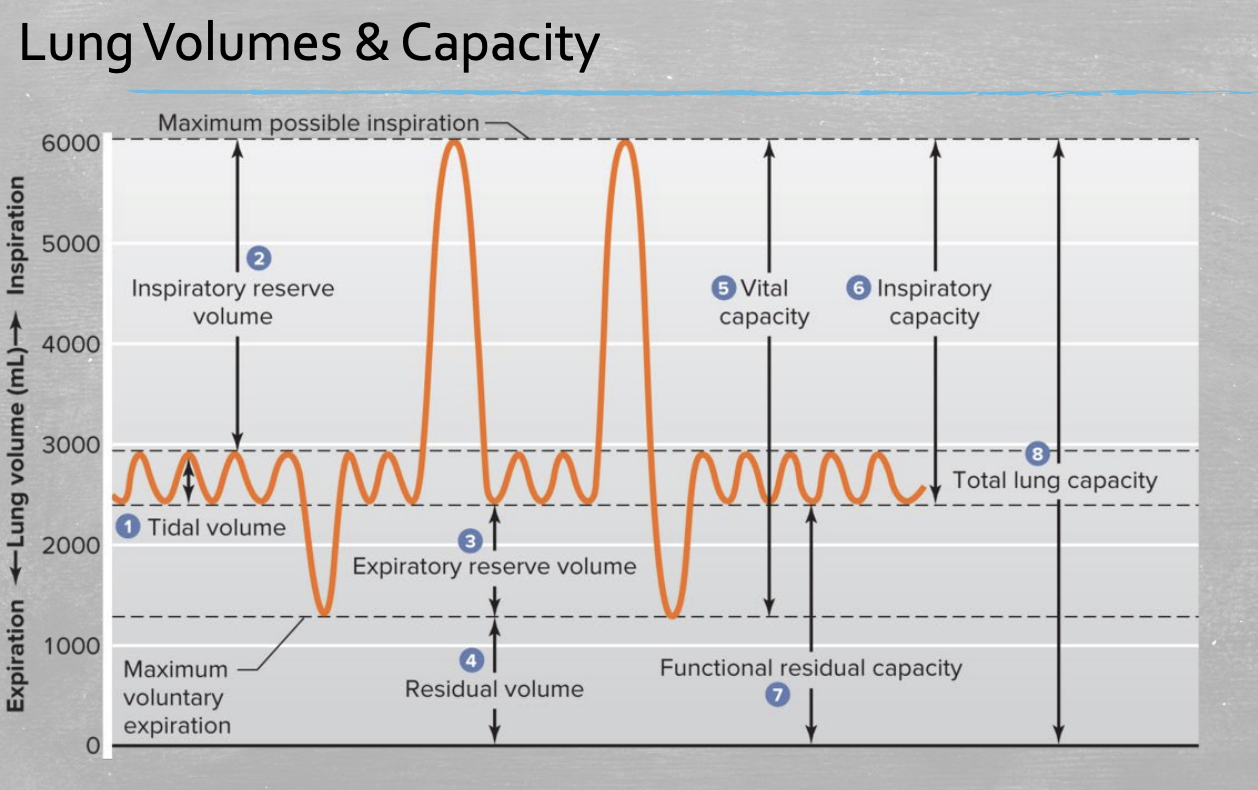
Vital capacity
The maximum volume of air a person can exhale from the lungs after taking a maximal inhalation.
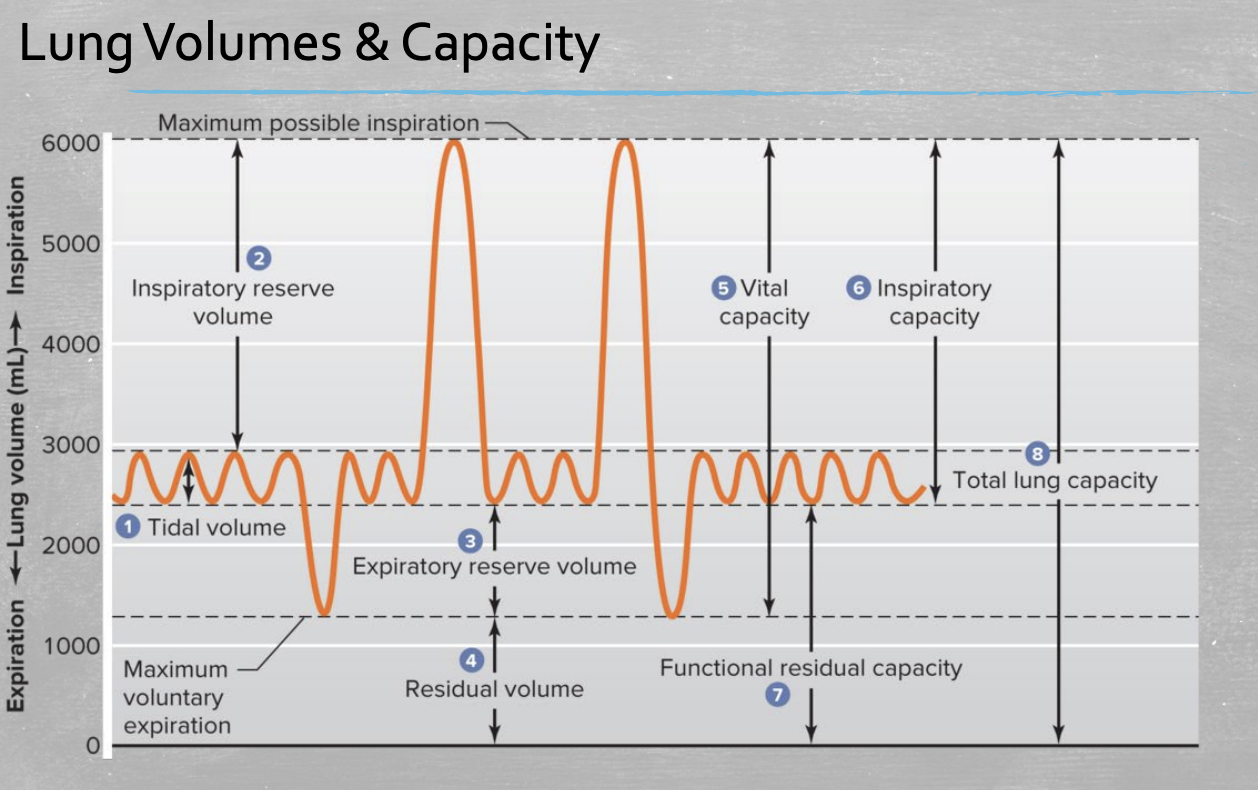
Minute ventilation (Ve)
The total volume of gas inhaled or exhaled from a person’s lungs in one minute.
Ve = TV * f
Minute ventilation = Tidal volume x respiratory rate
Typically mL/min
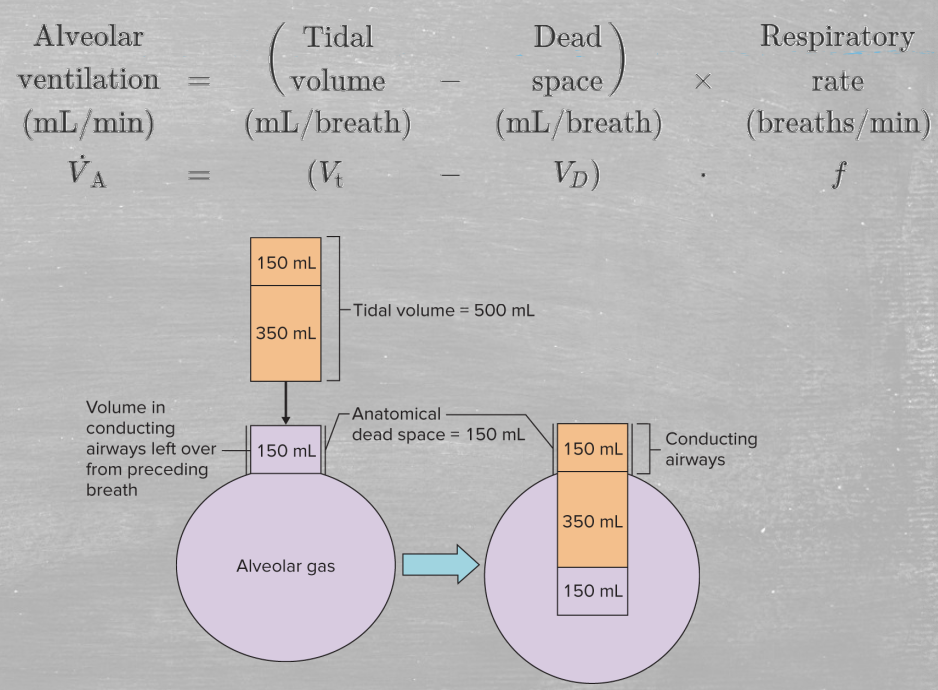
Dead space (Vd)
The volume of inspired air that does not participate in gas exchange with the blood. Only about ~350 mL of air participate in gas exchange.
Conducting zone = anatomical dead space (Vd)
~150 mL
VA = (Vt - VD) * f
If you had a long enough snorkel, could you go 10 meters under water?
No; the snorkel serves as an extension of the trachea. You are only increasing dead space; fresh air won’t get to where exchange needs to occur.
Partial Pressure
The independent pressure exerted by a particular gas contained within a mixture of gases
Directly proportional to percentage of that gas in the total air mixture
Is there less percentage of oxygen molecules in the air on top of Mt. Everest?
No; the percentage stays the same. Only pressure drops; partial pressure drops as well.

O2 exchange
O2 diffuses from alveoli to blood
Change in pressure = 65 mmHg
O2 diffuses from blood to tissues

CO2 exchange
CO2 diffuses from tissue to blood
CO2 diffuses from blood to alveoli
Pressure = 6 mmHg

O2 and CO2 exchange
In a healthy person at rest, O2 is transferred to the blood early in the capillaries.
What happens when fluid fills the lungs?
Pulmonary Edema
Alveolar partial pressures are a function of alveolar ventilation rate
Hyper/hypo ventilation is relative to metabolism
Which way does the curve shift during exercise when cardiac output increases?
Right
How can you prepare to hold your breath underwater?
Hyperventilate before
