Arth330 Exam2
 Call Kai
 Learn
 Practice Test
 Spaced Repetition
 Match
 Flashcards
 Knowt Play
1/20

There's no tags or description
Looks like no tags are added yet.
21 Terms

Title: Folio 1 of the Fejérváry-Mayer Codex
Culture: Nahua
Medium: Pigment on amate paper
Date: 1400–1521
Context: This page represents the organization of the universe through four cardinal directions and a sacred center, called a quincunx. Xiuhtecuhtli, the fire deity, appears at the center, while trees and birds mark the directions. The manuscript connects the cosmos with the 260-day ritual calendar and divination.

Title: Midwife and Child-Naming Ceremony, Book 6, Florentine Codex
Culture: Nahua (Aztec), colonial Mexico
Medium: Ink drawing on paper
Date: 1575–1577
Artist: Master of the Three-Quarter Profile
Context: Shows a ceremony surrounding childbirth and naming. The artist uses European-influenced techniques, including three-quarter views of figures, while recording Nahua cultural practices.
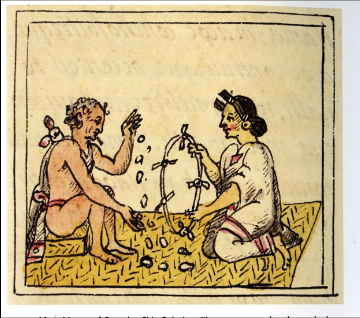
Title: First Creator Couple, Book 4, Florentine Codex
Culture: Nahua (Aztec), colonial Mexico
Medium: Ink and pigment on paper
Date: 1575–1577
Artist: Master of Complex Skin Coloring
Context: Depicts a primordial couple associated with Nahua creation traditions. The artist uses different skin tones and shading to give figures depth, showing the incorporation of European painting techniques.

Title: Cuauhtemoc (Descending Eagle), Book 8, Florentine Codex
Culture: Nahua (Aztec), colonial Mexico
Medium: Ink and pigment on paper
Date: 1575–1577
Artist: Master of Both Traditions
Context: Depicts Cuauhtemoc, the last Mexica ruler of Tenochtitlan. The image combines Nahua symbolic conventions with European-influenced representation. The blue xiuhuitzolli (royal diadem) is a symbol of rulership.

Title: The Process of Obtaining and Producing Nocheztli (Cochineal), Book 11, Florentine Codex
Culture: Nahua (Aztec), colonial Mexico
Medium: Ink drawing on paper
Date: 1575–1577
Artist: Unspecified Nahua artist
Context: Shows the production of a red pigment from cochineal insects associated with cactus plants. It illustrates the technical knowledge of Indigenous artists and the importance of natural materials in making color.

Title: The Production of Quiltic (Maya Green), Book 11, Florentine Codex
Culture: Nahua (Aztec), colonial Mexico
Medium: Ink drawing on paper
Date: 1575–1577
Artist: Unspecified Nahua artist
Context: Illustrates making green coloring associated with the indigo plant. The image shows how Nahua artists understood and processed natural materials to produce pigments.

Title: Gathering the Red Tlahuitl and White Tizatl, Book 11, Florentine Codex
Culture: Nahua (Aztec), colonial Mexico
Medium: Ink drawing on paper
Date: 1575–1577
Artist: Unspecified Nahua artist
Context: Shows the collection of mineral pigments. Red tlahuitl and white tizatl were materials used for producing colors. This example highlights the distinction between mineral-based pigments and pigments obtained from plants or insects.

Title: Folio 46, Codex Mendoza
Culture: Aztec (Indigenous artist, colonial period)
Medium: Painted manuscript
Date: 1542
Context: Records tribute goods supplied to the Aztec Empire, including valuable materials and luxury objects. The manuscript demonstrates how pictorial records were used to document political power and economic obligations.

Title: Folio 26, Book 9, Florentine Codex
Culture: Nahua (Aztec), colonial Mexico
Medium: Painted manuscript
Date: 1575–1577
Creators: Bernardino de Sahagún and Nahua artists/writers
Context: Represents the role of long-distance merchants, called pochteca, in acquiring and transporting luxury goods. These merchants connected distant regions and helped supply artisans with precious materials, such as feathers.

Title: Page from Book 9 of the Florentine Codex
Culture: Nahua (Aztec), colonial Mexico
Medium: Painted manuscript
Date: 1575–1577
Creators: Bernardino de Sahagún and Nahua artists/writers
Context: Illustrates luxury craftsmanship and the specialized artistic knowledge documented in Book 9. The manuscript records the work of Indigenous artisans and the importance of precious materials.

Title: Feather Penacha (Headdress)
Culture: Aztec
Medium: Feathers, gold, wood, and vegetable fibers
Date: 1519
Context: A luxurious headdress made with prized feathers, especially brilliant green feathers. Featherwork communicated high status, spiritual importance, and connections with rulers or deities. Amanteca were the skilled artists who produced feather objects.
Remember: Green feathers + elite status + amanteca.

Title: Featherwork Shield with Supernatural Coyote
Culture: Mexica
Medium: Wood, feathers, and gold
Date: 1400–1521
Context: Shows how feathers could transform a shield into an object of political, military, and religious significance. Feather mosaics required precise placement of feathers to produce brilliant patterns and figures.
Remember: Feather mosaic + supernatural coyote + warrior prestige.
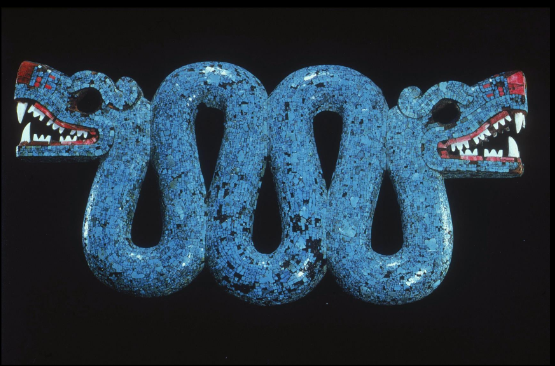
Title: Mosaic Serpent Pectoral
Culture: Mexica
Medium: Wood, turquoise, coral, and shell
Date: 1350–1521
Context: A double-headed serpent ornament covered with turquoise mosaic. Turquoise was associated with sacred powers, fire, and rulership. Its brilliant blue-green surface made it a highly valued luxury material.
Remember: Double-headed serpent + turquoise + sacred rulership.
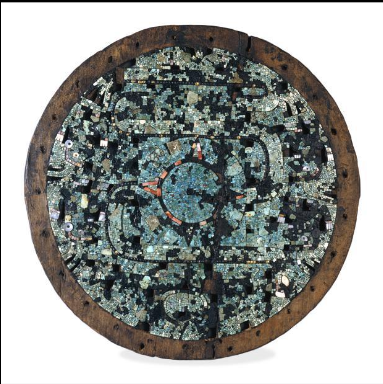
Title: Turquoise Mosaic Disk
Culture: Mexica
Medium: Wood, spondylus shell, oyster shell, mother-of-pearl, turquoise, and gold
Date: 1200–1521
Context: Combines several precious materials to create a luminous mosaic surface. Turquoise and reflective shells were valued for their color, brilliance, and associations with sacred forces.
Remember: Mosaic disk + turquoise and shells + brilliance

Title: Mask (Representing Xiuhtecuhtli)
Culture: Mexica
Medium: Turquoise, wood, seashells, and mother-of-pearl
Date: 1400–1521
Context: Represents Xiuhtecuhtli, the fire deity. Turquoise was closely associated with fire, heat, divinity, and rulership. The mosaic surface created an impression of sacred brilliance.
Remember: Xiuhtecuhtli = fire deity + turquoise mask.

Title: Ceremonial Knife
Culture: Mexica
Medium: Wood, turquoise, maguey fiber, shell, spondylus shell, flint, and malachite
Date: 1400–1521
Context: A ritual knife combining flint with elaborate mosaic decoration. The use of precious materials shows that ceremonial objects had significance beyond their practical function.
Remember: Flint blade + turquoise mosaic + ritual purpose.

Title: Pectoral
Culture: Mexica
Medium: Jadeite and gold
Date: 1400–1521
Context: A chest ornament combining gold with valuable greenstone. In Mexica culture, jadeite was highly prized and could be as significant as, or more significant than, gold. Both materials carried associations with prestige and sacred value.
Remember: Pectoral = chest ornament + jadeite + gold.

Title: Shell (Maybe Part of a Pendant)
Culture: Mexica
Medium: Shell and gold
Date: 1300–1521
Context: Combines a natural shell with precious metal. Shells were valued for their reflective surfaces and connections with water and the natural world. The object illustrates how Mexica artists combined materials to produce luxury ornaments.
Remember: Shell + gold + luxury adornment.
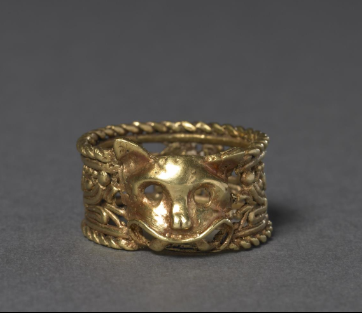
Title: Ring with Jaguar and Serpent Motifs
Culture: Mexica
Medium: Gold
Date: 1400–1521
Context: A gold ornament decorated with animal imagery. Jaguars and serpents were important in Mesoamerican visual culture, often associated with powerful supernatural and political forces. This ring shows the sophistication of Indigenous metalworking.
Remember: Gold ring + jaguar + serpent.

Title: Atlatl (Spear Thrower)
Culture: Mexica
Medium: Wood, cotton, shell, obsidian, and gold
Date: 1400–1521
Context: An atlatl is a device used to launch spears with greater force. This richly decorated example demonstrates how a weapon could also communicate status, military authority, and prestige.
Remember: Atlatl = spear thrower + military prestige.

Title: Pair of Ceremonial Knives, Offering 125
Culture: Mexica
Medium: Flint, jadeite, shell, obsidian, spider monkey skin, gold, and copal
Date: 1400–1521 (the reading dates Offering 125 to 1486–1502)
Context: These ceremonial knives were discovered in Offering 125 at the Templo Mayor and are associated with Ehecatl-Quetzalcoatl, the wind deity. Their gold ornaments functioned as divine insignia. The objects demonstrate how precious materials were used to adorn representations of deities.
Remember: Offering 125 + Ehecatl-Quetzalcoatl + divine adornment.