ADA
 Call Kai
 Learn
 Practice Test
 Spaced Repetition
 Match
 Flashcards
 Knowt Play
1/19

There's no tags or description
Looks like no tags are added yet.
20 Terms
generel ADA timeline
-pre ADA: rehabilitation act
-ADA passed 1990
-Supreme Course Olmstead: individuals w/ disabilities have same rights, can’t be held agains their will
-ADA Amendments: 2008
*video 30 year celebration: took longer to get rights and still ways to go; long history of discrimination
who does the ADA cover?
anyone with a physical or mental impairment that would substantially impact their life
-Has a physical or mental impairment that substantially limits one or more major life activities
-Has a history or record of a physical or mental impairment that substantially limited one or more major life activities
-Is regarded as having an impairment
-Has temporary impairment status that alters major life activities (*ex=tore ACL and need more time to get to class)
ADA Amendments Act of 2008
-broadens definition of disability; disability is any impairment that is episodic or in remission that substantialy limits major life activity
-prohibiting consideration of “mitigating measures”=anything that improves a person’s disability (ex those covered under ADA=diabetes and insulin, person w/ prosthetic, medications)
exception=eye classes

major life activities vs major bodily functions (definitions)
-Major life activities=ADL; Those functions that are important to most people’s daily lives
include, but are not limited to, caring for oneself, performing manual tasks, seeing, hearing, eating, sleeping, walking, standing, lifting, bending, speaking, breathing, learning, reading, concentrating, thinking, communicating, and working
-Major Bodily functions: include, but are not limited to, functions of the immune system, normal cell growth, digestive, bowel, bladder, neurological, brain, respiratory, circulatory, endocrine, and reproductive functions
Regarded as
not a disability but others would think so bc of their physical appearance; things visibly see and have stigma
-Has an impairment that does not substantially limit a major life activity
-Has an impairment that substantially limits a major life activity only as a result of the attitudes of others toward them
-Does not have any impairment but is treated by an entity as having an impairment.
*does NOT include obesity
Record of
-history of a disability

upstrea/downsream framework
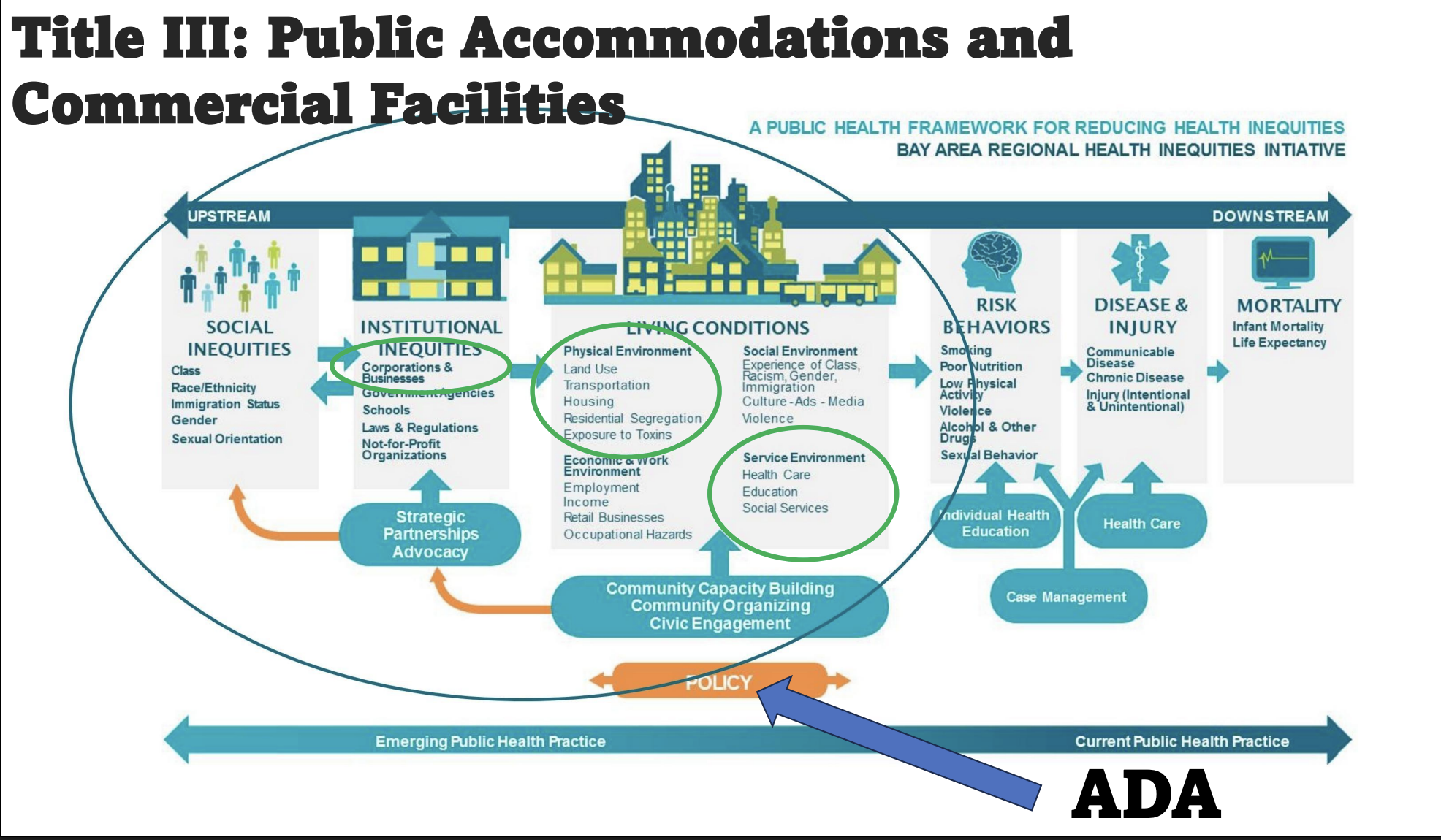
social inequities <-> institutional inequities → living conditions → risk behaviors → disease and injury → mortality

structural ableism + where does ADA fall in framework?
-=any “ism”
-all upstream!

what systemic levels does the ADA effect
-ADA attempts to address ALL levels
-effects policy level directly

ADA 5 Titles
-Title I: Employment
-Title II: State and Local Governments
-Title III: Public Accommodations and Commercial Facilities
-Title IV: Telecommunications for the Deaf
-Title V: Miscellaneous Provisions
ADA Title I
employment
-living conditions: economic and work envionrment
-Employers with 15+ employees
-Includes employment agencies and labor unions
-Prohibits discrimination of a "qualified person with a disability", one able to perform the essential job functions with or without a reasonable accommodation
-Employers cannot ask about existence, nature, severity of a disability
-Can ask about ability to perform specific job functions
-also effects how do interviews, recruiting, etc. (ex: can’t ask or disclose if have disability)
Examples
-Modified work schedules (part time schedule, allowing extended time between patients)
-Providing qualified readers or interpreters
-Making facilities physically accessible (doors, bathrooms, access to another area)
-Modification or acquisition of equipment

True or False
-The ADA forces employers to hire unqualified individuals with disabilities
-Under the ADA, employers must give people with disabilities special privileges, known as accommodations.
-Under the ADA, an employer cannot fire an employee who has a disability
all False!
-#2: no to special previledges, yes to accommodations
How does an employer know if an accommodation is needed?
employee has to speak up!
-Responsibility of the applicant or employee to request an accommodation
-Employer may then ask person for suggestions, or research options
-"Reasonable Accommodation" cost average is under $500 and not required if it would result in undue financial burden
-No pre-employment medical tests or inquiries
-Post-employment medical exams only if done for all
-Cannot pose a direct threat to workplace health or safety
who enforces the ADA?
Equal Employment Opportunity Commission (EEOC)
*timeline to file…
-Individuals who believe they have been discriminated against must file with the EEOC within 180 days from the incident
-In cases where state or local law provides relief for discrimination cases must be filed within 300 days from incident
ADA Title II
State and Local Government
-Institution inequities + Living Conditions
-facilities need to be accessible

ADA Title III
Public Accommodations and Commercial Facilities
-Institutional Inequities + Living Conditions
-Private business, health care facilities
ADA Title II and III
-Applies to state and local health care entities, private sector health care, and service providers.
-The ADA covers any communication that takes place throughout a health care providers’ interactions with a patient and their companion
-The communication must be effective (*healthcare providers!)
-ADA’s effective communication requirement states
misconceptions about Title I-III implementation
-family can’t translate for you, need an interpreter

ADA Title IV
Telecommunications for the Deaf
-Institutional inequities + living conditions
-closed captions on TV

Peerson First Language (PFL)
-use phrases such as “a person who has” instead of “disabeled perosn”
Exceptions
-Visual: Visually impaired, preferred over blind, people who are blind
-Hearing: Deaf, Hard of Hearing preferred over "person with a hearing loss"
-Autism: autistic individual, autistic
-“Disabled people” is an example of identity-first language (in contrast to people-first language). It is the preferred terminology in Great Britain and by a growing number of U.S. disability activists
-Use PFL unless asked to do otherwise
