Glucose regulation
 Call Kai
 Learn
 Practice Test
 Spaced Repetition
 Match
 Flashcards
 Knowt Play
1/30

There's no tags or description
Looks like no tags are added yet.
31 Terms
Epinephrine functions
use stores of ATP and phosphocreatine (phosphate store in muscles for making ATP)
use up stores of glycogen and oxygen
start gluconeogenesis in liver
GLUT1
Glucose uptake in Brain, kidney, colon, placenta erythrocytes
GLUT2
Rapid uptake or release of glucose in Liver, pancreatic B cells, small intestine, kidney
GLUT3
Glucose uptake in brain, kidney, placenta
GLUT4
Insulin-stimulated glucose uptake in Heart and skeletal muscle, adipose tissue
Regulation of GLUT4 by insulin signaling Step 1
When insulin binds to receptor the activated receptor phosphorylates IRS-1 protein which recruits GRB2 and Ras pathway activated
Regulation of GLUT4 by insulin signaling Step 2
IRS-1 activates PI3 kinase which catalyzes the addition of a phosphate group to the membrane lipid PIP2 to make PIP3
Regulation of GLUT4 by insulin signaling Step 3
PIP3 binds a protein kinase called Akt which is activated by other protein kinases
Regulation of GLUT4 by insulin signaling Step 4
Akt catalyzes phosphorylation of key proteins leading to increase in glycogen synthase and recruitment of GLUT4 to the membrane
Insulin moving GLUT4 into plasma membrane step 1
Glucose transporters stored within cell in membrane vesicles

Insulin moving GLUT4 into plasma membrane step 2
When insulin binds to receptor, transporter filled vesicles move to surface and fuse w/ plasma membrane

Insulin moving GLUT4 into plasma membrane step 3
When insulin drops glucose transporters are removed by the plasma membrane by endocytosis, forming small vesicles

Insulin moving GLUT4 into plasma membrane step 4
The smaller vesicles fuse w/ larger endosome

Insulin moving GLUT4 into plasma membrane step 5
Patches of the endosome enriched w/ glucose transporters bud off to become small vesicles, ready to return to the surface when insulin levels rise again
GLUT 5
Adsorption of fructose in Small intestine
SGLT1
Na glucose synport
secondary active transporter using Na gradient to recover glucose in intestinal and kidney cells
step 1 in glycolysis and gluconeogenesis regulated by
Glucose-6-Phosphate
Glycolysis reciprocal regulation by energy charge
High ATP inhibits glycolysis
High AMP activates glycolysis
Glucagon inhibits glycolysis
Insulin activates glycolysis
Gluconeogenesis reciprocal regulation by energy charge
High AMP inhibits gluconeogenesis because you need energy to make glucose
High ATP activates gluconeogenesis
Glucagon activates gluconeogenesis
Insulin inhibits gluconeogenesis
Cori cycle
lactic acid recycling during anaerobic glycolysis in the muscles
most regulated/committed step in glycolysis and gluconeogenesis
Step 3
What does PFK-1 do
Catalyzes most committed step of glycolysis (step 3)
Synthesizes fructose 1,6-biphosphate from Fructose-6-Phosphate
fructose 2,6 bisphosphate regulation of glycolysis and gluconeogenesis
suppresses gluconeogenesis by inhibiting fructose 1,6 bisphosphatase
induces the glycolysis pathway by activating PFK-1
ATP sigmoidal kinetics
ATP is both substrate and inhibitor of phosphofructokinase-1

How does insulin activate glycolysis?
by dephosphorylating PFK-2 (turns on) and Fructose 2,6 bisphosphatase-2 (turns off)

How does glucagon activate gluconeogenesis?
by phosphorylating PFK-2 (turns off) and Fructose 2,6 bisphosphatase-2 (turns on)

What does PFK2 do?
Activates glycolysis
Synthesizes fructose-2,6-bisphosphate from Fructose-6-Phosphate
Bifunctional enzyme
Phosphofructokinase-2 and fructose 2,6-bisphosphatase activities are found on the same enzyme
Unphosphorylated increases PFK2 so more F26BP and glycolysis
Phosphorylated increases fructose 2,6-bisphosphatase so less F26BP and less glycolysis
Regulation of pyruvate carboxylase
Acetyl-CoA increases fat breakdown and gluconeogenesis
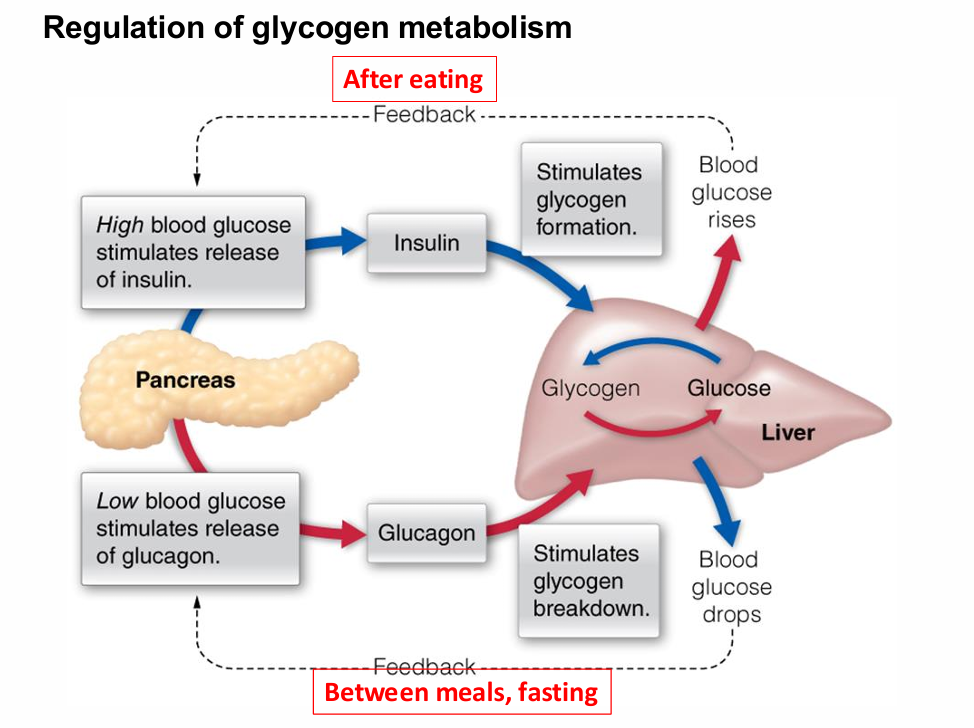
After eating
Insulin release from pancreas
Glucose high in blood, uptake into cells
Glycolysis starts
Gluconeogenesis stops
Glycogen synthesis begins

Fasting
Glucagon release from pancreas
Glucose low in blood, uptake low in cells
Glycolysis stops
Gluconeogenesis starts
Glycogen breakdown starts