SECTION 01: MALE REPRODUCTIVE SYSTEM
 Call Kai
 Learn
 Practice Test
 Spaced Repetition
 Match
 Flashcards
 Knowt Play
1/34

There's no tags or description
Looks like no tags are added yet.
35 Terms
What is the function of the male reproductive system, and what are its five main components?
Function: Produce, develop and transport male gametes (sperm).
Components:
Testes
Scrotum
Male duct system
Accessory glands
Penis

What are the testes, and what are their dimensions?
Two oval-shaped organs responsible for sperm production and development.
Length: 4–5 cm.
Diameter: 2.5–3 cm.

What are the two protective coverings of the testes?
Tunica vaginalis: Outer protective covering.
Tunica albuginea: Inner fibrous coat or capsule that divides the testis into approximately 250–300 lobules, each containing up to four seminiferous tubules.

What are seminiferous tubules, and what is their function?
tightly coiled tubules located within the lobules of the testes that are responsible for sperm production.
Approximately 600–1,000 tubules per testis.
Approximately 80 cm long when uncoiled.

Where are Leydig cells located, and what is their function?
Located in the loose connective tissue between the seminiferous tubules. They produce and secrete testosterone.

What are sperm, and what are their four anatomical regions?
Sperm are male gametes that carry paternal genetic information.
Four regions:
Head
Neck
Midpiece
Tail (flagellum)
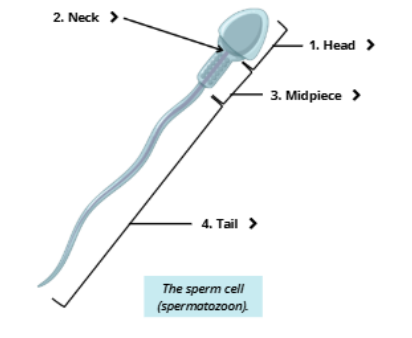
Describe the structure and function of the head of a sperm cell.
he head is flat and oval-shaped and contains:
Nucleus: Carries paternal genetic information, including either an X or Y chromosome.
Acrosomal cap: Contains enzymes released before fertilization to help sperm penetrate the layers of the egg.

What are the functions of the neck, midpiece and tail of a sperm cell?
Neck: Connects the head to the midpiece.
Midpiece: Contains a mitochondrial collar that produces energy.
Tail (flagellum): Provides movement and propels sperm.

What is the scrotum, and where is it located?
A sac of skin and fascia surrounding the testes. It is derived from the anterior abdominal wall and is located outside the abdominopelvic cavity.

Where is the dartos muscle located, and what is its function?
Located superficially within the skin of the scrotum.
Produces the rugose (wrinkled) appearance of the scrotum.
Regulates temperature by altering the exposed surface area of the scrotum.

Where is the cremaster muscle located, and what is its function?
Located deep to the scrotal wall, covering the testis.
Reflexively contracts in cold environments, drawing the testes superiorly toward the body wall to absorb body heat.

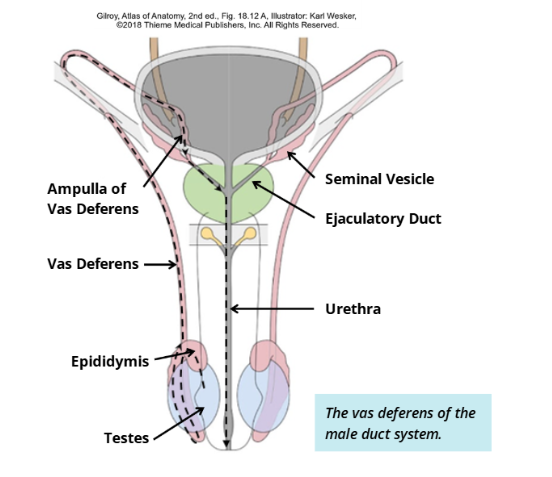
What is the function of the male duct system, and what are its main components?
Transports sperm from the testes to the exterior of the body.
Epididymis
Vas deferens
Ejaculatory duct
Urethra
The right and left testes each have their own duct systems before entering the urethra.
Describe the location, structure and histology of the epididymis.
Location: Superior and posterior borders of each testis.
Structure: Comma-shaped, approximately 4 cm long, containing coiled tubules measuring 4–5 metres in total length.
Histology: Pseudostratified columnar epithelium.

What are the three regions of the epididymis and their functions?
Head: Receives sperm originating from the seminiferous tubules.
Body: Located on the posterolateral border of the testis and contains the highly coiled epididymal duct.
Tail: Located near the inferior border of the testis. Stores sperm before ejaculation and continues superiorly into the vas deferens.

What is the vas deferens (ductus deferens), and what is its function?
A duct that stores and transports sperm from the epididymis toward the urethra.

Describe the histology of the vas deferens.
Pseudostratified columnar epithelium containing stereocilia.
Small lumen.
Thick muscularis composed of layers of smooth muscle that help propel sperm through the duct.

What is the ampulla of the vas deferens, and how is the ejaculatory duct formed?
Ampulla: Expanded distal portion of the vas deferens.
Ejaculatory duct: Formed when the ampulla of the vas deferens joins the duct of the seminal vesicle.

What is the length and function of the male urethra?
Approximately 15–20 cm long.
It serves both the urinary and reproductive systems by transporting urine and semen out of the body. It is the terminal portion of the male duct system.

What are the three regions of the male urethra, from proximal to distal?
Prostatic urethra: Located within the prostate gland.
Membranous urethra: Located at the base of the penis.
Penile urethra: Most distal and longest portion of the urethra.

What are the three types of male reproductive accessory glands and their overall function?
Two seminal vesicles.
One prostate gland.
Two bulbourethral glands.
They produce secretions that nourish and protect sperm as they travel through the reproductive system.

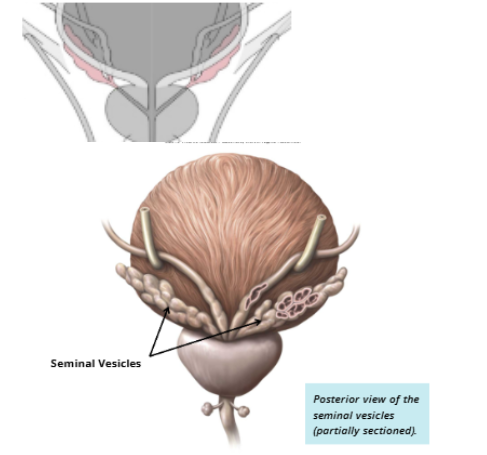
Describe the location, structure and function of the seminal vesicles.
Location: Posterior to the urinary bladder and anterior to the rectum.
Structure: Two large, coiled, tubular glands.
Function: Provide fluid and nutrients to the ejaculate.
Contribution to semen volume: Approximately 60%.
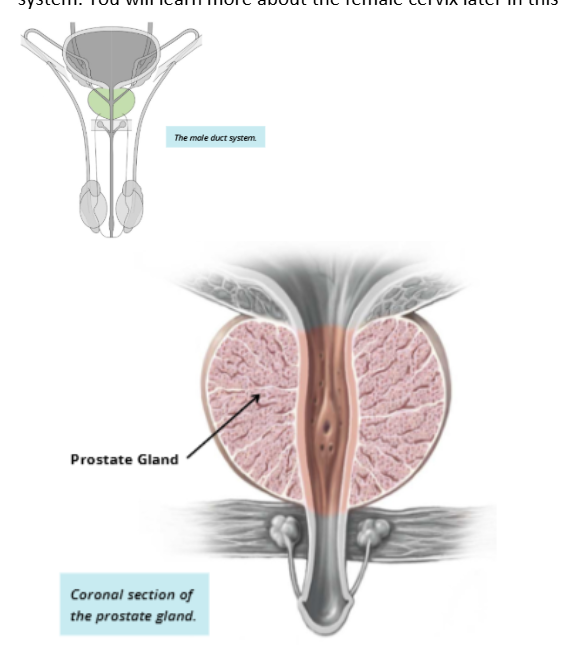
Describe the location, structure and function of the prostate gland.
Location: Inferior to the urinary bladder.
Structure: Single, walnut-sized gland consisting of tubular glands embedded in smooth muscle and connective tissue.
Function: Produces and secretes sugars and enzymes.
Contribution to semen volume: Approximately 33%.
What is prostate-specific antigen (PSA), and what is its function?
PSA is a protease (protein-digesting enzyme) found in prostatic fluid.
According to the course notes, prostatic proteases aid in liquefaction and dissolution of cervical mucus in the female reproductive system.
Describe the location, structure and secretions of the bulbourethral glands.
Location: Immediately inferior to the prostate gland, at the base of the penis.
Structure: Two pea-sized glands.
Secretion: Thick, clear, alkaline mucus that drains into the penile urethra.
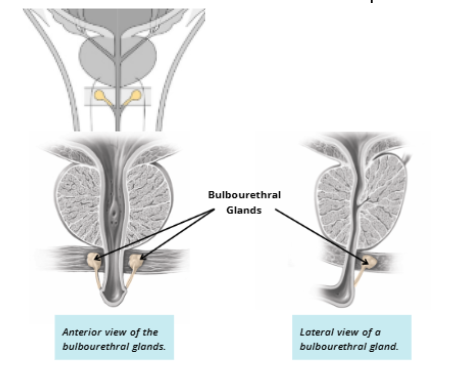
When are bulbourethral gland secretions released, and what are their functions?
Released before ejaculation to:
Neutralize traces of acidic urine remaining in the urethra.
Lubricate the urethra and penis.
Compare the three male reproductive accessory glands.
Feature | Seminal vesicles | Prostate gland | Bulbourethral glands |
|---|---|---|---|
Number | 2 | 1 | 2 |
Location | Posterior to bladder | Inferior to bladder | Inferior to prostate |
Secretion | Fluid and nutrients | Sugars and enzymes | Alkaline mucus |
Function | Provide energy | Enzymatic activity | Neutralization and lubrication |
Semen volume | 60% | 33% | Not specified |
Why are nutrients and alkaline secretions added to sperm?
Nutrients: Provide sperm with energy to travel through the male and female reproductive systems.
Alkaline secretions: Neutralize the acidic environment of the vagina, protecting sperm and promoting survival.
Trace the pathway of sperm through the male reproductive system.
Seminiferous tubules
Epididymis (head → body → tail)
Vas deferens
Ampulla of vas deferens
Ejaculatory duct
Prostatic urethra
Membranous urethra
Penile urethra
External urethral opening
What is the difference between sperm and semen?
Sperm: Male gametes produced within the seminiferous tubules.
Semen: Sperm combined with fluid secretions from the accessory glands.
What are the functions and three anatomical regions of the penis?
Functions: Both urinary and reproductive, providing a passageway for urine and semen.
Regions:
Root: Fixed portion that attaches the penis to the ischium (pelvic bone).
Body: Tubular, movable portion containing three cylinders of erectile tissue and the urethra.
Glans: Expanded distal end containing the external urethral opening.

What are the two types of erectile tissue in the penis?
Corpora cavernosa: Two cylinders of erectile tissue.
Corpus spongiosum: One cylinder of erectile tissue.
Together, they form three cylinders of erectile tissue.

Describe the structure and location of the corpora cavernosa.
Two cylinders of erectile tissue located on the dorsal surface of the penis.
Make up most of the mass of the penis.
The proximal portions are called the crura (singular: crus), which are attached to the bony pelvis by muscles.
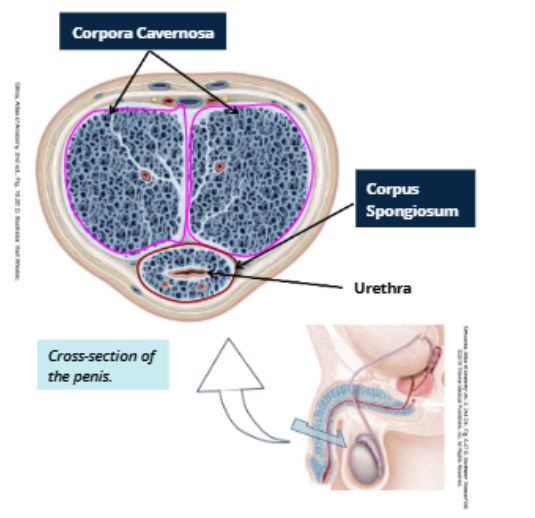
Describe the structure and location of the corpus spongiosum.
One cylinder of erectile tissue that surrounds the urethra.
Expands distally to form the glans of the penis.
Expands proximally to form the bulb of the penis.
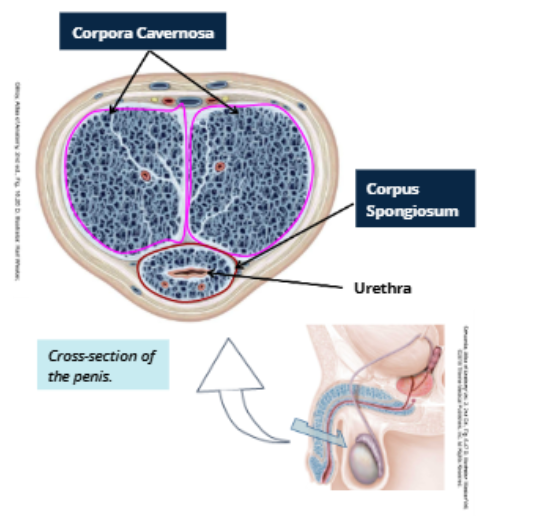
Compare the corpora cavernosa and corpus spongiosum.
Feature | Corpora cavernosa | Corpus spongiosum |
|---|---|---|
Number of cylinders | 2 | 1 |
Location | Dorsal surface | Surrounds urethra |
Proximal structure | Crura | Bulb of penis |
Distal expansion | — | Glans of penis |
Main characteristic | Forms most of penile mass | Contains urethra |
What is a vasectomy, and how does it prevent fertilization?
A permanent method of birth control involving the cutting or clamping of the vas deferens.
This blocks sperm transport from the epididymis toward the urethra, preventing sperm from entering the ejaculate once remaining sperm have cleared.