Liver disease: pathophysiology and clinical signs
 Call Kai
 Learn
 Practice Test
 Spaced Repetition
 Match
 Flashcards
 Knowt Play
1/24

There's no tags or description
Looks like no tags are added yet.
25 Terms
What is the function of the liver?
Intermediate metabolism
Storage
Protein synthesis
Production of bile
Detoxification
What are the consequences of hepatic dysfunction?
compromised:
Bile production
Metabolic
Circulation
Detoxification
Coagulation
List some of the clinical signs of hepatic dysfunction
Jaundice (most evident in sclera)
Weight loss / loss of condition
Hypoglycaemia (glucose production in liver)
Hypoalbuminaemia which can lead to ascites / subcutaneous oedema (only in chronic dz)
PUPD - not a major clinical sign
Hepatic encephalopathy
Bleeding
Recall the classifications of icterus/ jaundice
Prehepatic: haemolysis
Hepatic: hepatocyte dysfunction; intrahepatic cholestasis
Post hepatic: extra hepatic cholestasis
NB- there can be severe hepatic dysfunction without jaundice
What is the cause of ascites due to hepatic dysfunction?
Hypoalbuminaemia
Portal hypertension
Sodium and water retention

Why does hepatic dysfunction cause PUPD?
Cannot concentrate urine maximally- urea prod in the liver
Not usually major clinical sign
resolve when tx dz
What are the different types of portosystemic shunts?
Congenital (single vessel connecting portal vein to caudal vena cava usually)
Acquired (multiple)
Caused by cirrhosis or portal hypertension

What can cause hepatic encephalopathy?
Defective urea formation from NH3 due to either:
Decr functional liver mass
and/or
portosystemic shunt
cause incr blood NH3 (± other toxins)
altered CNS function

What are the signs of hepatic encephalopathy?
Anorexia
V+ + D+
PUPD
Dullness, aggression, staggering, blindness, head-pressing, seizure
copper coloured irises in cats
incr ensitivity to anaesthesia
What can worsen a hepatic encephalopathy?
High protein meal
GI bleed
Dehydration, acid-base imbalance
Why can bleeding occur 2° to liver disease?
Defective production and storage of clotting factors
Vit K malabsorption
Portal hypertension causing GI bleeding
What are the clinical signs of liver dz?
Icterus/jaundice (most evident in sclera)
Faecal changes
Grey (acholic)
Melaena
Hepatic encephalopathy
Drug intolerance
Ascites
Stunted growth (if young)
Vomiting and diarrhoea
Polyuria & polydipsia
Non-specific signs
Anorexia
Weight loss
Weakness
Poor coat and skin condition
What are the classifications of hepatopathies?
Primary
Inflammatory
Infectious or Non infectious
Non inflammatory
Non infectious
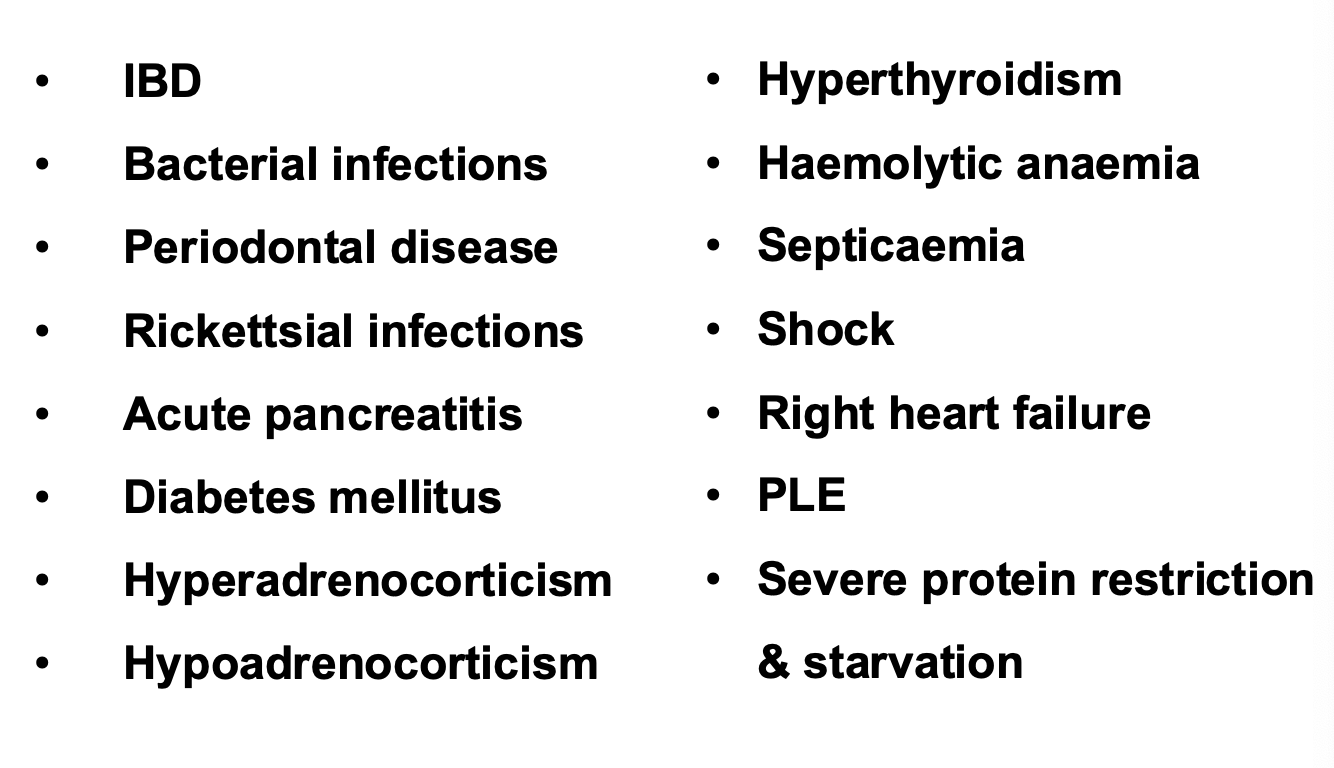
Secondary (=reactive hepatopathy- more common)
Little loss of hepatic function
Reversible
What are some consequences of the reversible liver changes due to 2o hepatic dz?
Anoxia
Toxaemia
Nutritional imbalance
Metabolic changes
Infection
List some of the causes of reactive hepatopathies
List some infectious causes of primary hepatopathy
Bacterial
Lepto
Bacterial cholangiohepatitis
Viral
Infectious canine hepatitis
Canine herpes virus
FIP
Protozoal
Toxoplasma
What are some non infectious inflammatory diseases of the liver?
Toxic hepatic disease
Drug induced hepatic disease
All forms of chronic hepatitis
Canine chronic hepatitis
Feline lymphocytic cholangitis
What are some non inflammatory diseases of the liver?
Congenital portosystemic shunt
Juvenile hepatic fibrosis
Feline hepatic lipidosis
Neoplasia
Teleangiectasis and Peliosis
Surgical - trauma, liver lobe torsion/entrapment
Why are cats susceptible to certain drugs (e.g. aspirin, paracetamol, phenols, alcohols)?
Relative deficiency of glucoronyl transferase
Difficulty in conjugating toxins
(Aspirin, Paracetamol, Phenols, pine tars, morphine, benzenes, alcohols, barbiturates)
Explain the pathophysiology of paracetamol toxicity in cats
Relative deficiency of glucoronidation and glutathione conjungation which metabolise paracetamol into non-toxic compounds
=> Paracetamol metabolised into reactive compound => methaemoglobinaemia
What are the clinical signs of paracetamol toxicity?
Haemolytic anaemia (depression, dyspnoea)
Facial oedema
Hepatocellular damage (liver failure and icterus)
What is the lethal dose of paracetamol in cats?
LD50 = 65 mg/kg
(abt 1 tablet/cat)
How is paracetamol toxicity treated?
N-acetyl cysteine
S-adenosyl methionine
Vit C
Supportive care- IV fluids, emetic or active charcoal if recent ingestion
How do clinical signs of liver disease differ in cats vs dogs?
Anorexia and weight loss more common in cats
Icterus more common
PUPD less severe
Hepatoencephalopathy and hypersalivation
Microhepatia and cirrhosis rarely seen
Pyrexia common in suppurative cholangitis
Chorioretinitis or uveitis (FIP, toxoplasmosis)
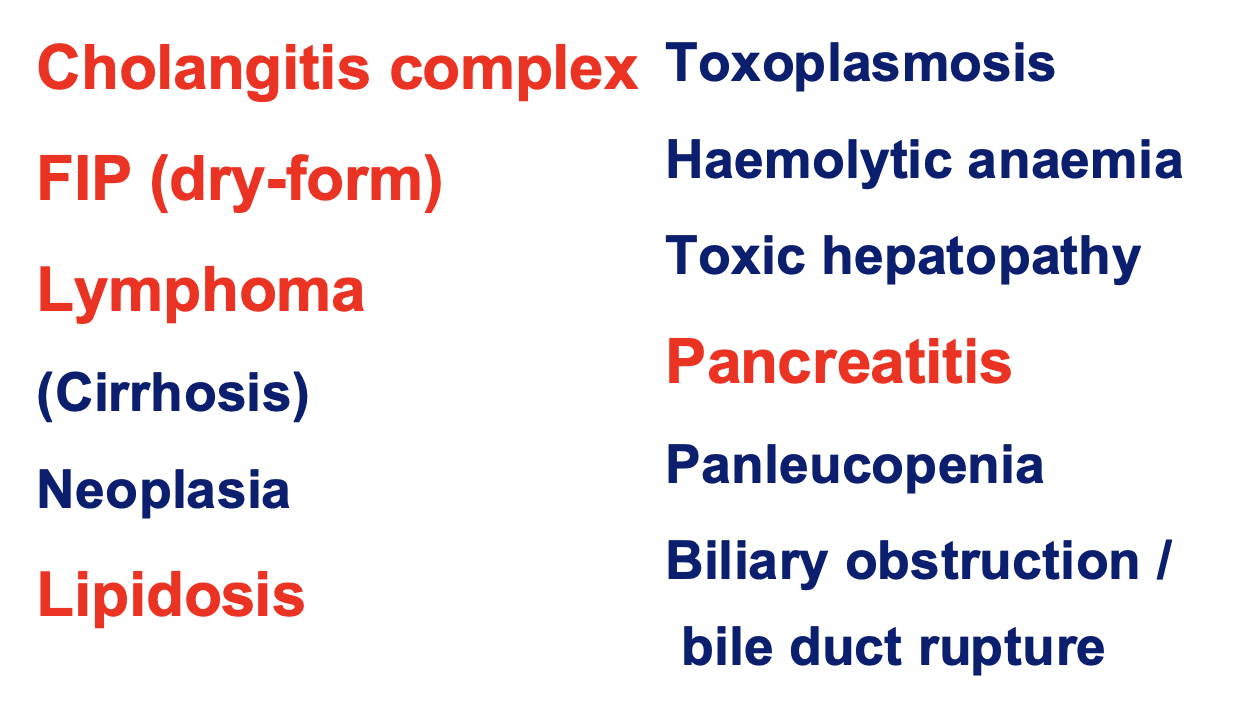
What are ddxs for a cat with jaundice?
red=more common