CYP2D6 Polymorphisms
 Call Kai
 Learn
 Practice Test
 Spaced Repetition
 Match
 Flashcards
 Knowt Play
1/39

There's no tags or description
Looks like no tags are added yet.
40 Terms
CYP2D6 Allele Functional Scores
Normal function
decreased function
markedly decreased function
no function
increased metabolism
Normal function = 1
*1, 2, 27, 33, 34, 35, 39, 45, 46, 48, 53
decreased function = 0.5
*14, 17, 29, 49, 50, 54, 55, 59
markedly decreased function = 0.25
9*, 10, 32, 41, 52, 91, 109, 132
no function = 0
*3-8, 11-13, 15, 18-21, 31, 36, 40
increased metabolism = multiply by N
*1xN, 2xN

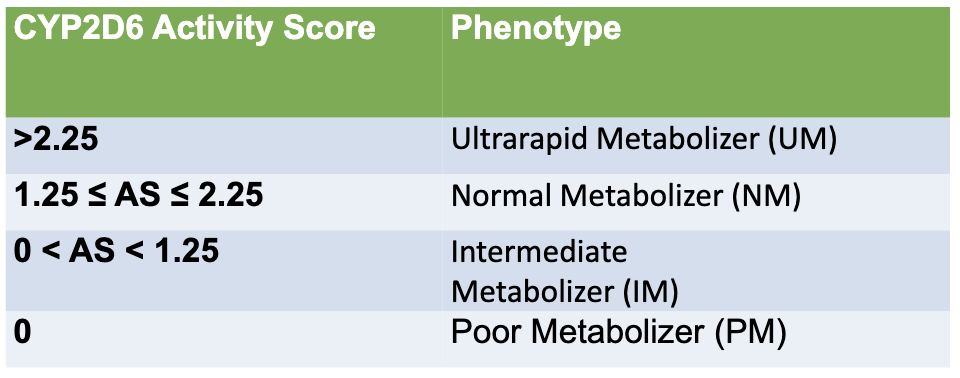
CYP2D6 activity score phenotypes
UM
NM
IM
PM
UM
> 2.25
NM
1.25 ≤ AS ≤ 2.25
IM
0 < AS < 1.25
PM
0
opioid analgesics metabolized by CYP2D6
codeine
tramadol
hydrocodone
oxycodone
Codeine
prodrug
converted to morphine
rapid metabolism → increased risk of life-threatening respiratory depression
Tramadol
racemic mixture
(+) and (-) tramadol is active analgesic inhibiting 5HT and NE reuptake to produce analgesia
fraction of (+) tramadol metabolized to form metabolite M1
M1 = potent u opioid receptor agonist and accounts for analgesia effect
Tramadol:
PM have
UM generates
PM have lower plasma M1 → increased risk of tx failure
UM generates more M1 → increased risk of opioid receptor-mediated side effects
Hydrocodone
active analgesic, metabolite w/ greater affinity
biotransformed by CYP2D6 into hydromorphone
PM and NM demonstrate similar analgesic response
Oxycodone
u opioid receptor agonist
active analgesic, more potent metabolite (desmethyl metabolite oxymorphone)
11 % metabolized
PM = poor analgesic response
UM = higher toxicity
Recommendations for Codeine and Tramadol
UM
PM
UM
> 2.25
increased morphine formation → higher toxicity risk
avoid use due to toxicity → use non-codeine, non-tramadol
strong level
PM
0
greatly reduced morphine formation → insufficient pain relief
avoid use due to lack of efficacy → use non-codeine, non-tramadol

Codeine and Tramadol toxicity risks
sedation
respiratory depression
death
T or F: Hydrocodone and oxycodone are good alternatives to Codeine and Tramadol
False → still affected by CYP2D6 metabolism
Recommendations for Hydrocodone
UM
PM
UM
> 2.25
minimal evidence for PK or clinical effect
no recommendation
PM
0
decreased metabolism to hydromorphone
use label recommended age or weight specific dosing
no response → use non-codeine or non-tramadol opioid
optional

Codeine and Tramadol FDA contraindications
not used to treat pain or cough (Codeine)
not used to treat pain (Tramadol younger than 12 yrs old)
Codeine and Tramadol not recommended in
adolescents (12 - 18 yrs old) who are obese or have conditions such as sleep apnea or severe lung disease
Codeine and Tramadol warning
mothers breastfeeding due to ADR in infants → excess sleepiness, breathing problems
Antidepressants Affected by CYP2D6
SSRIs
Paroxetine, Fluvoxamine, Vortioxetine → inactive metabolites
SNRIs
Venlafaxine → Desvenlafaxine (active)
TCAs
secondary — Despramine, Nortriptyline
tertiary — Amitriptyline (also affected by CYP2C19)
SSRIs PK
PM
UM
PM
poor metabolism → increased drug concentration → higher risk of side effects
UM
fast metabolism → decreased active drug → tx failure
SSRIs/SNRIs side effects
CNS effects (HA, insomnia)
GI dysfunction
sexual dysfunction
serious side effects
serotonin syndrome
arrythmias from QT prolongation
Recommendations for Paroxetine
UM
IM
PM
UM
increased metabolism → low active drug concentration → tx failure
use alternative drug not metabolized by CYP2D6
moderate level
IM
reduced metabolism → higher concentration → increased side effects risk
start lower starting dose and slower titration
moderate level
PM
greatly reduced metabolism → higher concentration -. increased side effects risk
50% reduction of starting dose, slower titration, 50% lower maintenance dose
moderate level

Recommendations for Fluvoxamine
UM
PM
UM
no data
no recommendation
PM
greatly reduced metabolism → increased concentration → increased risk of side effects
25 - 50% lower starting dose and slower titration OR
alternative antidepressant not metabolized by CYP2D6
optional level

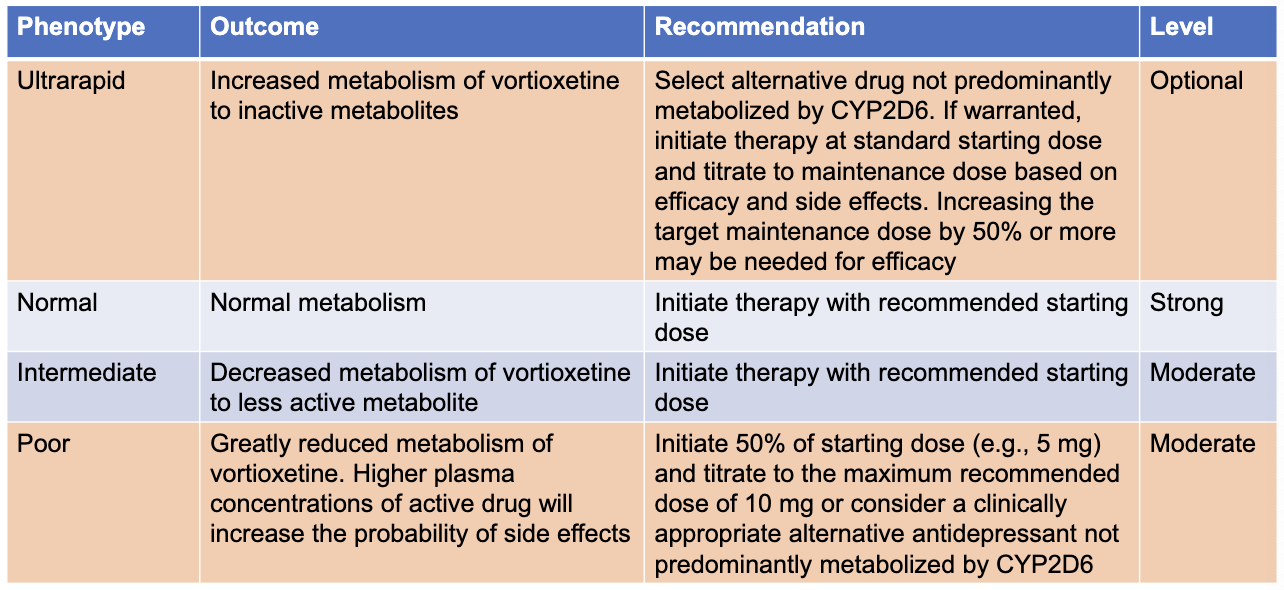
Recommendation for Vortioxetine
UM
PM
UM
increased metabolism to inactive metabolites
alternative drug not metabolized by CYP2D6
if warranted → starting dose and titrate
increasing target maintenance dose by 50% or more may be needed for efficacy
optional level
PM
greatly reduced metabolism → higher concentration → increased risk of side effects
initiate 50% of starting dose and titrate to max dose OR
alternative drug not metabolized by CYP2D6
moderate level
Recommendation for Venlafaxine
PM
PM
decreased metabolism to active metabolite
associated w/ adverse effects
alternative drug not metabolized by CYP2D6
optional level
Summary of SSRI/SNRI recommendations

SSRIs/SNRIs NOT metabolized by CYP2D6
citalopram
escitalopram
sertraline
polymorphisms of — affects all TCAs
polymorphisms of — affects only tertiary TCAs
CYP2D6
Desipramine
Nortriptyline
CYP2C19
Amitriptyline
Clomipramine
Doxepine
Imipramine
Trimipramine
TCA PK
loss of function CYP2D6
increased CYP2D6
loss of function
increased active TCA → higher risk of toxicity
increased functions
decreased TCA → risk of tx failure
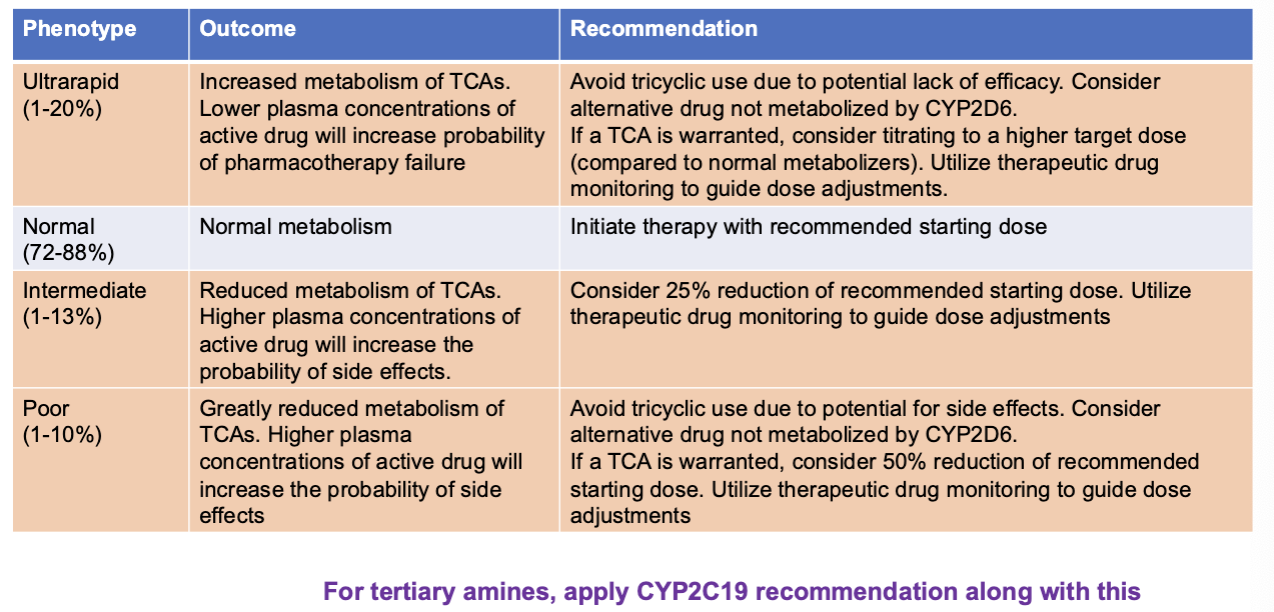
Recommendations for all TCAs
UM
IM
PM
UM
increased metabolism → low plasma concentration → risk of tx failure
avoid use, consider alternative not affected by CYP2D6
if TCA warranted → titrate to higher dose + TDM
IM
reduced metabolism → high concentration → risk of side effects
25% reduction of starting dose + TDM
PM
greatly reduced metabolism → higher concentration → high risk of side effects
avoid use, consider alternative not affected by CYP2D6
if TCA warranted → 50% reduction of starting dose + TDM
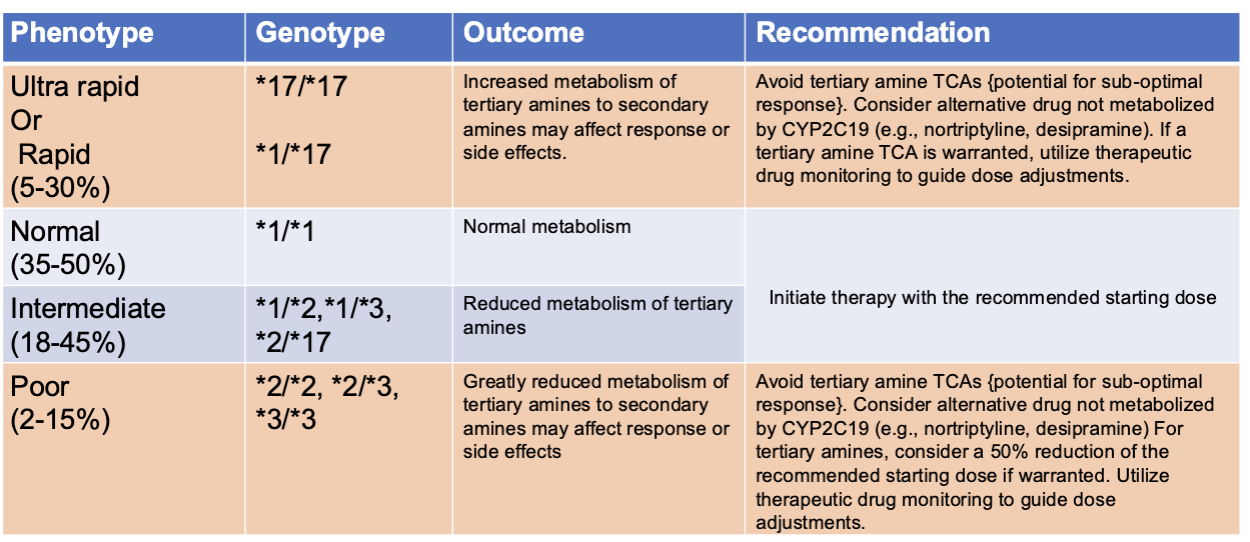
CYP2C19 Recommendations for tertiary TCAs
UM or RM
PM
UM or RM (17/17, 1,17)
increased metabolism to secondary amines
avoid tertiary TCAs, consider alternative (Nortriptyline or Desipramine)
tertiary TCA warranted → TDM to guide dose adjusments
PM (2/2, 2/3, 3/3)
greatly reduced metabolism
avoid tertiary TCAs, consider alternative (Nortriptyline or Desipramine)
tertiary TCA warranted → 50% reduction of starting dose + TDM to guide dose adjustments
Amitriptyline recommendations (based on 2C19 and 2D6)
Consider alternative: CYP2C19 UM/RM or PM, CYP2D6 UM or PM
Consider 25% dose reduction: CYP2D6 IM but CYP2C19 NM or IM
Consider 50% dose reduction (if no alternative): CYP2D6 PM but CYP2C19 NM or IM
Antidepressant Polymorphism summary

Ondansetron and CYP2D6 Polymorphism
5HT3 receptor antagonist for n/v
chemo-induced, radiation-induced, or post-op n/v
side effects
HA
constipation
transient increase in liver enzymes
serious: QT prolongation
Ondansetron recommendations
For ultrarapid metabolizer: consider alternative
For intermediate/poor metabolizer: initiate as recommended normally
Aripiprazole (Abilify)
atypical antipsychotic
metabolized by CYP2D6 and CYP3A4
ADE
weight gain
hyperglycemia
GI
akathisia
dizziness
tremor
extrapyramidal sigh
HA
insomnia
sedation
blurred vision
anxiety
restlessness
Aripiprazole Recommendations
tabs and solutions
injection
tabs and solutions
2D6 PM → half of usual dose
2D6 PM and strong 3A4 inhibitors → quarter of usual dose
injection
2D6 PM → 300 mg
2D6 PM and 3A4 inhibitors → 200 mg

strong 3A4 inhibitors
itraconazole
ketoconazole
clarithromycin
atazanavir
darunavir
indinavir
ritonavir
CYP2D6 and Atomoxetine (Strattera)
nonstimulant med for ADHD
side effects (due to PM)
insomnia
weight loss
constipation
xerostomia
depression
treamor
excoriation
conjunctivitis
syncope
early morning awakening
mydriasis
sedation
Atomoxetine (Strattera) in Children

Atomoxetine (Strattera) in Adults

phenoconversion
DDIs can affect phenotype due to interaction w/ same CYP enzymes
phenoconversion DDI: CYP2D6 inhibitors
Fluoxetine (strong)
Paroxetine (strong)
Bupropion (strong)
Terbinafine (strong)
Quinidine (strong)
Cinacalcet (moderate)
Mirabegron (moderate)
Duloxetine (moderate)