B5
 Call Kai
 Learn
Learn Practice Test
 Spaced Repetition
 Match
Match Flashcards
 Knowt Play
1/82

There's no tags or description
Looks like no tags are added yet.
Name | Mastery | Learn | Test | Matching | Spaced | Call with Kai | Chat |
|---|
No analytics yet
Send a link to your students to track their progress
83 Terms
Many human actions are reflexes.
(a) Which statement describes a reflex action?
a reflex action is automatic


Which two human actions are reflexes?
blinking when an insect flies into the eye
1
removing the hand from a hot object


There is an anomalous result for student R.
Draw a ring around the anomalous result in the table above.
635
Give two factors that might affect a person’s reaction time.
f) any two from:
• age
• drugs
allow a named example of a drug such as alcohol /
caffeine
• tiredness / sleep
• sex
allow gender
allow practice at the test or playing computer
games
allow distractions
Conditions inside and outside of the human body often change.
Homeostasis helps the human body to survive changing conditions.
(a) Explain what is meant by the term ‘homeostasis’.(2)
regulation / control / maintenance of internal conditions
allow keeping internal conditions the same
1
for optimum conditions for cell(s) / enzyme(s) (activity)
The kidneys have an important role in homeostasis.
(b) Describe what happens to glucose, protein and urea in the kidneys.
(biology only) (4)
glucose and urea are filtered (out of the blood)
allow a description of filtration of glucose and urea
(out of the blood)
1
protein is not filtered (out of the blood)
1
all glucose reabsorbed
allow all glucose absorbed back into the blood
1
urea (mostly) not reabsorbed
or
urea passes out in urine
allow urea not absorbed back into the blood
Explain how ADH affects the production and concentration of urine by the
kidneys. (biology only) (HT only)(4)
(increased / high) ADH increases water reabsorption
or
(increased / high) ADH
increases permeability to water
allow converse for decreased / low / no ADH
1
(water reabsorption) from kidney tubules
1
(so) ADH increases the concentration (of urine)
1
(so) ADH decreases the volume (of urine)


Some human actions are reflex actions.
What is a reflex action?
any two from:
• fast / rapid
• a response / reaction
ignore action
• automatic / involuntary
or
not under conscious control
allow not coordinated by the conscious part of the
brain
or
allow does not involve thought / thinking
ignore not coordinated by the brain
• protects (from danger / harm)
Many reflex actions are movements.
What type of tissue causes movement?
muscle

B
A
balance

A=optic nerve
B=lens
Contract

A=optic nerve
Thicker
Iris
any one from:
• (sent as) impulses
allow (sent as) electrical signals
ignore messages
• along sensory neurone(s)

f)the light rays do not meet / focus / converge on the retina
g)any one from:
• (hard / soft) contact lenses
• (laser) surgery
• replacement lens (in the eye)
A person’s eyes can focus on objects at different distances.
A person looks at a distant object.
The person then looks at a near object.
The person’s eyes make adjustments so that the near object forms a clear
image.
(a) Which term describes the adjustment of focus from the distant object to the
near object?
accommodation

b) B
c) E
What happens to the shape of the lens when focusing on a near object?
(biology only)
becomes fatter / thicker / wider
The eyes can function in dimly-lit areas and in brightly-lit areas.
The iris contains muscles.
Describe how muscles in the iris help the person to see clearly when
moving from a dimly-lit area to a brightly-lit area.
any two from:
• (muscles in the iris) contract
allow (muscles in the iris) shorten
ignore circular / radial muscles
ignore (muscles in the iris) relax
do not accept ciliary muscles contract
• reduce size of pupil
allow constrict pupil
allow reduce size of aperture / gap /
hole
• reduces (amount of) light entering
allow reduces (amount of) light reaching
retina
It is important to be able to react quickly.
Many people think that drinking coffee decreases reaction time.
Plan an investigation to test the effect of drinking coffee on reaction time.
You should include:
• the test for reaction time that you would use
• how to make the investigation valid.(4)
• identification of method eg ruler drop
• correct details of method chosen eg hold ruler above thumb
• repetitions – at least two more times
• repeat with (at least 2 more) other students
• tested without coffee and with coffee or with different amounts
of coffee
• calculate mean value with coffee and without coffee
• compare results with and without coffee
• correct control variables for method chosen, eg:
o same age
o sex
o BMI
o amount of sleep
o volume / concentration / type of coffee
o time interval between drinking and testing
o control variable within method described

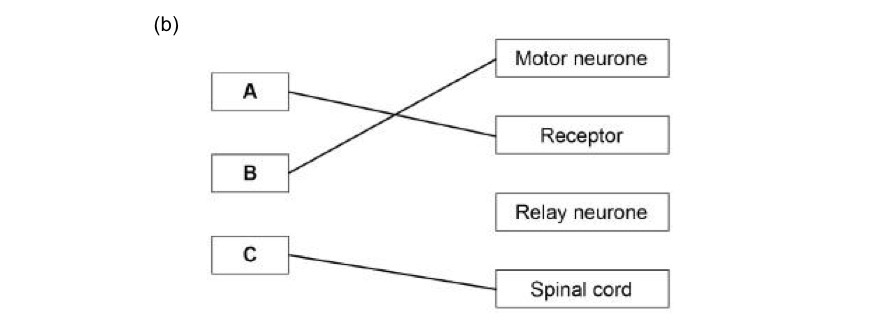

(a) (lowest) 1 (°C)
allow a tolerance of ± 0.2 (°C)
(highest) 34 (°C)
allow a tolerance of ± 0.2 (°C)
both correct for 1 mark
1
(b) 5 / five
1
(c) so stored food or glycogen does not run out
or
to replace stored food or glycogen
allow so stored fat does not run out
or to replace stored fat
or because stored food or glycogen /
fat has run out
ignore to provide energy
Most mammals use a lot of energy to evaporate sweat.
The echidna does not sweat.
Suggest one use of energy in the echidna’s body. (biology only)
any one from:
• movement
allow functioning of internal organs – eg
heartbeat
• muscle contraction
• keeping warm
• growth / repair
allow synthesis / described
• active transport
The control of body temperature is important in the human body.
An athlete trained in a hot climate.
(f) On one day, the athlete lost 3 200 cm3 of water in sweat.
Evaporation of 1 cm3 of sweat requires 2.5 kJ of energy.
Calculate the energy the athlete used for evaporation of sweat. (biology
only)
3200 × 2.5
1
8000 (kJ)
On a different day the athlete used 6 000 kJ of energy to evaporate sweat.
The athlete’s energy intake was 24 000 kJ.
Calculate the percentage of the athlete’s energy intake used for
evaporation of sweat.
6000/24,000 ×100
25%
Some days the athlete did not do any training and rested at home.
What effect would resting have on the volume of sweat produced each
day? (biology only)
reduced

echidna: 27 to 35 or by 8 (°C)
allow a tolerance of ± 0.5 (°C)
and
human: 36.2 to 37.2 or by 1 (°C)
allow a tolerance of ± 0.1 (°C)
1
echidna is more variable
or
human fluctuates less
allow echidna is 7 (°C) more variable for 2 marks
allow echidna is 8 times more variable for 2 marks

In the cold winter months, the echidna hibernates.
During hibernation:
• the echidna’s body temperature decreases to below 5 °C
• the echidna sleeps for up to 17 days at a time
• the echidna’s rate of metabolism slows down.
(b) Explain why the decrease in body temperature is an advantage to the
echidna during hibernation.
loses less energy (from its body)
allow loses / wastes less heat
1
(so) body energy store lasts longer
allow glycogen / fat lasts longer
allow stored food lasts longer
1
OR
lower temperature gradient (between echidna and air) (1)
(so) loses less energy (1)
allow loses less heat
OR
less energy transferred maintaining (higher) body temperature (1)
allow less energy transferred for keeping warm
(so) more energy available for processes vital for life (1)
allow more energy for eg heart / brain function
ignore metabolism
do not accept energy produced / made / created
do not accept energy used for respiration
(c) During hibernation the echidna wakes up several times.
Each time the echidna wakes up it becomes active and its body
temperature increases to over 30 °C.
Explain why the echidna has a higher body temperature when it is active.
activity / movement requires energy from respiration
1
(and) respiration / metabolism releases heat (which increases
body temperature)
1
OR
respiration / metabolism releases heat (which increases body
temperature) (1)
(which) increases the rate of chemical reactions
or
increases enzyme activity (1)
do not accept energy produced / made / created
once only
An echidna can dilate and constrict blood vessels in its skin.
Explain how the dilation of blood vessels in the skin can help to decrease
body temperature.
more blood flow near surface (of skin)
or
more blood flow to the skin
do not accept blood vessels move nearer to
surface of skin
1
(so) more heat / energy is lost (from the blood)
1
cools blood which cools the body
ignore cools blood / body unqualified
An athlete trained in a hot climate.
The athlete lost a large volume of water each day in sweat.
(e) The athlete’s energy intake each day from food was 20 000 kJ.
Evaporation of 1 cm3 of sweat requires 2.5 kJ of energy.
40% of the athlete’s daily energy intake was used to evaporate sweat.
Calculate the volume of sweat the athlete lost each day. (biology only)
Give your answer in dm3
1 dm3 = 1 000 cm3

Suggest why the athlete was advised to take salt tablets each day. (biology
only)
to replace ions / salt lost (in sweat)
The hormone insulin helps to control the concentration of glucose in the blood.
(a) Which organ produces insulin?
Pancreas
People with Type 2 diabetes:
• produce insulin
• have body cells that do not respond to insulin
• often have a high concentration of glucose in their blood.
(b) Why do people with Type 2 diabetes often have a high concentration of
glucose in their blood?
(b) the body cells take in a low amount of glucose from the blood
Drug X is used for treating people who have Type 2 diabetes.
Scientists investigated the effect of drug X on the concentration of glucose in the
blood of mice.
This is the method used.
1. Give two groups of mice the same diet for 8 weeks.
2. Give each mouse in group A 2 cm3 of water to drink.
3. Give each mouse in group B 2 cm3 of drug X to drink.
4. After 30 minutes, give each mouse 1 cm3 of glucose solution to drink.
5. Measure the concentration of glucose in the blood of each mouse at
intervals for 3 hours.
(c) Give two control variables used in the investigation.
(c) any two from:
• (same) diet
• (same diet for same) duration
• (same / 30-minute) time before being given glucose
if neither point given allow time
• (same) volume of water and drug X
allow (same) amount of water and drug X
allow 2 cm3 of drink
• (same) volume of glucose (solution)
allow (same) amount of glucose (solution)
allow 1 cm3 glucose (solution)
if neither bp4 nor bp5 awarded, allow 1 mark for
(same) volume / amount of drink

20 and 30
allow an answer in the range 28 to 32 for group A
1
(30 – 20 =) 10 (minutes)
allow an answer consistent with values for A
between 28 and 32

Give two conclusions about the effect of drug X on the concentration of
glucose in the blood.
Do not refer to reaching the maximum value earlier.
any two from:
(with drug X)
• lower throughout
• lower maximum (concentration)
• slower increase (in concentration)
• slower decrease (in concentration)
• returns to original (concentration) (sooner)
(f) use different concentrations of drug X
How could scientists find the best dose of drug X for controlling blood
glucose concentration?
By the blood
Q2.
Hormones are important for controlling many processes in the human body.
Hormones are produced by glands.
(a) Which organ system has glands that produce hormones?
the endocrine system
How are hormones transported around the body?
By the blood


Give one effect of insulin.
any one from:
allow sugar for glucose
• lowers (blood) glucose
allow controls (blood) glucose
• (makes) cells / liver / muscles take in glucose
• (changes) glucose to glycogen
allow makes glycogen
Some hormones control a woman’s menstrual cycle.
(g) Which hormone causes an egg to mature in the ovary?
follicle stimulating hormone (FSH)
Which two are hormones that help to maintain the lining of the uterus
during pregnancy?
oestrogen
1
progesterone
(i) Contraception prevents pregnancy.
Give two methods of contraception that use hormones.
any two from:
• oral contraceptive
allow the pill
• injection
• implant
allow contraceptive rod
• (skin) patch
• (some) IUDs
allow IUS
allow named methods
allow coil with hormone


158.1 (dm3)

A doctor states:
‘It is better to treat a person with kidney disease by
using a kidney transplant rather than by dialysis.’
Evaluate the doctor’s statement. (biology only)
Use information from Figure 2.
points for transplant:
• transplant is cheaper
• numerical comparison, eg £18 000 cheaper in first year and
£30 000 cheaper in subsequent years
• less / no inconvenience, eg time or cost for hospital visits
• less / no restriction on lifestyle
• less / no restriction on diet or fluid intake
• no danger of infection from eg puncturing skin or blood in
contact with machine
• less / no possibility of blood clots
• no need to take anti-clotting drugs
• transplanted kidney keeps water / urea / ions in blood at correct
level at all times
• feel well all the time
points against transplant:
• danger of rejection
• need tissue match for transplant
• donors in short supply
• possibility of organ damage due to anaesthetic
• possibility of infection in surgery
• possibility of damage due to surgery
• need to take immunosuppressant drugs
• may suffer other infections due to suppressed immune system
• may need repeat operation (after about 10 years)
A kidney transplant costs £17 000 in the first year and then £5 000 in each
of the following years for drugs.
Calculate the total cost of treatment by kidney transplant over the first 5
years. (biology only)
) 4 × 5 000 = 20 000
1
20 000 + 17 000
allow 25 000 + 17 000
1
(£) 37 000
allow (25 000 + 17 000) = (£) 42 000
Follicle stimulating hormone (FSH) is another female reproductive
hormone.
What is the function of FSH in the menstrual cycle?
FSH causes an egg to mature in the ovary
(c) Sperm cells can survive inside a woman’s reproductive organs for five
days.
An egg cell can survive for one day after ovulation.
In one woman ovulation occurred on day 14.
Give the range of days on which sexual intercourse could result in
fertilisation.
From day _______________ to day _______________
from day) 9 (to day) 15
If a man and a woman have sexual intercourse and do not want to produce
a baby, they may use contraception.
Explain how different methods of contraception prevent pregnancy
oral contraceptive / the ‘pill’
◦ (contains hormones / oestrogen / progesterone) to
prevent egg / follicle maturing or prevents ovulation
• injection / implant / skin patch
◦ (contains hormones / oestrogen / progesterone) to
prevent egg / follicle maturing or prevents ovulation
• condom / femidom
◦ prevents sperm reaching egg or prevents sperm
entering woman’s body / vagina
• diaphragm
• IUD
◦ prevents sperm reaching egg / womb / oviduct
◦ prevents implantation
or releases hormone / progesterone to prevent
ovulation
or (releases copper ions to) thicken mucus and
prevent sperm passage
spermicide
◦ kills sperm
• sterilisation / vasectomy / tubular ligation
◦ prevents passage of sperm / egg
• rhythm method
◦ no egg available for fertilisation

an answer in the range 1.1 to 2(.0) (hours)
b) Explain the effect a high concentration of insulin has on blood glucose
concentration
effect: lowered
1
explanation:
glucose taken in
or
glucose converted to glycogen
or
glucose used in respiration
1
by cells / liver / muscles

underweight
1
(d) (from) 67.5 (kg to) 90 (kg)

person C has) higher glucose (than mean)
allow comparison of higher glucose using numbers
allow (person C’s) glucose is too high
1
(person C has) higher insulin (than mean)
f) more exercise
allow example of (more) exercise
1
eat less carbohydrate / sugar or eat a low carbohydrate diet
allow eat less fat
allow eat a carbohydrate
controlled diet
if no other marks awarded allow 1 mark for
lose weight
or maintain healthy weight
or eat less
or eat fewer calories
ignore references to healthy / balanced diet or diet
unqualified
The human body has two coordination systems:
• the nervous system
• the endocrine system.
(a) Two students investigated human reaction time.
Student A held a metre rule above student B’s hand.
Student A then released the metre rule and student B caught the rule as
quickly as possible.
Figure 1 shows the method used.
Suggest two ways to improve the students’ method for measuring human
reaction time.
any two from:
• same starting position of rule(r)
allow ensure the starting position of rule(r) is at 0cm
allow other control variables
allow two control variables for 2 marks
• more precise scale
allow rule(r) with mm scale
ignore more accurate scale
• repeat and calculate mean
or
repeat and eliminate anomalies
• convert distance to time
• student (B) rests hand / arm on table
Student B’s reaction is coordinated by the nervous system.
Give two ways that coordination by the endocrine system is different from
coordination by the nervous system.
any two from:
endocrine system:
• (hormones) via blood
allow converse if clearly referring to nervous system
allow not via neurones / cells
• chemical transmission
allow not (electrical) impulses
allow not electrical signals
ignore messages
ignore hormones
• slower
• longer-lasting
answers must be comparative
ignore reference to target organs

c) thyroxine
d) insulin+glucagon
) The adrenal gland produces the hormone adrenaline.
Describe two effects of adrenaline on the human body.
any two from:
• increases heart rate
allow increases blood flow
• increases breathing rate
• increases oxygen delivery to cells / tissues / organs
• increases glucose delivery to cells / tissues / organs
allow examples of cells / tissues / organs
• increases respiration / metabolism
allow increases energy release
do not accept energy produced / made / created
• increases sweat(ing)
allow dilation of pupils
allow vasoconstriction in skin or vasoconstriction in
digestive system
allow raises blood sugar / glucose level or increase
conversion of glycogen to glucose
allow vasodilation in (skeletal) muscles / brain
allow increased blood pressure
allow slows digestion
allow other correct effects of adrenaline
if no other marks awarded allow 1 mark for
prepares for ‘fight or flight’
Hormones can be used for controlling human reproduction.
Explain the use of hormones in:
• contraception
• the treatment of infertility.
use of hormones oestrogen and progesterone or progesterone (only)
o inhibition of FSH (production / release)
- lack of FSH prevents follicle / egg development / maturation
- therefore there is no egg to fertilise
○ inhibition of LH (production / release)
- lack of LH prevents ovulation
- therefore there is no egg to fertilise
• contraceptive methods include oral contraceptive pill,
injection, implant, skin patch, IUD / IUS with hormones
treatment of infertility:
• use of FSH
○ (FSH) stimulates maturation of (several) egg(s) / follicle(s)
- (FSH) increases number of eggs matured
• use of LH
○ (LH) stimulates ovulation
- (LH) allows eggs / follicles to be collected (from ovary)
- (so) increased chance of fertilising an egg
- IVF and insertion of embryo(s) into uterus
• use of progesterone
○ (to) maintain uterus lining
- increased chance of implantation

Explain how the concentration of substance Q in the blood is controlled by
negative feedback.
Use information from the figure above. (HT only)
if (concentration of substance) Q becomes high (hormone) A is released /
used
1
if (concentration of substance) Q becomes low (hormone) B is
released / used
1
hormone(s) / A / B brings (concentration of) substance Q back to
ideal / normal
allow answers in terms of insulin for
hormone A and / or glucagon for
hormone B
allow answers in terms of blood glucose
(concentration) for substance Q
Thyroxine is a hormone produced by the thyroid gland.
A decrease in body temperature causes an increase in thyroxine
production.
Explain how the production of thyroxine causes an increase in body
temperature.
thyroxine) increases (basal) metabolic rate
allow (thyroxine) increases metabolism
allow (thyroxine) increases respiration
allow (thyroxine) increases reactions in
cells
1
1
respiration releases energy

Explain how the decrease in the concentration of ADH would cause the
changes to the urine shown in the table above.
kidney) tubules less permeable to water
1
(so) less water is reabsorbed
allow (so) less water taken back into the
blood
1
(so) more water in urine causing increased rate of production (of
urine)
allow (so) more water in urine causing
increased volume (of urine)
1
(so) more water in urine causing lower concentration of dissolved
substances (in urine)

as volume of follicles rises oestrogen concentration (in blood) rises (for 7 /
8 days)

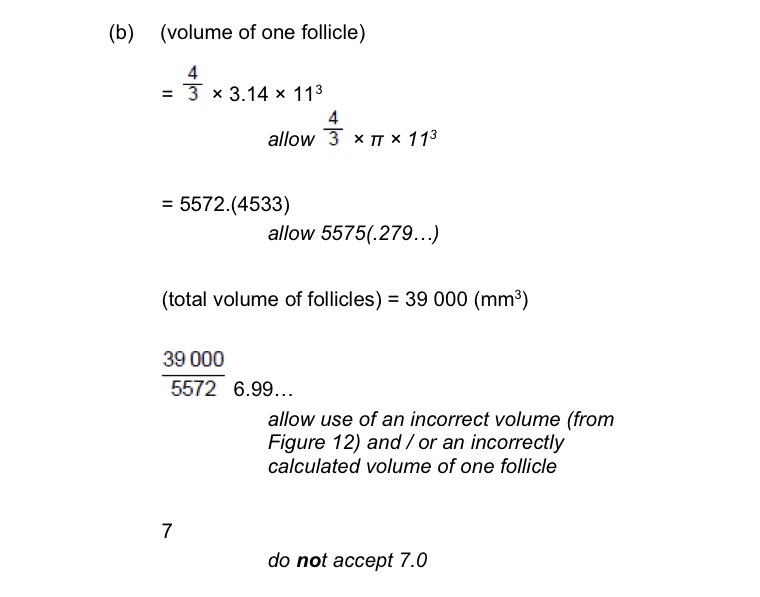
Before treatment with FSH, the woman had underdeveloped breasts.
Explain why the lack of FSH in the woman’s blood caused underdeveloped
breasts.
(lack of FSH causes) lack of oestrogen (production)
allow lack of FSH causes lack of follicle
development / growth / maturation
1
breast development is dependent on oestrogen (from follicles)
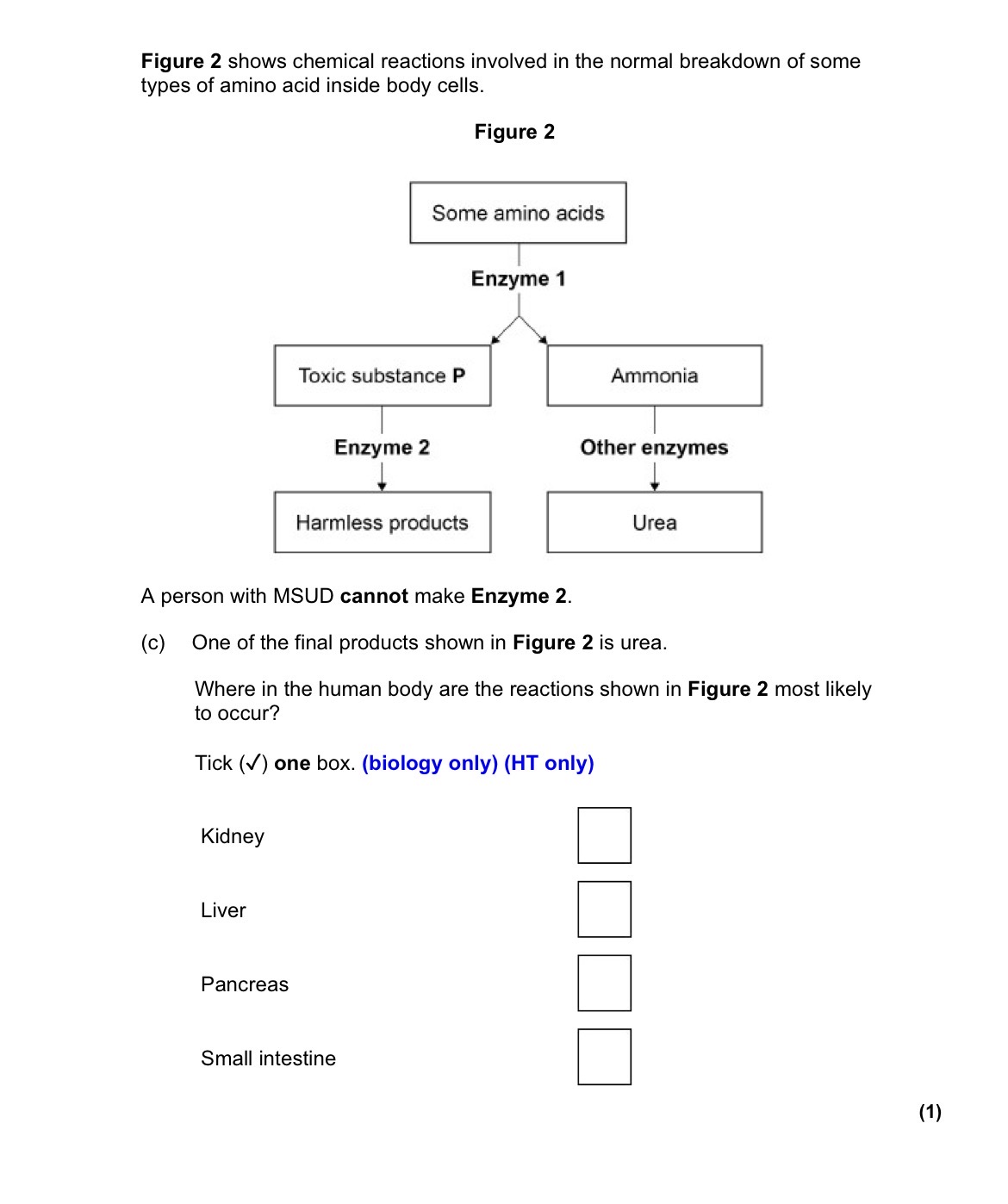
liver

Scientists can analyse blood samples or urine samples to see if a person has
MSUD.
The test identifies high concentrations of toxic substance P, shown in Figure 2.
(d) Explain why the blood of a person with MSUD will have a high
concentration of toxic substance P.
Use information from Figure 2.
(no enzyme 2 made so) cannot break down the toxic substance
allow (no enzyme 2 made so) cannot change toxic
substance into harmless products
1
the toxic substance is still made (from the amino acids)
allow toxic substance builds up over time
ignore concentration of toxic substance is high(er)
1
toxic substance diffuses / moves (from cells) into the blood

Explain why the urine of a person with MSUD will have a high
concentration of toxic substance P.
the toxic substance passes through filter in kidney
or
P passes through filter in kidney
1
(some / all) not reabsorbed

Explain why a person with MSUD must have a low-protein diet. (biology
only) (HT only)
(f) proteins contain amino acids
or
proteins are made of amino acids
allow proteins are broken down into amino acids
1
must keep (certain) amino acids in low amount
allow (so) (certain) amino acids do not build up
allow (so) less of (certain) amino acids are
produced
1
(so) toxic substance or P does not build up in the body and
cause damage to cells / tissues / organs
Plants grow in response to the direction of light and to gravity.
(a) What name is given to a plant’s growth response? (
tropism
plant root grows downwards in response to gravity.
Which two substances can the root absorb in larger amounts when it
grows downwards? (biology only)
nitrate ions
water

growth of plant seedlings.
You should include:
• a control
• the measurements you would record
• any other observations you would make.
You may use the equipment shown in below figure and any other
laboratory apparatus. (biology only)
plant shoot responds to the stimulus of light shining on it from one side.
(a) What name is given to the type of response shown by the plant shoot?
(biology only)
Tropism
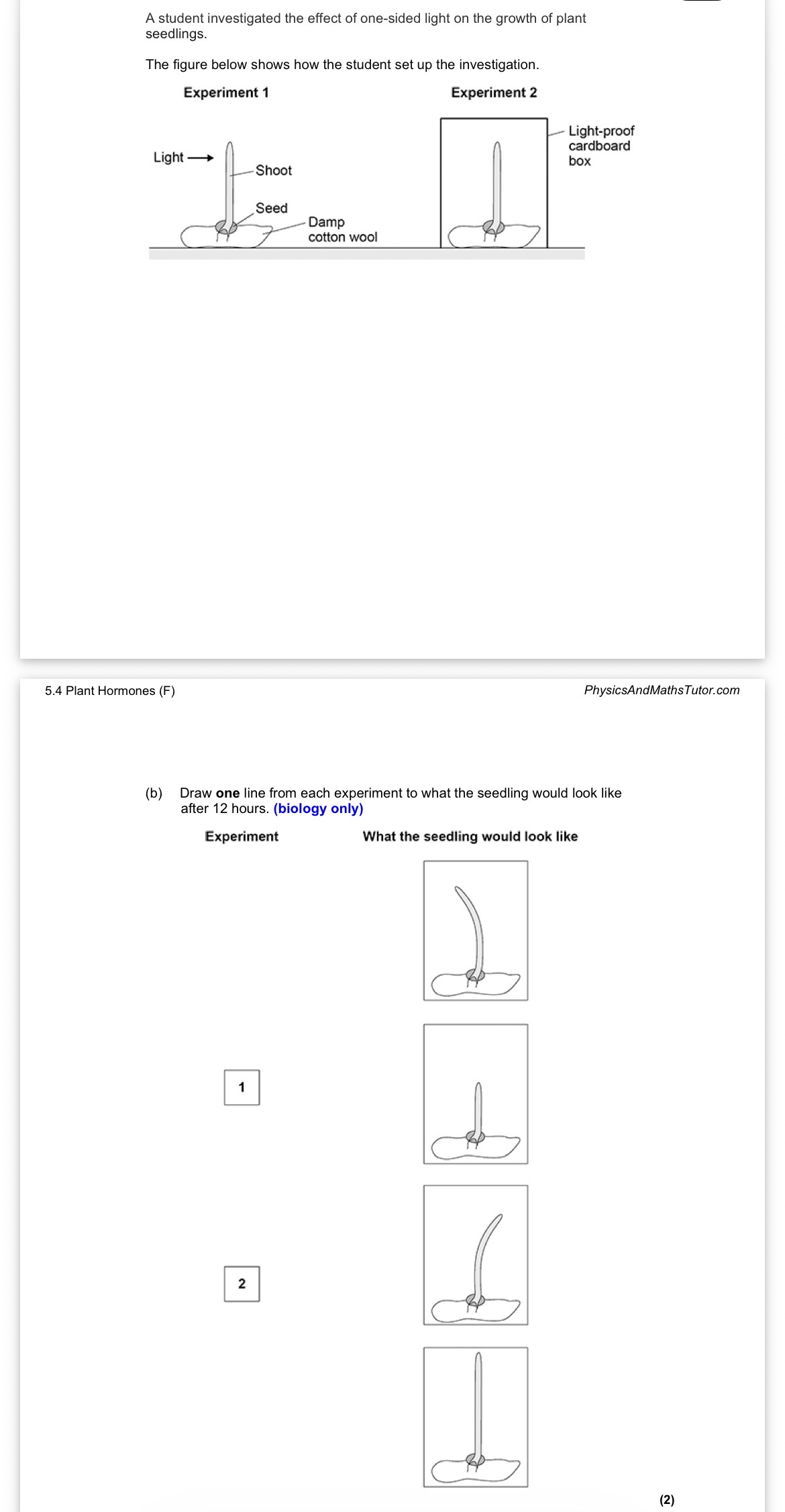


Why did the student set up experiment 2 in this investigation? (biology
only)
to show the response in experiment 1 is caused by (1-sided) light
allow to compare (with experiment 1)
allow to show the difference between (1-sided) light
and no light
or
as a control
) The student wanted to make the investigation of the effect of one-sided
light more valid.
The student decided to set up a third experiment.
How should the student set up the third experiment? (Plant auxin experiment)
shine light from all sides on the third seedling
What is a suitable control variable for the investigation? (biology only) (plant auxin experiment)
keep each seedling at the same temperature
Give one stimulus a plant root responds to. (biology only)
any one from:
• gravity
• water
allow moisture
• chemicals / minerals / ions
allow a named chemical such as nitrate
ignore nutrients
ignore light
Scientists often repeat investigations several times. (biology only)
Give two reasons why
because of variation (in results)
or
to identify / eliminate anomalies
allow example such as some may not grow
1
to calculate a mean
allow to calculate an average
or
a mean value would be more representative / typical
ignore to improve accuracy / precision / validity