Unit 1 Changing Population IB Geography
 Call Kai
 Learn
Learn Practice Test
 Spaced Repetition
 Match
Match Flashcards
 Knowt Play
1/61

Earn XP
Description and Tags
Name | Mastery | Learn | Test | Matching | Spaced | Call with Kai | Chat |
|---|
No analytics yet
Send a link to your students to track their progress
62 Terms
north/south divide
The economic division between the wealthy countries of Europe, North America, and Japan and the generally poorer countries of Asia, Africa, and Latin America.

development gap
The difference in wealth between the developed world (North) and the developing world (South).
OPEC
An organization of countries formed in 1961 to agree on a common policy for the production and sale of oil and petroleum.
G7/G8
A group of the world's wealthiest and most powerful countries

G10
a group representing the wealthiest members of the International Monetary Fund.
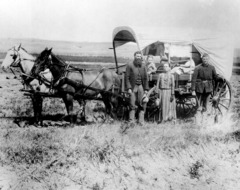
internal migration
Permanent movement within a particular country.
population distribution
how population is spread out in an area

population density
A measurement of the number of people per given unit of land

apartheid
A social policy or racial segregation involving political and economic and legal discrimination against non-whites.
migrant labourers
Labourers who move to another location to take a job, often a low-paying, temporary one

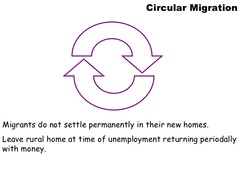
circular migration
the temporary and usually repetitive movement of a migrant worker between home and host areas, typically for the purpose of employment
natural increase rate
The percentage growth of a population in a year, computed as the crude birth rate minus the crude death rate.

doubling time
The number of years needed to double a population, assuming a constant rate of natural increase.

population momentum
continued population growth that does not slow in response to growth reduction measures

demographic dividend
A rise in the rate of economic growth due to a rising share of working age people in a population.
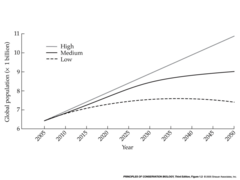
population projections
predictions about future population based on trends in fertility, mortality and migration
total fertility rate
The average number of children a woman will have throughout her childbearing years.

Gender-Related Development Index
An indicator constructed by the U.N. to measure the gender gap in the level of achievement in terms of income, education, and life expectancy.

life expectancy at birth
the average number of years a newborn infant can expect to live

dependency ratio
The number of people under age 15 and over age 64 compared to the number of people active in the labour force

aging population
Life expectancy is long and lots of old people so may cause shortage of workers

forced migration
permanent movement compelled usually by cultural factors although could also be natural factors such as drought.
Conflict-induced displacement
Forced migration due to armed conflict including civil war, generalized violence, and persecution on the grounds of nationality, race, religion, political opinion or social group when the government is unable or unwilling to protect the victims
development-induced displacement
forced migration due to development projects such as dam building

disaster-induced displacement
people are displaced as a result of natural disasters, environmental change (deforestation, desertification, land degradation, global warming) and human-made disasters (industrial accidents, radioactivity).
refugee
People who are forced to migrate from their home country and cannot return for fear of persecution because of their race, religion, nationality, membership in a social group, or political opinion.
asylum seeker
a person who has left their home country as a political refugee and is seeking asylum in another.

internally displaced person
someone who is forced to flee his or her home but who remains within his or her country's borders

Smuggled people
Smuggled migrants are moved illegally for profit. Smuggled migrants may include those who have been forcibly displaced as well as those who have left their homeland in search of better economic and social opportunities.
trafficked people
people who are moved by deception or coercion for the purposes of exploitation. the profit from these people comes from the sale of their sexual services or labor in the country of destination

pro-natalist
An attitude or policy that encourages childbearing

Anti-natalist
A government policy concerned with limiting population growth.
family planning
the practice of regulating the number or spacing of offspring through the use of birth control
Malthusian Theory
focuses on how the exponential growth of a population can outpace growth of the food supply and lead to social degradation and disorder

birth rate
the number of births in a country in a year, per 1000 people

death rate
the number of deaths in a country in a year, per 1000 people

natural increase
the birth rate minus the death rate
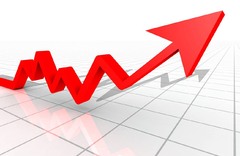
exponential growth
very quick growth

infant mortality rate
The total number of deaths in a year among infants under one year old for every 1,000 live births in a society.
child mortality rate
A figure that describes the number of children that die between the first and fifth years of their lives in a given population.
life expectancy
A figure indicating how long, on average, a person may be expected to live from birth
MEDC
More Economically Developed Country (richer country)

LEDC
Less Economically Developed Country (poorer country)
DTM
Demographic Transition Model
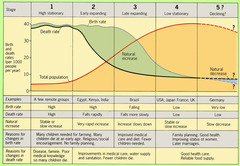
demography
scientific study of human populations
elderly dependents
The population aged over 65 who may be dependent on others

empowerment
giving a certain group rights they have been not allowed to have

Feminism
A political idea that fights for women's rights
population pyramid
A bar chart representing the distribution of population by age and sex.

census
A periodic and official count of a country's population.

welfare state
A government that takes responsibility for the welfare of its citizens through programmes in public health and public housing and pensions and unemployment compensation etc.
incentive
something that encourages a person to do something

sanction
a penalty to discourage certain behaviour
BRICS
five major emerging national economies: Brazil, Russia, India, China and South Africa
NICs (Newly Industrialized Countries)
Countries that have recently industrialized and have seen improvements in living standards and income. Living standards, while improved, are still not at level of the economic core, or more developed countries. Includes BRICS and several other rapidly developing countries. Similar concept to semi periphery.

Asian Tigers
Group of new industrial countries comprising Taiwan, South Korea, Hong Kong, and Singapore.

high-income countries
nations with highly industrialized economies; technologically advanced industrial, administrative, and service occupations; and relatively high levels of national and personal income

low-income countries
primarily agrarian nations with little industrialization and low levels of national and personal income
middle-income countries
nations with industrializing economies, particularly in urban areas, and moderate levels of national and personal income
N11
Next 11 countries (Bangladesh, Egypt, Indonesia, Iran, Mexico, Nigeria, Pakistan, The Philippines, Turkey, South Korea, Vietnam and have been consistently the fastest growing countries this century
MINT
Mexico, Indonesia, Nigeria, Turkey
CIVETS
Colombia, Indonesia, Vietnam, Egypt, Turkey, South Africa