Perio II, Lecture 5 - Crown Lengthening Surgery (Dr. Hempton)
 Call Kai
 Learn
 Practice Test
 Spaced Repetition
 Match
 Flashcards
 Knowt Play
1/83

There's no tags or description
Looks like no tags are added yet.
84 Terms
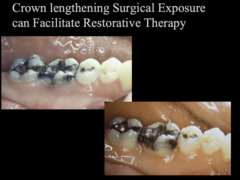
What is a major indication for crown lengthening?
- Surgical Exposure to facilitate restorative therapy
- To improve esthetics
T/F: Altered Passive Eruption (also known as delayed passive eruption) is pathologic
False
T/F: Altered Passive Eruption (also known as delayed passive eruption) is a variation of normal/ healthy anatomy
True
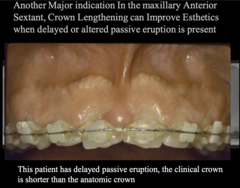
T/F: Altered Passive Eruption (also known as delayed passive eruption) has a clinical presentation excess gingival tissue i.e. the clinical crown is shorter than the anatomic crown
True
Crown Lengthening can increase crown length and completely expose the ________ crown
Anatomic

In Altered Passive Eruption (also known as delayed passive eruption), it may be associated with the osseous crest being
located close to the _________
CEJ (excess gingiva with excess bone)

Bone is normally located ___ mm from CEJ
3 mm

The issue may be soft tissue, but what sets the tone?
Bone

In the situation where bone is located at the level of the CEJ. Gingivectomy will not work because you can expect bone to facilitate re-growth of gingiva _____ mm coronal to the osseous crest
3 mm

What is the dentogingival junction made of?
- Supracrestal fibrous attachment: 1mm
- Epithelial attachment: 1mm
T/F: A gingivectomy is the necessary treatment to treat altered passive eruption in the case that the bone is located at the level of the CEJ
False
What is a common clinical finding associated with altered passive eruption?
- Thick gingival biotype
- Short clinical crowns

T/F: Crown Lengthening cannot expose caries and expose the anatomic crown
False, subgingival caries/fractured restoration/anatomic crown can be exposed with crown lengthening

The longer a preparation in a _______ dimension, the greater the crowns resistance to dislodgement
Occluso-apical

Another major indication in the maxillary anterior sextant, Crown Lengthening can improve ________ when delayed or altered passive eruption is present
Esthetics

Radiograph indicates more enamel apical to caries. What is shorter: the clinical crown or the anatomic crown?
Clinical crown
When doing crown lengthening, bone is resected until the osseous crest is ___mm from the CEJ at the mid-facial of the tooth
3mm
For esthetic crown lengthening, should you adjust the interdental area as well as mid-facial?
No - only mid-facial
For crown lengthening, the scalloping of the bone mirrors the apical contour of the _______ of the teeth
CEJs

Dentogingival junction is ____mm
2 mm

A healthy sulcus depth is about __mm
1 mm

What was the old term for the dentogingival junction + a healthy sulcus?
Biological width (3mm)
The recommended distance between the osseous
crest and a restorative margin is still __mm
3 mm

What is the new term for biological width?
Supracrestal attached tissues
What makes up the dentogingival junction?
- Epithelial Attachment (~1 mm)
- Supra-crestal fibers (~1 mm)

ID the problem:
Violation of biological width
A crown with a margin closer than 3 mm to the osseous crest
may result in _____ (2) due to violation of the supracrestal attached tissues (biological width)
- Chronic inflammation
- Bone loss

When providing a CLP, we need to obtain a ___ mm occlusal-apical distance between the restorative margin and the osseous crest!!
3 mm
(This is the recommended distance to allow for protection of the dentogingival junction: 2mm and 1mm buffer zone in sulcus)
Crown Lengthening can result in improvement in the ______, making it more cleansable
Embrasure space
(Margins are less likely to be missed when taking an impression)

T/F: Crown lengthening can be utilized to establish a ferrule
True
Define the following:
Height of natural tooth structure engaged by a full coverage restoration apical to a foundation restoration
Ferrule
What is a indication of CL procedure help in a post/core with crown procedure?
To establish Ferrule
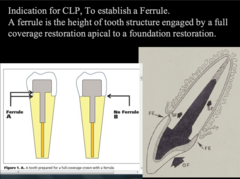
The _________ is the length of tooth structure engaged by a complete crown margin apical to the foundation material
Ferrule length

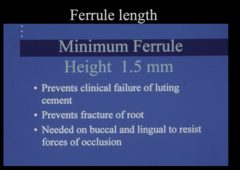
A ferrule length should be ___-___ mm
1.5-2 mm


Does this tooth have a ferrule?
No

Does this tooth have a ferrule?
Yes
How much tooth structure should be engaged by a crown apical to its foundation?
2mm (def 2mm on B/L but could be as little as 1.5mm on M/D)

All of the following are the benefits of having Ferrule except:
A) Prevents clinical failure of luting cement
B) Increases fracture of root
C) Resists occlusal forces when placed on lingual and buccal surfaces
B - PREVENTS fracture of root
All the following are indications for a crown lengthening procedure except:
A) Exposure of subgingival caries
B) Eposure of subgingival fracture
C) Exposure of tooth structure for increased retention of crown
D) Exposure of tooth structure for esthetics
E) Exposure of a prosthetic ferrule
F) Exposure of tooth structure to prevent impingement of supraosseous attachment
G) Exposure of tooth to supragingival caries
G) Exposure of tooth to supragingival caries
All the following are contraindications to crown lengthening except:
A) An esthetic compromise
B) Poor crown to root ratio
C) Extensive occlusal caries
D) Furcation invasion
F) Caries located ≤3mm from CEJ to fornix of furcation
C) Extensive occlusal caries

Why is CLP contraindicated?
Esthetic compromise

Why is CLP contraindicated?
CLP would result in poor crown to root ratio
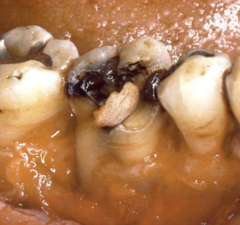
Why is CLP contraindicated?
CLP would result in exposure of the furcation
The _______ is defined as the distance between the CEJ and the separation of the roots, i.e. the fornix of the furcation
Root trunk
If osseous resection of 3 mm results in furcation invasion, what should you do?
Extract the tooth
If you have to remove bone 3 mm in an apical direction to expose Caries on the root trunk and you would remove bone in the furcation, what should you do?
Extract the tooth

Why is CLP contraindicated?
Results in furcation invasion

Patient presents with #19 caries in the furcation area. What is the treatment?
Extract the tooth
In what situations would a gingivectomy work for crown lengthening?
If soft tissue removal will still leave 3mm of soft tissue coronal to the bone crest (otherwise, tissue will grow back there to have that 3mm)

Elevation of periodontal flaps can help to achieve our goals of what? (2)
- Reshaping the bone
- Decontaminating root surfaces
With an apically positioned flap to osseous crest, the
supraossoeus gingival will coronally rebound ____ mm
3 mm

Does a gingivectomy provide access to recontour the bone?
No!
Does a surgical flap elevation provide access to recontour the bone?
Yes!
If the caries or fracture is not just located on the facial or lingual but extends to the mesial or distal, the surgery should involve __ teeth to establish positive osseous architecture
3 teeth
Bone recontouring should not be done with a diode laser but with a ________
Waterlase ND:YAG
What are two instruments we can use to reshape bone?
- Chisel
- High speed handpiece
Flap elevation may be needed to expose additional tooth structure via __________
Osseous resection
Define the following:
The removal of supporting bone
Ostectomy

Define the following:
The removal of nonsupporting bone
Osteoplasty
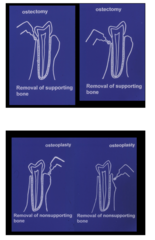
How much total vertical space is required for biologic width and ferrule when performing surgical crown lengthening?
5 mm
(3 mm for biologic width + 2 mm for ferrule)
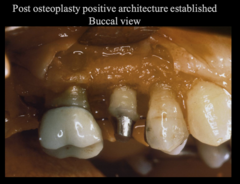
Post osseous resection (positive or negative) architecture must obtained on all three teeth
Positive

What does it mean to have positive architecture when performing CL procedure?
Bone in the M-D area is more coronal to the bone in the B-L area
Post osseous resection, flap is positioned _________
Apically

The longer the preparation in an occlussal-apical dimension, the ________ the resistance to dislodgement.
Greater
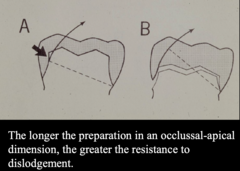

What does this show?
No Ferrule, cement between post and internal post preparation space fatigues and tooth may fracture
What has the following characteristics?
- Strengthens the restoration against failure resulting from microleakage between the crown and the tooth
- Important concern for extensively damaged teeth treated with foundation materials
Ferrule Effect
After crown lengthening, the posterior teeth take about how long to heal?
3 months
After crown lengthening, the anterior teeth take about how long to heal?
3-6 months
A restorable maxillary 1st molar, number 3, has
subgingival caries on the mesial and distal. Endodontic
therapy with post and core is treatment planned. A CLP
outcome involving osseous resection should:
A) Result in Positive osseous architecture
B) Not result in Furcation invasion
C) Expose an adequate ferrule
D) All of the above
D) All of the above
How much vertical tooth structure must a tooth fitted for a post/core with crown have?
3mm biologic width + 1.5-2mm ferrule

The ideal distance between a restorative margin and the osseous crest (Biologic Width) is __mm
3 mm
The optimal length for a ferrule on a tooth treated with a post and core and full coverage crown is __mm
2 mm
If there are mesial and distal caries on the tooth in question, how many teeth will be involved in the osseous surgery?
3 teeth
When you include a 2mm ferrule in your post and core prep, you allow the occlusal forces to be distributed to the _______
PDL
Reverse/negative architecture is associated with:
A) Perio health
B) Periodontal disease
C) Optimal bony contour
B) Periodontal disease
In reverse/negative architecture, the interdental bone is ____ to the buccal/lingual bone height:
A) Equal to
B) Coronal
C) Apical
C) Apical
Reduction of thick bone ( bucco-lingually) decreases soft tissue height in an _______ dimension on aproximal and interproximal surfaces
apico-occlusal
What has the following characteristics?
- Osseous crest follows the CEJ
- Aproximal bone is apical to the interdental bone height
- The CEJ is apically positioned on the buccal and lingual and rises coronally on the proximal surface
Positive architecture
A long root trunk tooth has ____ parabola on the approximal surface:
A) 0
B) 1
C) 2
D) 3
B) 1
A short root trunk tooth has ____ parabola on the approximal surface:
A) 0
B) 1
C) 2
D) 3
C) 2
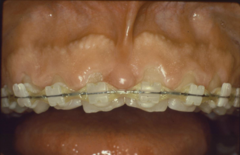
Your patient present like this clinically, but radiographically the crowns look much longer. What is the diagnosis?
Delayed/ incomplete passive eruption (gummy smile)

Your patient present like this clinically, but radiographically the crowns look much longer. What is the treatment?
Ressective surgery
What is the goal for treating patients with delayed/ incomplete passive eruption (gummy smile)?
Expose the anatomical crown
The goal of an aesthetic crown lengthening procedure when treating delayed passive eruptio is to resect periodontal tissue so the:
A) Clinical crown is equal in length to the anatomic crown
B) Clinical crown is shorter in length than the anatomic crown
C) Clinical crown is greater in length than the anatomic crown
D) None of the above
A) Clinical crown is equal in length to the anatomic crown