Chem120 Chp 15 Carbohydrates
 Call Kai
 Learn
 Practice Test
 Spaced Repetition
 Match
 Flashcards
 Knowt Play
1/21

There's no tags or description
Looks like no tags are added yet.
22 Terms
carbohydrates
aka “saccharides” (sugar, in greek)
major energy source in food
molecular formula of (C(H2O))n
glucose: C6H12O6
carbohydrates: glucose
produced by photosynthesis in plants
synthesized in plants from CO2, H2O and energy from the sun
oxidized in living cells to produce CO2, H2O and energy
types of carbohydrates
monosaccharides — one repeating sugar subunit
disaccharides — two repeating sugar subunits
polysaccharides — many repeating sugar subunits
monosaccharides
3-6 carbon atoms (typically)
a carbonyl group (aldehyde or ketone)
hydroxyl groups on all carbons, except the carbonyl group
polyhydroxyaldehyde, polyhydroxyketone
classification of monosaccharides
-ose
triose (3 C atoms)
tetrose (4 C atoms)
pentose (5 C atoms)
hexose (6 C atoms)
aldoses
monosaccharides with an aldehyde group
aldotriose (3 C atoms)
aldotetrose (4 C atoms)
aldopentose (5 C atoms)
aldohexose (6 C atoms)
ketose
monosaccharides with a ketone group (C2 position)
ketotriose (3 C atoms)
ketotetrose (4 C atoms)
ketopentose (5 C atoms)
ketohexose (6 C atoms)
achiral
object whose mirror image is identical to the original and can be superimposed on (e.g. baseball bat)
chiral
objects that have non-superimposable mirror images (e.g. gloves)
chiral compounds
carbon atoms are chiral if they are bonded to four different atoms or groups
stereoisomers
same molecular formula
chiral carbon
differ in 3D arrangement of their atoms in space
enantiomers pt1
mirror images of chiral carbon compounds
stereoisomers that cannot be superimposed
non-superimposable mirror images r called enantiomers
enantiomers pt2
same physical properties, except the direction they rotate polarized light
identified by D- and L-
natural sugars are D- forms
Fisher projection
2D representation of a chiral molecule
places the most oxidized group at the top (aldehyde)
use vertical lines for bonds that go back
use horizontal lines for bonds that go forward
chiral carbons at the intersection
D- and L- Enantiomers
determined by the -OH farthest away from the most oxidized group
L- isomer has -OH to the left of the chiral carbon
D- isomer has the -OH to the right of the chiral carbon
monosaccharides to memorize
D-glucose, D-galactose, D-fructose
all hexoses
all have molecular formula of C6H12O6
all isomers of each other
D-glucose (dextrose)
C6H12O6
most common hexose
found in fruits, veggies, honey
aka dextrose or blood sugar in body
monosaccharide in polymers of starch, cellulose, and glycogen

D-galacatose
aldohexose with C6H12O6
not found free in nature
obtained from lactose (disaccharide) (glacatose + glucose)
important in the cellular membranes of the brain and nervous system

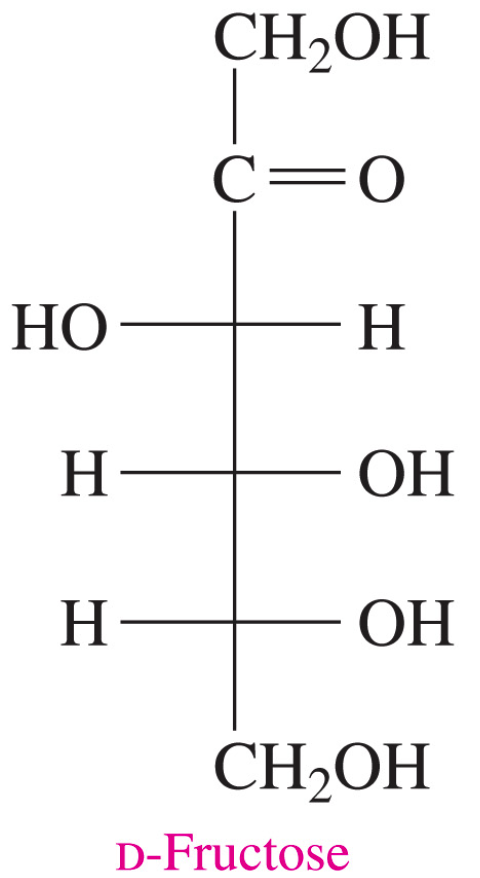
D-fructose
a ketohexose with C6H12O6
sweetest carbohydrate
found in fruit juices and honey
converted to glucose in the body
Haworth structures
right structure of saccharides
produced after the reaction of a carbonyl group and a hydroxyl group in the same molecule (hemiacetal reaction)