Week 8b — Long-term Memory + When Memory Fails
 Call Kai
 Learn
 Practice Test
 Spaced Repetition
 Match
 Flashcards
 Knowt Play
1/52

There's no tags or description
Looks like no tags are added yet.
53 Terms
What is the lecture's core distinction between keeping information in mind and learning it?
Temporary maintenance through rehearsal does not guarantee lasting memory; what determines later remembering is encoding, storage, and retrieval.
Contrast maintenance rehearsal with elaborative rehearsal.
Maintenance: repeating without enriching meaning ("hippocampus, hippocampus…") — good for temporary maintenance, poor for durable learning. Elaborative: connecting new info to meaning, examples, existing knowledge ("the hippocampus helps link elements of an experience into a memory") — supports effective long-term encoding.
Why is simple repetition a poor encoding strategy?
The item stays isolated — with no connections to existing long-term memory, it's hard to maintain over time. (The penny demo: Lincoln faces right, yet after thousands of exposures people are ~50/50 — mere exposure without meaningful encoding doesn't create LTM.)
Name the three levels of processing with the lecturer's TABLE example.
Structural: is the word printed in uppercase? Phonological: does it rhyme with "stable"? Semantic: would you find it in a dining room?
What did Craik & Lockhart propose?
That later retention depends heavily on the kind of processing carried out during encoding.

In Hyde & Jenkins (1969), what were the incidental conditions, and how did deep incidental encoding compare with intentional learning? [Figure: levels-of-processing-graphs.png]
Incidental: find the "e," count the letters (shallow) vs. how pleasant? (deep). Deep incidental recall (~16 words) matched intentional learning ("learn these!") — even though participants didn't know a test was coming.
In Craik & Tulving (1975), how did recall differ across structural, phonological, and semantic processing?
Recall rose with depth: upper/lower case (~10%) < rhymes with (~16%) < fits in this sentence (~24%).
Why does depth of processing help memory, in the lecturer's indexing analogy?
Learning establishes indexing — paths to the information; more connections (like an organized library vs. a messy pile) create more retrieval routes.
What are mnemonics?
Strategies that improve memory by organizing information and providing retrieval cues.
Give the lecture's examples of a first-letter mnemonic, the peg-word method, and visual imagery.
ROY G. BIV; peg-word: associate items with a familiar ordered sequence (1=bun, 2=shoe, 3=tree…) using visual images; visual imagery: creating memorable visual associations.
Describe the method of loci.
Choose a familiar route ("memory palace"), associate each to-be-remembered item with a specific location along it, then mentally walk the route to retrieve items in order.
What caution did the lecturer give about mnemonics for real learning?
They support "repeat it back" recall (good for cramming lists like cranial nerves) but don't attach meaning — weaker in LTM than deep connections, and they don't build understanding you can apply.
What are schemas, and what was the restaurant example?
Organized knowledge structures from prior experience that guide interpretation/encoding and influence what is remembered; e.g., entering → hostess seats you → menu → eat → pay → leave.
How do schemas both help and distort memory?
Schema-consistent information is easier to remember; but schemas can make you believe you saw details you never actually experienced.
Contrast hierarchical and associative organization of knowledge.
Hierarchical: general → specific categories (Animals → Mammals → Dogs), supporting organized search. Associative: meaningful links (Dog → pet, barking, leash), providing multiple retrieval cues; retrieval time depends on distance between nodes.
For each brain region, state its contribution to memory.
Hippocampus + medial temporal lobe: formation of new declarative memories. Prefrontal cortex: strategic encoding, working memory, retrieval control. Amygdala: emotional modulation of memory. Striatum + cerebellum: skill learning, habits, conditioned responses. Distributed cortical regions: representation of perceptual/conceptual information.
What was the lecturer's caveat about the biological-basis material?
Don't stress about it — she won't ask students to label a brain; the point is that multiple areas are involved.
How is information about one experience represented in the brain during encoding?
Across multiple cortical regions by modality — visual aspects in visual processing regions, auditory in auditory regions, tactile in somatosensory regions — with frontal cortex influencing what gets attention and how it's organized.

What did the perception-vs-remembering study show? [Figure: perception-remembering-overlap.png]
The same cortical regions active when viewing pictures (green) or hearing sounds (orange/red) were reactivated when those pictures/sounds were remembered — illustrating that LTM representations are distributed patterns of cortical activity, not stored in one spot.
How does the hippocampus's role change as memories consolidate?
Critical early for acquiring new episodic memories; over time memories are transferred out to distributed cortical regions.
Define consolidation.
Processes through which newly formed memories become more stable over time — memories change after initial encoding, with the hippocampus and distributed cortical networks establishing and maintaining declarative memories, continuing after learning.
What is long-term potentiation (LTP), and what does it model?
Certain patterns of neural activity produce lasting increases in synaptic strength, so later stimulation evokes a larger postsynaptic response — a cellular model of experience-dependent plasticity/memory formation.
In the LTP demonstration, what happened after the intense frequent pulses?
A weak pulse that initially rarely made the neuron fire evoked much more firing 30–60 minutes later.
Name three factors that support consolidation after learning.
Reactivation (thinking/re-experiencing the memory), sleep (facilitates consolidation of some memory types), and emotion/arousal (via the amygdala; e.g., vivid "flashbulb" memories like 9/11 — strong and confident but not necessarily accurate).
What is reconsolidation, and what is its trade-off?
Reactivating an established memory can make it susceptible to modification — it may need restabilization, and new information/perspectives can be incorporated. Result: a stronger memory that may be less faithful to the original experience.
Match each retrieval task to the lecture's example: free recall, cued recall, recognition.
Free recall: "name the three memory processes" (no cues). Cued recall: "which process involves acquiring information?" Recognition: "is encoding one of the three memory processes?"
State the encoding specificity principle (Tulving & Thomson, 1973) with the BANK example.
Retrieval is facilitated when test cues match information encoded with the original experience — BANK learned in a river sentence is better cued by RIVER than by MONEY.
What did Godden & Baddeley (1975) do, and what did they find?
Participants learned words underwater or on land, then were tested in the same or a different environment — recall benefited when learning and testing contexts matched (context-dependent memory).
Contrast rereading with retrieval practice.
Rereading = repeated exposure; increases familiarity and can create an illusion of knowing. Retrieval practice = reconstructing information from memory; improves long-term retention and reveals what you can and can't retrieve.
Summarize the three determinants of a lasting memory from the final slide.
Encoding: meaningful processing, elaboration, organization → rich representations. Storage: consolidation and neural plasticity → lasting retention. Retrieval: depends on effective cues and the encoding–retrieval match.
The lecturer classified making up a story while learning as which kind of rehearsal?
Elaborative rehearsal — it connects the material meaningfully.
What is the lecture's thesis about why memory fails?
Failures arise not only because information is lost or inaccessible, but because remembering is an active, reconstructive process.
Distinguish the two broad kinds of memory failure.
Forgetting/"drawing a blank": failure to retrieve information or experiences. Mistaken remembering: thinking you remember but erring subtly or significantly.
List the seven sins of memory and how they group.
Sins of omission (failures to remember): absentmindedness, transience, blocking. Sins of commission (distortions): misattribution, suggestibility, bias. Plus persistence: unwanted remembering.
What is absentmindedness?
A lapse in attention causing memory failure — insufficient attention during encoding or retrieval; the information may never have been encoded well enough to remember.
What is transience, and what did Ebbinghaus show?
Reduced memory accessibility with the passage of time; using nonsense syllables, Ebbinghaus showed forgetting is rapid initially then slows, and additional learning/review improves retention.

Describe the shape of Ebbinghaus's forgetting curve. [Figure: ebbinghaus-forgetting-curve.png]
Savings (%) drops steeply in the first hours after learning, then levels off — rapid initial decline followed by much slower subsequent decline.

According to the "Overcoming the Forgetting Curve" graph, when should reviews happen and what do they do? [Figure: overcoming-forgetting-curve.png]
Review immediately after class, then at 24 hours, 1 week, and 1 month — each review resets the curve so that less is forgotten after each successive review.
Define decay, proactive interference, and retroactive interference, with the lecture's examples.
Decay: information becomes less accessible over time (forgetting details as the retention interval grows). Proactive: old learning interferes with new (entering your old password instead of the new one). Retroactive: new learning interferes with old (forgetting your previous password after repeatedly using the new one).
What is blocking?
Temporary inability to retrieve information believed to be stored — the tip-of-the-tongue state: a feeling of knowing, partial info accessible (first letter, syllables), with related words competing during retrieval.
What are the three ways memory can fail, and the primary issue in each?
Absentmindedness: inadequate attention/encoding. Transience: reduced accessibility over time. Blocking: temporary retrieval failure.
What is persistence, and what brain structure is involved?
Recurrence of unwanted or hard-to-suppress memories; emotionally significant experiences are especially memorable, and the amygdala modulates consolidation of emotionally arousing experiences.
What are flashbulb memories, and what is their accuracy caveat?
Vivid memories of where you were and what you were doing when you learned of a highly emotional public event; vividness and confidence can stay high even as details become inaccurate.
Distinguish bias, misattribution, and suggestibility.
Bias: current beliefs/feelings shape recollection of the past. Misattribution: remembering information but confusing its source. Suggestibility: later-encountered information influences what you remember.
Name the three types of bias on the slides.
Consistency bias; change bias (exaggerating how different you feel now vs. then); egocentric bias (self-enhancing).
What is source monitoring, and what are the lecture's examples of misattribution?
Evaluating the origin of remembered information; e.g., did I read that fact or hear it? Have that conversation or only imagine it? See the event or a photo of it afterward? False recognition can be reduced with distinctive information.
In the false-memory word-list demo, which word was falsely recognized, and why?
SLEEP — never presented, but falsely recognized because related list words activate overlapping semantic representations; people remember the gist/theme and the unpresented associate feels familiar. ("The processes that make memory efficient can also make it vulnerable to distortion.")
What is the single point the slides make about Elizabeth Loftus's false-memory research?
That entire episodes can be fabricated — a striking demonstration of suggestibility. (Slides only; the Oct 30 lecture was canceled, so no transcript elaboration exists.)
How did question wording affect speed estimates in the eyewitness demo?
"How fast were the cars going when they smashed into / collided with / bumped / hit / contacted each other?" — the verb choice shaped the estimates.
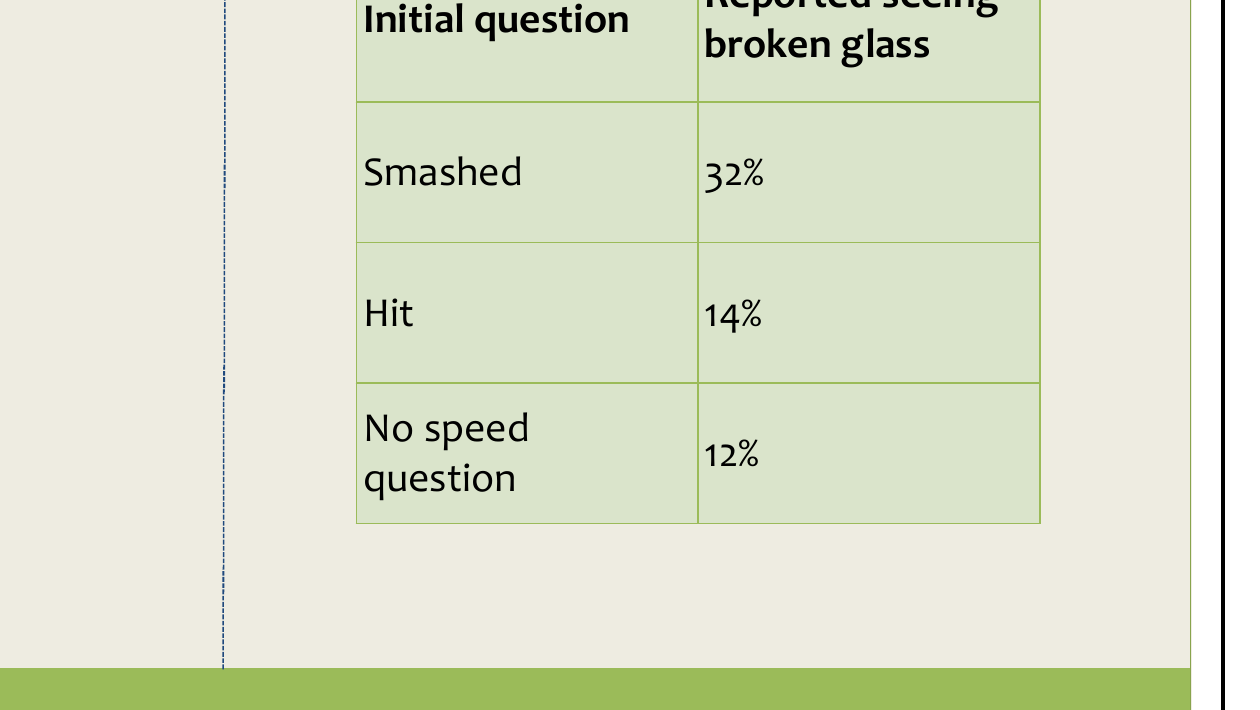
In the broken-glass data, what percentage reported seeing broken glass after "smashed" vs. "hit" vs. no speed question? [Figure: broken-glass-suggestibility.png]
32% vs. 14% vs. 12% — even though there was no broken glass; the leading verb created the false memory.
Why does eyewitness suggestibility matter?
Leading questions influence memory reports; post-event information gets confused with the original experience; confidence does not guarantee accuracy; interview procedures should minimize suggestive questioning.
For each memory process, how can errors arise?
Encoding: inattention and expectations influence what's represented. Storage: representations weaken, change, or compete. Retrieval: cues, schemas, suggestions, and source confusion influence remembering.
What does "memory is constructive, not reproductive" mean — selective, associative, constructive?
Selective: we create memories — choose what/how/when to encode and retrieve. Associative: we link what we know, tracing connections. Constructive: we fill in gaps and later "remember" the filled-in knowledge. Memory is not a video recording.