Aromatic Chemistry
 Call Kai
 Learn
 Practice Test
 Spaced Repetition
 Match
 Flashcards
 Knowt Play
1/6

There's no tags or description
Looks like no tags are added yet.
7 Terms
What is a Benzene ring and Describe its Bonding?
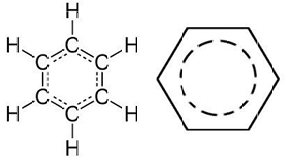
Benzene is an aromatic compound consisting of a ring of six carbon atoms with a hydrogen atom attached to each carbon, and a ring of delocalised electrons. Each bond in the benzene ring has an intermediate length in between that of a single and a double bond. It is a planar molecule.
The outer electron the each p-orbital of each carbon atom is delocalised to form the central ring. This ring structure makes benzene very stable compared to other molecules of similar size.
What were the original predictions of Benzene?
When Benzene was discovered, its structure was not known. It was predicted from empirical measurements that it had a structure similar to 1,3,5-Cyclohexatriene, with 3 double bonds and 3 single bonds.
This meant that its predicted enthalpy of hydrogenation was -360 kJmol-1. It was later discovered to instead be -208 kJmol-1 which led to the conclusion of its different and unusual structure and it being more stable due to its delocalised electron ring.

What are Arenes/Aromatic Compounds?
Arenes/Aromatic Compounds are compounds that contain benzene as part of their structure. They have high melting points due to the high stability of the delocalised ring, but low boiling points as they are non-polar molecules and often cannot be dissolved in water.
How do Aromatic Compounds React?
The benzene ring is very electron rich due to the cloud of electrons above and below the ring, which means that it is attacked by electrophiles. It also goes under substitution reactions where H atoms on the ring are replaced. As a result the undergo Electrophilic Substitution reactions. They don’t readily undergo addition reactions as they lose their delocalisation and so they lose their extra stability.
The two types of Electrophilic Substitution they undergo are Nitration and Friedel-Crafts Acylation. In both the catalyst is reformed at the end.
Describe the process and mechanism for Nitration?
Reagents - Conc HNO3 and Conc H2SO4
Conditions - 50oC
What Happens - The H atom on the ring is replaced by an NO2 group.
Products - Aromatic nitro compounds are used to make aromatic amines or to make explosives.
Overall Equation - C6H6 + HNO3 → C6H5NO2 + H2O
Generation of Electrophile (NO2+) - HNO3 + 2H2SO4 → NO2+ + 2HSO4- + H3O+
Mechanism - See Image
This is a Mono-Substitution as at this temperature only a single NO2+ can attack.

Describe the process and mechanism for Friedel-Crafts Acylation with an Acyl Chloride?
Reagent - Acyl Chloride and AlCl3
Condition - Anhydrous to prevent the reaction of AlCl3.
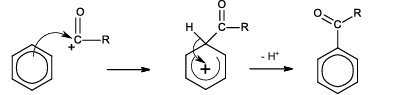
What Happens - The H atom on the ring is replaced by RCO (acyl group).
Products - Aromatic Ketones are produced and this reaction is very useful in organic synthesis.
Overall Equation - C6H6 + RCOCl -(AlCl3)→ C6H5COR + HCl
Generation of Electrophile - RCOCl + AlCl3 → RCO+ + AlCl4-
Mechanism - See Image

Describe the process and mechanism for Friedel-Crafts Acylation with an Acid Anhydride?
Reagent - Acyl Abhydride and AlCl3
Condition - Anhydrous to prevent the reaction of AlCl3.
What Happens - The H atom on the ring is replaced by RCO (acyl group).
Products - Aromatic Ketones are produced and this reaction is very useful in organic synthesis.
Overall Equation - C6H6 + RCOOCOR -(AlCl3)→ C6H5COR + RCOOH
Generation of Electrophile - RCOOCOR + AlCl3 → RCO+ + RCOOAlCl2
Mechanism - See Image