Design for Reliability
 Call Kai
 Learn
Learn Practice Test
 Spaced Repetition
 Match
Match Flashcards
 Knowt Play
1/18

There's no tags or description
Looks like no tags are added yet.
Name | Mastery | Learn | Test | Matching | Spaced | Call with Kai | Chat |
|---|
No analytics yet
Send a link to your students to track their progress
19 Terms
Reliability
The ability of a product to perform as expected over time
Reliability as a probability
Value between 0 and 1, a numerical measure with a precise meaning
Different ways to see reliability
The probability that a system will perform on a given trial, the frequency of successful performances of a system in a given number of attempts
The probability that a product will last for a given length of time in use
Components of reliability
time
performance
Standard/ prescribed operating conditions
Time as a component of reliability
Perform its function for a specified period of time
Performance as a component of reliability
related to the objective for which the product was made
(failure leads to expectations of performance of the intented function not being met)
Functional Failure
At the start of the product’s life due to manufacturing or material defects
Reliability Failure
After some period of use
Standard/ Prescribed Operating conditions as a component of reliability
The type and amount of usage and the environment in which the product is used
Inherent reliability when measuring reliability
The predicted reliability is determined by the design of the product
Achieved reliability when measuring quality
The actual reliability observed during use (normally lower than inherent)
Product life characteristics curve (bathtub curve)
Early stage failure → Useful Life → End of life failures
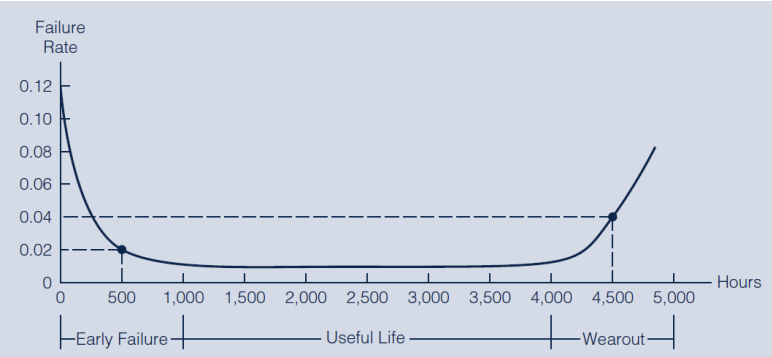
Early stage failure
High failure rate at the beginning of products life due to weak components, resulting in poor manufacturing or quality control procedures
To minimize this manufacturers incorporate a “burn-in” phase at the end of the manufacturing process, where products are run for a specified amount of time, products that succeed the burn in are released for shipment
Useful Life
Low and constant failure rate, normal pattern of random failures caused by uncontrollable factors (to reduce failure rate would generally require a redesign of the product)
End of life failure
Failure rate increases as the age of the product takes over, due to the product exceeding its intended normal life expectancy
System reliability
Many systems are composed of individual components; the reliability of each component can be used to predict the reliability of the system at the design stage
Components in Series
All components are required for the system is to work
Increasing the reliability of a component increases the reliability of the entire system
Systems with a very large number of components: there is a limit to how much system reliability can be increased
To further increase system reliability, we can use redundancy
Components in parallel
The extra components increase the overall reliability because if the primary system or component fails, then the backup component or system can take over, and the overall system wont fail
Parallel redundancy
Parallel Redundancy
Add backup components or an additional backup system to the existing system