metabolism :(
 Call Kai
 Learn
 Practice Test
 Spaced Repetition
 Match
 Flashcards
 Knowt Play
1/39

There's no tags or description
Looks like no tags are added yet.
40 Terms
1st law of thermodynamics
law of conservation of energy
total amount of energy in universe is constant
energy cannot be created nor destroyed, only transferred/transformed
2nd law of thermodynamics
the entropy of the universe increases over time
3rd law of thermodynamics
entropy of a system approaches 0 when the temperature approaches absolute 0
entropy (s)
measure of the randomness/”disorder” of a system
higher entropy = more disorder
low entropy = more organized
consequences of laws of thermodynamics
in order to decrease entropy in a system, more entropy has to be created somewhere else (it takes energy to organize a deck of cards)
gibbs free energy
the energy available in a system that can perform work
in living systems, free energy is stored/released by complex energy molecules
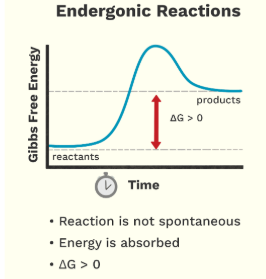
endergonic rxn
free energy of a system is absorbed by products (+G)
nonspontaneous: needs a constant input of energy for rxn to occur
exergonic
when a molecule releases free energy (-G)
spontaneous: once initial activation energy is “paid”, rxn will continue to completion

temp. affect on enzyme activity
higher temp = higher kinetic energy = rate of enzymatic rxn increases
every enzyme has an optimal temp. where activity is greatest
if temp. is too high, enzyme denatures, activity lvl reduces
cells use water to absorb heat to prevent denaturing during normal metabolic processes since cells contain lots of water and it can absorb lots of energy before its temp. increases
ph affect on enzyme activity
changes in ph can make/break intra/intermolecular bonds
denaturing proteins
enzymes have optimal ph ranges
conc. of enzyme/substrate affect on enzyme activity
more enzyme = higher rate of rxn
more substrate = higher rate of rxn (but with a limit)
too much substrate = active sites r fully saturated = no available enzymes to catalyze more substrate
inhibitors and rates
competitive
becomes less effective as substrate conc/ increases
additional substrate binds to enyme more frequently so they have nowhere to bind
non competitive
not as affected by substrate conc.
not competing for active site
cellular respiration equation
c6h12o2+6o2—>6co2+6h2o+atp
where does cell resp occur
glycolysis in cytoplasm, the rest in mitochondrial matrix
coenzymes
nadh and fadh2 are nucleotide coenzymes that are important for transferring electrons (redox rxns) to other molecules
NAD+ and NADH
nad+ accepts h+ ion and 2 electrons to become nadh (reduction)
can be reversed (oxidation)
FADH2 and FAD
fad accepts 2 h+ ions and 2 electrons to become fadh2 (reduction)
can be reversed (oxidation)
glycolysis overview
occurs in cytoplasm
anaerobic (no oxygen required)
1 glucose molecule —> 2 pyruvates (and some atp)
energy investment and energy payoff phases
glycolysis initial molecules
1 glucose
2 atp
2 nad+
glycolysis net products
2 pyruvate
2 nadh
2 water
2 atp (4 but 2 were used)
2 h+
pyruvate oxidation overview
occurs in mitochondrial matrix
pyruvates from glycolysis travel into matrix (active transport via symport)
pyruvate oxidation initial molecules
2 pyruvate
2 nad+
2 coa
pyruvate oxidation net products
2 acetyl-coa
2 nadh
2 h+
2 co2
kreb’s cycle overview
occurs in mitochondrial matrix
purpose is to move electrons from acetyl coa to produce nadh and fadh2
done by constantly rearranging the acetyl coa that started the cycle
kreb’s cycle initial molecules
2 acetyl coa
2 oxaloacetate
6 nad+
2 fad
2 adp
4 h2o
kreb’s cycle net products
4 co2
6 nadh
6 h+
2 fadh2
2 atp
(2 oxaloacetate but 2 were used so 0)
ETC overview
final step in cell resp where most atp is generated
series of redox rxns initiated by nadh and fadh2
occurs in inner mitochondrial membrane
photosynthesis equation
6co2+6h2o+light energy—>c6h12o6+6co2
antenna complex
rgions in photosystems that collect light and use it to excite electrons which provides energy for additional biochem rxns
pigment protein complexes that collect photons and transfer electrons to the rxn center
rxn center
the center of the antenna complex
contians specialized chlorophyll molecule
calvin cycle initial molecules
6co2
18atp
12 nadph
6 rubp
calvin cycle net products
2 g3p
18adp
12nadp+
(6rubp but 6 were used so 0)
alcohol fermentation
pyruvate is converted into acetylaldehyde instead of acetyl coa
acetylaldehyde then converted into ethanol molecule through redox rxn with nadh2
products = ethanol, co2, nad+
nad+ is then reused in glycolysis, makes this efficient
lactate fermentation
in humans muscle cells when o2 is low
etc backs up
when o2 is low, there is excess pyruvate
pyruvate will react with nadh to produce nad+ and lactate
nad+ goes back to glycolysis which allows this to proceed quickly
when o2 is available again, lactate is converted back into pyruvate
lipid metabolism
fats broken down into fatty acids and glycerol
glycerol converted to g3p
fatty acids undergo beta oxidation which produces acetyl coa
fats create 2x amount of energy as glucose
C4
fix carbon molecules into 4 carbon atom containing molecules
carbon fixation happens in one part of the leaf while calvin happens in another
this region is high in co2 and low in o2 conc. to prevent photoresp
more efficient at photosynth in hot/dry conditions
ex. corn, grasses, sugarcane
cam (special c4)
use c4 pathway but perform fixation at differnt times of day instead of in different regions at the same time
c4 at night, calvin during day
causes high conc of co2 during the day, suppresses photoresp during calvin cycle
ex. pineapple, cacti, orchids