Double entry bookkeeping
 Call Kai
 Learn
 Practice Test
 Spaced Repetition
 Match
 Flashcards
 Knowt Play
1/18

There's no tags or description
Looks like no tags are added yet.
19 Terms
overview of accounting process
Transaction occurs
Record effects from source documents
Balance ledger accounts
Produce trial balance
Make year end adjustments
Prepare financial statements
Source documents
the documents business transactions are recorded on
the original evidence of business transactions
accounting records are created from these documents
Stages of a transaction
Before sale purchase- quotation, purchase order, sales order
Goods movement- goods received/dispatched note
Payment or adjustment- invoice, credit or debit nore
What is a debit
Increases the value of an asset and decreases the value of a liability
cash recieved, equipment purchased
what is a credit
Accounting transaction that increases the value of liabilities
increasing the income for the business
Uses of source documents
}Quotation: states a fixed price for specified goods or services before an order is accepted
}Purchase order: records goods or services the business wants to buy from a supplier
}Sales order: records an order received from a customer and helps track customer demand
}Goods despatched note (GDN): records goods sent to customers and supports delivery queries
}Goods received note (GRN): confirms goods received from a supplier and supports checking against orders and invoices
}Receipt: confirms that a payment has been received
}Debit note: asks a supplier to issue a credit note for returned goods or an overpayment
}Credit note: reduces the amount owed where goods are returned or an overpayment has been made
Books of prime entry
Where transactions are first recorded
sales day book- credit sale
purchase day book- credit purchases
sales return book- credit note issues to customers
Purchase returns day book- Credit notes received from suppliers
Cash book- Cash and bank reciepts/payments
Petty cash book- Small cash payment
Duality concept- two effects of a transaction
Every debit has its corresponding credit entry
These two effects are equal and opposite such that the accounting equation will always prove correct
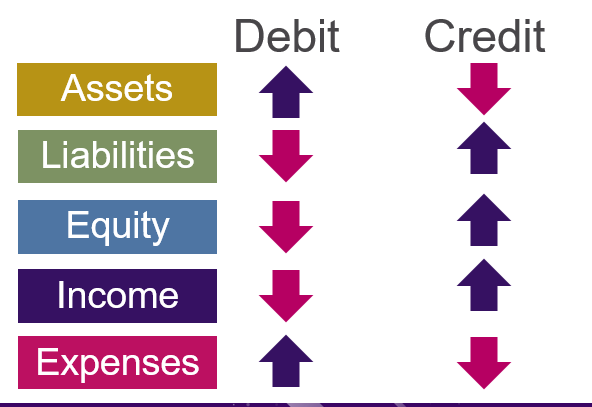
how credits and debits are recorded
In T accounts:
Debits (Dr) are recorded on the left
Credit (Cr) are recorded on the right
The accounting quandrat
“each transaction must have equal and opposite impacts

Ledger accounts
Transactions are recorded in the relevant ledger accounts.
There is a ledger account for each asset, liability, income and expense item.
Each account has the Debit (Dr) and Credit (Cr) sides.
forms of ledger accounts
no single form of ledger account rulings
it can take form of “T” account or “Three column ruiling”

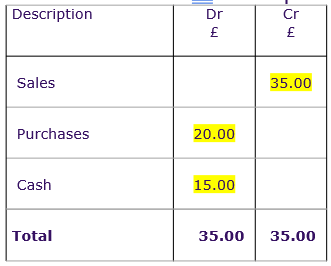
trial balance
the list of balances in the ledger.
Accruals concept
we should record income and expense in the year in which they are earned or incurred (occurred) irrespective of when the cash will be received or paid
Matching principle
Requires that the revenues and their related expenses are recorded in the same accounting period in which they occur
cash accounting v accruals accounting

what does it mean to capitalise an asset
recording assets as a non current asset
Bank loan
important source of long term finance
terms are agreed with lender
If repaying gradually may split loan between current (due within 1 year) and non-current liability (after 1 year).
Equity capital
A limited company issues shares to investors in return for cash.
Each share has a ‘nominal value’ determined when the company is formed
Depending on the value of a company, shares may be issued for more than their nominal value.
The difference between the cash received and the nominal value is share premium