MKT Ch 5: Consumer Learning
 Call Kai
 Learn
 Practice Test
 Spaced Repetition
 Match
 Flashcards
 Knowt Play
1/8

There's no tags or description
Looks like no tags are added yet.
9 Terms
Consumer Learning
Acquiring purchase and consumption knowledge and experience to apply to future behavior (e.g., researching a product before buying).
Elements of Learning Theories
Motivation: An internal trigger or unfilled need that drives a consumer to act (e.g., hunger).
Cues: External stimuli that direct toward a specific action (e.g., ads, sales).
Response: A consumer's reaction to a drive or cue (e.g., buying or not buying).
Reinforcement: An external outcome that increases the likelihood of repeating a behavior in the future (e.g., getting a reward).
weather its positive or negative it will increase the likelihood
Punishment is the consequence of not following the reinforcement that discorages
Two Major Learning Theories
Behavioral Learning (Stimulus-Response): Learning based on stimuli exposure
Cognitive Learning: Learning through active mental information processing and internal motivation
Behavioral Learning: Classical Conditioning
Pairing a conditioned stimulus with an unconditioned stimulus until the conditioned stimulus alone triggers a taught response
In marketing: associating a parent brand with a brand extension
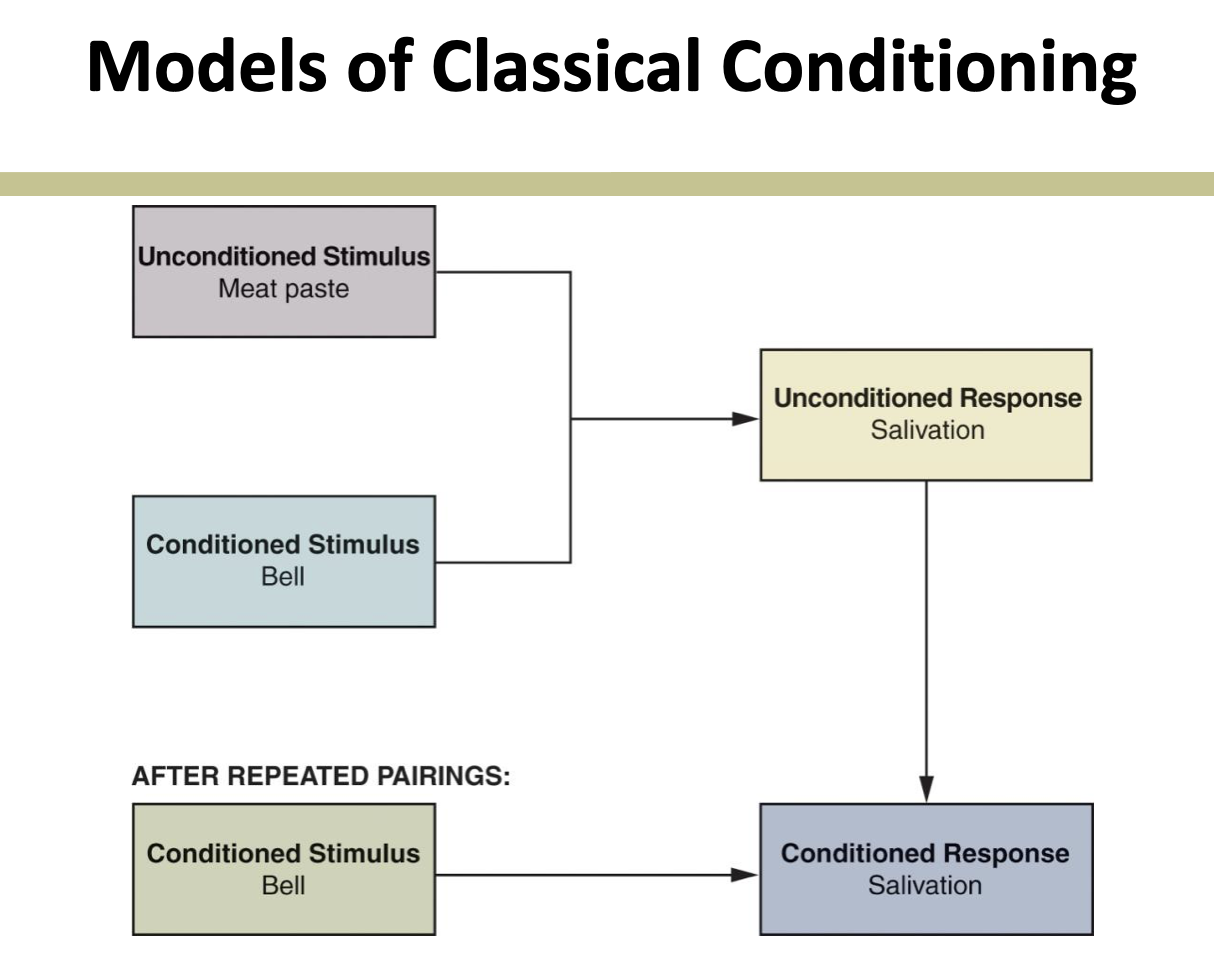
Behavioral Learning: Applications of Classical Conditioning
Repetition
Stimulus Generalization: Responding the same way to slightly different stimuli
Stimulus Discrimination: Selecting a specific stimulus from similar ones; the opposite of generalization
Behavioral Learning: Instrumental Conditioning
Learning through trial-and-error and personal experience
e.g., trying Brands A, B, and C of jeans until Brand D fits perfectly
Negatives:
Extinction: A learned response is no longer reinforced, breaking the link between stimulus and reward
Forgetting: The reinforcement is forgotten over time
How to overcome it:
customer satisfaction
Reinforcement Schedules:
Total Reinforcement: Always giving a reward every time (e.g., loyalty points on every purchase).
Systematic Reinforcement: Giving a reward after a fixed number of purchases, n+1 (e.g., buy 5, get 1 free).
Random Reinforcement: Giving rewards unpredictably (e.g., surprise buy 1 get 1 deals).
Learning Schedules:
Massed Learning: Bombarding consumers with ads in a short time for rapid learning

Information Storage

Involvement
the degree of involvement and interest in a specific product
How to measure cognitive learning
Recognition: can you remember something with an aid
Recall: can you remember from memory
Brand Loyalty
Attitudinal measures
Behavioral measures