Metabolism
 Call Kai
 Learn
 Practice Test
 Spaced Repetition
 Match
 Flashcards
 Knowt Play
1/75

There's no tags or description
Looks like no tags are added yet.
76 Terms
Give the definition of energy
Energy is the capacity to do work or produce heat.
What can Immobile objects can possess?
Potential energy.
Where is chemical energy found?
Held in chemical bonds between atoms.
What is the first law of thermodynamics
First law: energy in the universe is constant and neither created nor destroyed
What's the name given to a reaction where the products have less energy than the reactants?
Exergonic (-ΔG)
What's the name given to a reaction where the products have more energy than the reactants?
Endergonic (+ΔG)
Electrical thermal sound elastic and kinetic energy are linked by what?
Forms of energy that living cells can generate
Electromagnetic and potential energy are linked by what?
They are both sources of energy for living systems
Nuclear and gravitational energy are given by what?
Forms of energy that living cells can not generate
What does ATP stand for
Adenine triphosphate
What can ATP become?
ADP (Adenine diphosphate)
What do catabolic reactions result in?
Release of energy often as ATP (-ΔG)
What do anabolic reactions result in
Input of energy often as ATP (+ΔG)
How does ATP get used?
Hydrolysis of ATP
Describe characteristics of stramenopiles
Typically 2 unequal flagellum. The longer flagellum has tubular hairs
Some can lack a flagellum
What are the three groups of stramenopiles
Diatoms - photosynthetic
brown algae - photosynthetic
Oomycetes - not photosynthetic.
Describe characteristics of diatom (stramenopiles)
Unicellular
Carotenoids in chloroplasts (yellow/brown colour)
Photosynthetic storage products are synthesised from carbohydrates and oils
No flagella (except male gametes).
Almost all deposit silica in cell walls.
Cell wall – 2 pieces – top overlaps bottom
Morphologically diverse
Sexual and asexual reproduction (gametes form, remove outer cell wall, they fuse, zygote will grow, cell wall becomes deposited)
Found in oceans
Found in wet terrestrial surfaces (mosses)

Describe brown algae (stramenopiles)
Fucoxanthin (carotenoid) in chloroplasts (yellow/orange)
Chlorophylls (green)
Green/yellow/orange = brown colour
All multicellular
Giant kelps
Almost all marine
Branched filaments or leaf-like growths.
Some float in open ocean
Most attached to rocks near shore – holdfasts

Describe characteristics of oomycetes (stramenopiles)
Water molds – filamentous & stationary (they can’t move, they attach to decaying matter)
Absorptive heterotrophs – secrete enzymes - digest large food molecules into smaller ones
All aquatic saprobic (feed on dead organic matter).
Some parasitic on crops
Oomycetes are very similar to fungi (Oomycetes once classified as fungi)
– Oomycetes cell walls – cellulose
– Fungal cell walls – chitin
–Oomycetes are more distantly related to fungi than many other eukaryotes.

Give characteristics of rhizarians
◼ Unicellular.
◼ Mostly aquatic.
◼ Typically long, thin pseudopodia (contrast amoebozoans).
◼ Contribute to ocean sediments.
Give the three primary groups of rhizarians
– Cercozoans
– Foraminiferans
– Radiolarians
Describe characteristics of cercozoans (rhizarians)
Diverse
Many forms and habits (Aquatic, terrestrial soil etc.)
One group possess chloroplasts derived from secondary endosymbiosis
Describe characteristics of Foraminiferans (rhizarians)
Some secrete calcium carbonate shells
Accumulation shells (limestone)
Live as plankton on seafloor
Long pseudopodia extend through openings in shell & interconnect to form sticky network
Some have locomotion Thin, stiff pseudopodia – reinforced by microtubules.
Describe characteristics of Radiolarians (rhizarians)
Thin, stiff pseudopodia – reinforced by microtubules.
Distinctive radial symmetry.
Almost all secrete glassy endoskeletons
A few reach several mm in diameter
Give characteristics of Excavates
Excavates began to diversify ~ 1.5 bya
Several excavate groups lack true mitochondria
Give three examples of Excavates
Diplomonads & Parabasalids
Heteroloboseans
Euglenids & Kinetoplastids.
Describe characteristics of Diplomonads & Parabasalids (Excavates)
Unicellular
Lack mitochondria
2 nuclei
Cytoskeleton
Multiple flagella
Parabasalids – flagella,
cytoskeleton & undulating membranes (locomotion)
Describe characteristics of Heteroloboseans (Excavates)
Amoeboid body
can cause fatal nervous system disease in humans.
Describe characteristics of Euglenids & Kinetoplastids. (Excavates)
Clade – unicellular excavates with flagella.
Mitochondria with disc-shaped cristae.
Flagella – crystalline rod – not in other organisms.
Asexual reproduction
Euglenids
flagella from pocket at anterior cell.
Spiralling strips proteins control cell shape.
Some euglenids photosynthetic
Diverse nutritional requirements (Heterotrophs, autotrophs.)
Kinetoplasmids
Some species cause diseases
Parasite that lives in blood
Describe reduction
gain of electrons,gain of protons, loss of oxygen, the oxidation state decreases
Describe oxidation
Loss of electrons, loss of proton, gain of oxygen, the oxidation state increases
Describe a covalent bond
When two non-metals atoms share at least one electron
Describe the changes in oxidation state of molecules in the reaction to make water O2 + 4H => 2H2O
Oxygen gains 2 electrons (reduced)
Hydrogens lose 1 electron each (oxidised)
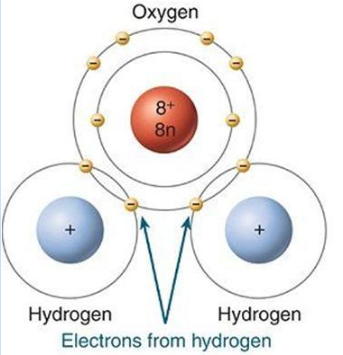
Is the process of catabolism reduction or oxidation
Oxidisation (Removing H and adding O)
List the four stages of aerobic respiration
Glycolysis
Pyruvate link- reaction
Krebs cycle
Oxidative phosphorylation (electron transport chain)
What are the two electron carriers in aerobic respiration?
NADH
FADH
Where do each of the steps of aerobic respiration occur?
Glycolysis - cytoplasm
Pyruvate link- reaction - mitochondria
Krebs cycle - mitochondria
Oxidative phosphorylation (electron transport chain) - mitochondria
What is NADH
- Nicotinamide
- NADH is an electron carrier
Describe/draw glycolysis

How many ATP is made in glycolysis
2 ATP made per Glucose
How many NADH is made in glycolysis
-2 NADH 1
Describe the allosteric site
Another place on the enzyme besides the active site that substrates can bind to
Describe the link reaction

How many ATP is made in the link reaction
0
How many NADH is made in the link reaction
1 NADH
Describe the krebs cycle

How many ATP is made in the Krebs cycle
2 ATP
How many NADH is made in the Krebs cycle
6 NADH
How much NADH is made from one glucose before ect
10
How many ATP is made from one glucose before ect
4
Describe the electron transport chain/ oxidative phosphorylation
The proton pumps transport protons (H⁺) from the mitochondrial matrix into the intermembrane space, creating a positive charge in the intermembrane space and a negative charge in the matrix. During this process, NADH is oxidised back into NAD⁺, releasing high-energy electrons. These electrons are passed along the electron transport chain, with ubiquinone (CoQ) acting as an electron carrier within the inner mitochondrial membrane, transferring electrons from Complex I and II to Complex III. The electrons are then passed from Complex III to Complex IV by cytochrome c. At Complex IV, the electrons combine with protons (H⁺) and oxygen to produce water, making oxygen the final electron acceptor. As the high-energy electrons pass through Complexes I, III and IV, they release energy that is used to actively pump protons from the matrix into the intermembrane space. This creates a high concentration of protons in the intermembrane space, meaning they naturally want to flow back into the matrix down their electrochemical gradient. For every two electrons that pass through Complexes I, III and IV, a total of ten protons are pumped into the intermembrane space.
Describe how Iron Sulfur Clusters transports electrons
Electrons will be transported one at a time down the iron sulfur cluster as it loses energy

What is the name how protons want to move back into the matrix
Proton motive force
Describe how atp synthase complex works
The upper part of the complex rotates when a new proton travels through it and back into the matrix. When three protons have passed through one ATP is made.
What occurs in anaerobic respiration?
Fermentation
Why does fermentation happen?
• If there is no O2 then there will be no ETC, so NAD+ will never be regenerated and glycolysis could stop.
• In order to keep glycolysis going we have to regenerate NAD+ by oxidising NADH
• Fermentation to ethanol (alcohol) or lactic acid (lactate) regenerates NAD+
• Some bacteria and yeast use Ethanol fermentation
• Certain cells, including human and animal cells use Lactic Acid fermentation
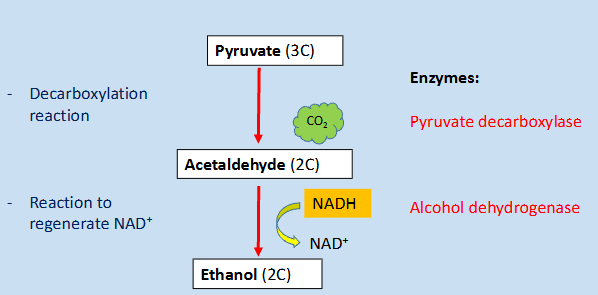
How many ATP is made per glucose in anaerobic respiration
2 ATP
What is acidosis
Acidosis is a medical condition in which there is too much acid in the body fluids, causing blood pH to drop below the normal range of 7.35 to 7.45
What are toxic consequences of lactate via acidosis
• Fatigue, Cramps, Ataxia
• Nausea, Vomiting
• Rapid Breathing
• Impaired cardiac output
• Organ Failure
Give another name for lactic acidosis
Hyperlactataemia
What happens when oxygen is now available after Lactate dehydrogenase (anaerobic respiration)
Lactate dehydrogenase is reversible
Describe gluconeogenesis
Occurs after anaerobic respiration
Co2 stuck onto pyruvate to make Oxaloaxitate
Oxaloaxitate loses a carbon and becomes phosphoenolpyruvate (PEP)
Describe why the Glycolysis and Gluconeogenesis cycle is futile
• Glycolysis produces
2 ATP, 2 NADH
• Gluconeogenesis requires
6 ATP, 2 NADH
• Every turn of the cycle from Glu -> Pyruvate/Lactate -> Glu
4 ATP wasted
What occurs in anaerobic respiration?
Fermentation
Why does fermentation happen?
• If there is no O2 then there will be no ETC, so NAD+ will never be regenerated and glycolysis could stop.
• In order to keep glycolysis going we have to regenerate NAD+ by oxidising NADH
• Fermentation to ethanol (alcohol) or lactic acid (lactate) regenerates NAD+
• Some bacteria and yeast use Ethanol fermentation
• Certain cells, including human and animal cells use Lactic Acid fermentation
How many ATP is made per glucose in anaerobic respiration
2 ATP
Describe how each carbon on a carbon chain is named?
Using the greek alphabet, starting on the caron next to the carboxyl group;
Alpha carbon, Beta carbon,
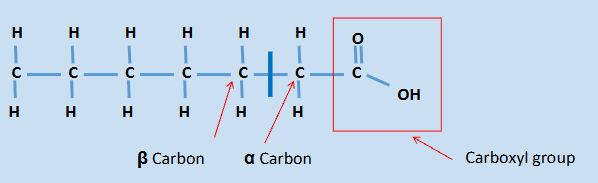
During respiration using fatty acids, instead of glucose, describe how beta oxidation occurs (the bond between the alpha and beta carbon breaks)
Occurs once a fatty acid is activated into acyl-CoA and
transported into the mitochondrial matrix.
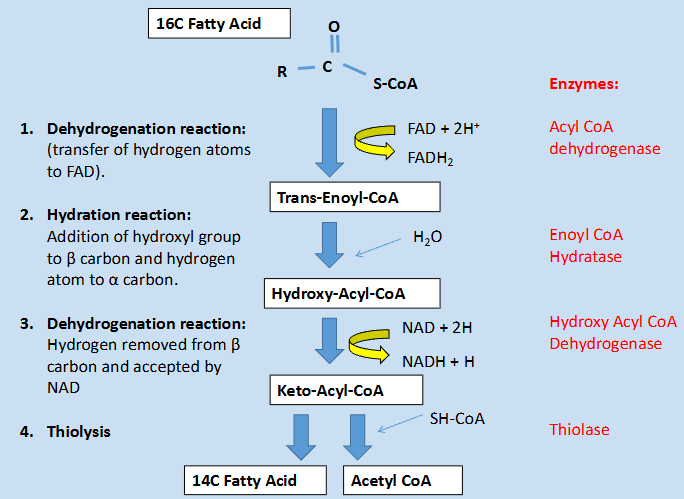
How many ATP per 16 carbon fat
108 ATP produced
Describe fatty acid synthesis
It is an anabolic reaction
a reversal of beta-oxidation.
2C units are added repeatedly from acetyl CoA.
Uses NADPH as a reducing agent (NADH with an extra P).
Only happens when surplus acetyl CoA (i.e. not needed to produce energy).
AcCoA is a crucial intermediate
Where does Gluconeogenesis occur
The liver
What is the purpose of Gluconeogenesis
Maintain blood sugar level